
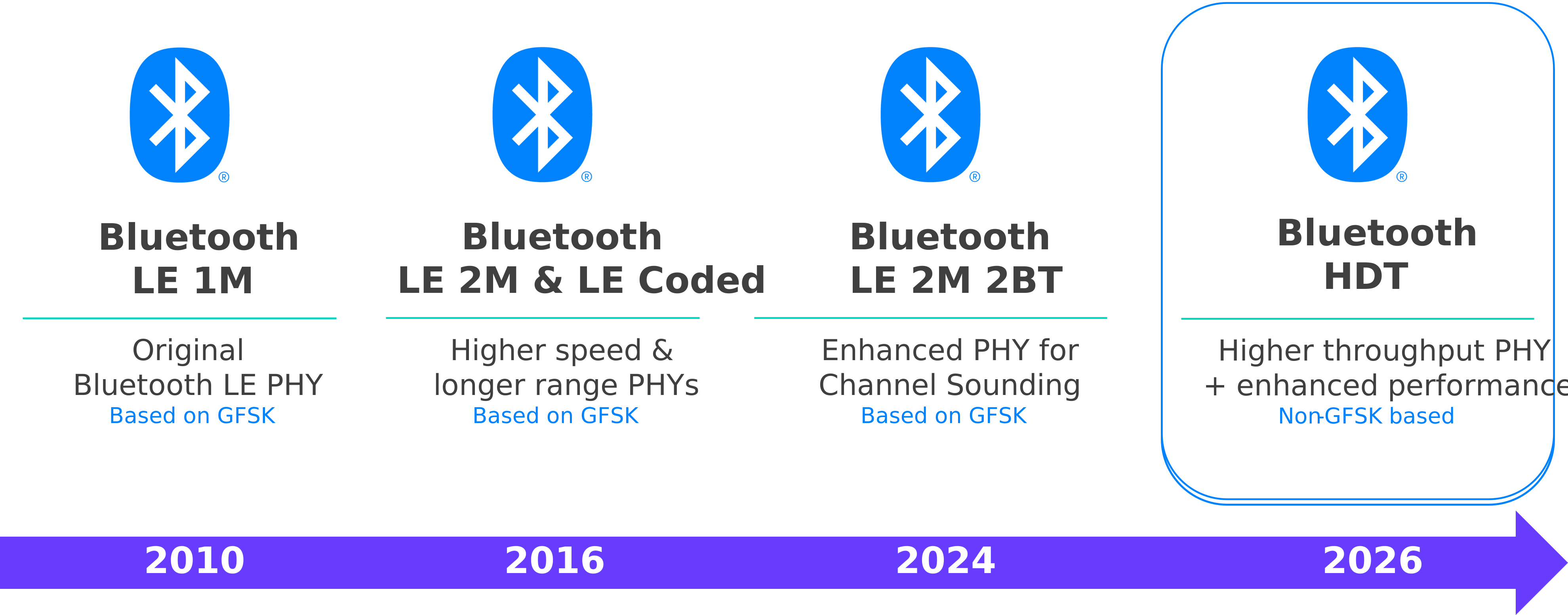
Bluetooth is about to get substantially faster. The new Bluetooth High Data Throughput feature raises Bluetooth LE’s maximum supported bit rate from 2 Mbps to 7.5 Mbps, giving manufacturers considerably more bandwidth to work with in future headphones, earbuds, wearables, and connected gadgets.
The Bluetooth Special Interest Group formally adopted HDT as an optional feature of Bluetooth Core 7.0 on November 4, 2026. Rather than simply pushing existing hardware harder, HDT introduces a new physical layer, or PHY, designed to move more information across the wireless link while improving efficiency and connection reliability.
The headline figure is nearly four times the throughput of Bluetooth LE’s current 2M PHY. That extra capacity should help devices complete transfers and synchronization more quickly. Because a radio can send the same amount of data in less time, it may also spend more time in lower-power states, potentially improving battery efficiency rather than draining it faster.
Wireless audio is the first major target. The Bluetooth SIG expects standardized premium audio applications using HDT to arrive in 2027, with enough bandwidth to support lossless and high-resolution listening alongside more ambitious multi-channel surround and spatial-audio experiences. The upgrade could give audio companies a common foundation for features that have traditionally required proprietary codecs or other workarounds.
HDT is not limited to music. The organization also points to faster transfers for wearables, health and fitness devices, smart-home products, peripherals, industrial systems, and immersive technologies. A smartwatch could synchronize large amounts of sensor data more quickly, while smart glasses and other AI-enabled devices could exchange information with a phone or nearby computer with less waiting.
There is an important catch for anyone hoping to upgrade an existing pair of earbuds: HDT is optional, so current Bluetooth products will not gain the feature through a routine software update. New compatible radios will be required on both ends of a connection, meaning buyers will likely need an HDT-capable phone and audio device before they can benefit from the higher ceiling. The first compatible products are expected to begin appearing in 2027.


