
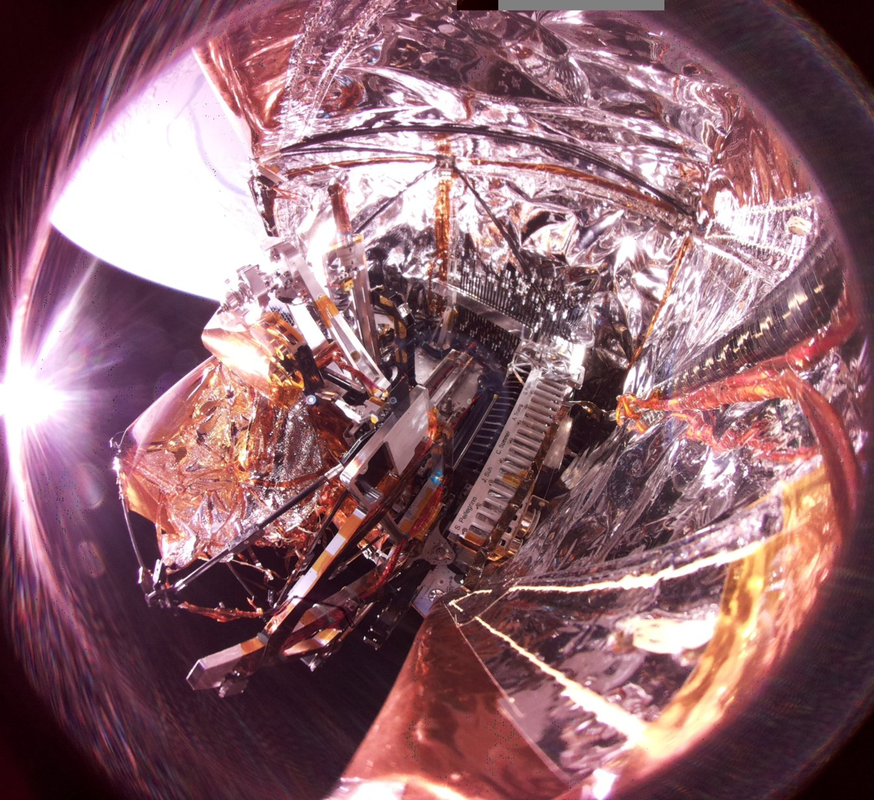
Caltech has taken a meaningful step toward constructing enormous hardware in orbit: its ASTRA robotic system has assembled part of a truss in space without astronauts physically handling the components. The achievement, the first autonomous construction of a space structure, comes from a team led by aerospace engineer Sergio Pellegrino under DARPA’s NOM4D program.
ASTRA is designed less like a traditional robotic arm and more like an orbital construction machine. Its manipulator retrieves composite-fiber struts and aluminum joints from motorized dispensers, fits them together into repeating structural bays, and pushes completed sections outward. The system also deploys a perforated Kapton reflective film, creating the basis for a lightweight reflector antenna.
The target is a 1.4-meter-diameter structure made from 11 connected bays. ASTRA spent roughly six months in low-Earth orbit after launching on March 30, 2026, as a payload aboard Momentus’s Vigoride 7 orbital vehicle. That spacecraft reached orbit through SpaceX’s Transporter-16 rideshare mission from Vandenberg Space Force Base.
The demonstration did not complete the entire antenna. Limited operating time and unexpected issues in the space environment meant the team finished the initial section instead. Engineers used a ground-based flight spare to reproduce problems, test workarounds, and transmit revised commands during only a handful of short daily communication windows. That partial result nevertheless gave the team evidence that the basic assembly method works outside the laboratory.
“NOM4D’s objective is to enable efficient, scalable construction of very large structures in space,” DARPA program manager Andrew Detor said. The agency describes the Caltech approach as comparable to assembling a K’Nex or Tinkertoy structure one node at a time, while another NOM4D Phase 3 project from the University of Illinois Urbana-Champaign is testing a different method for hardening composite structures in orbit.
The larger prize is freedom from the limits imposed by rocket fairings. Space telescopes, radio antennas, communications systems, and solar-power platforms could eventually use structures built from materials delivered separately rather than folded into a launch vehicle and unfurled later. DARPA’s long-term vision involves orbital manufacturing using raw materials from Earth, with structures potentially reaching hundreds of meters or even kilometers in scale.
ASTRA’s mission is expected to conclude in December, and the Caltech team says the next phase will involve simplifying and refining the design. The experiment is small compared with the giant observatories and arrays it may eventually support, but it demonstrates the essential idea: future space infrastructure could be assembled by machines in orbit before astronauts ever arrive.


