
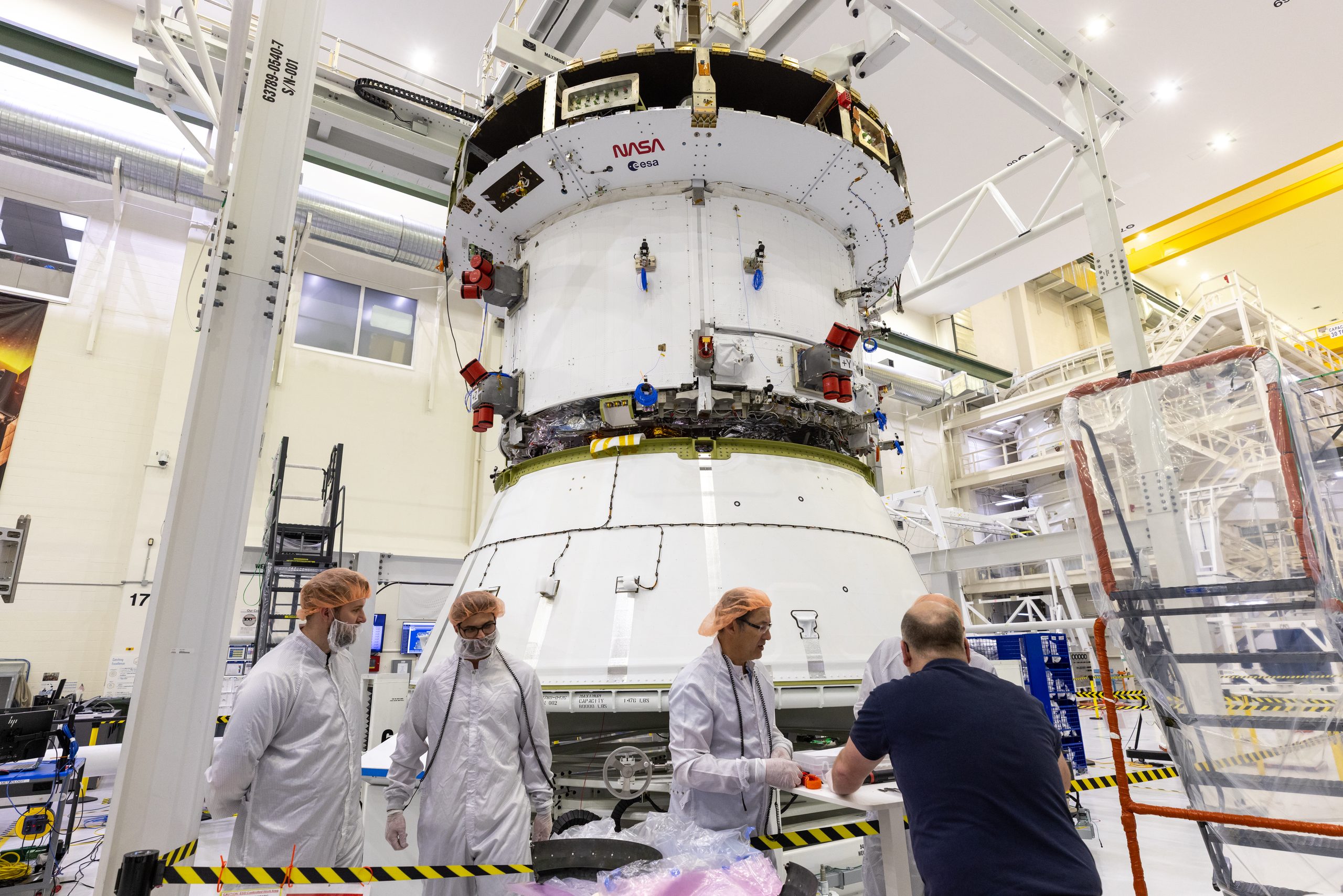
The next Artemis mission is being reshaped as a full-scale rehearsal for humanity’s return to the Moon. Rather than sending astronauts directly to the lunar surface, Artemis III is now planned as a 14-day Earth-orbit demonstration in 2027, where crews will practice docking and operational procedures with test versions of two commercial lunar landers. The accelerated Artemis roadmap is designed to clear the way for a crewed landing during Artemis IV in 2028.
Four astronauts will launch aboard the Orion spacecraft atop the Space Launch System rocket, while the lander hardware arrives separately on commercial launch vehicles. Blue Origin is expected to send a Blue Moon test article into low Earth orbit first. Orion will rendezvous and dock with that vehicle before SpaceX launches a Version 3 Starship lander test article. The crew will then switch from Blue Moon to Starship for another docking demonstration, allowing flight controllers to expose problems while the spacecraft remain relatively close to Earth.
That sequence makes Artemis III less of a traditional destination mission and more of an orbital compatibility exam. NASA’s commercial-space program describes SpaceX and Blue Origin as partners developing vehicles that can move astronauts from lunar orbit to the surface and back, but the two companies are pursuing radically different spacecraft architectures. Testing rendezvous, docking, habitation, and crew operations together is intended to reduce the number of unproven steps left for Artemis IV.
The 2028 mission is expected to send Orion toward lunar orbit, where two astronauts would transfer to a commercial lander and descend near the Moon’s south pole while their crewmates remain aboard Orion. The agency is developing parallel approaches: SpaceX’s Starship plan involves orbital propellant transfers before the vehicle heads for the Moon, while Blue Origin’s accelerated Blue Moon concept uses three transfer stages and postpones propellant transfer for the landing campaign.
The schedule is ambitious, but the program is also trying to shorten its hardware pipeline. Officials say Artemis III processing timelines have been cut roughly in half, while engineers redesigned and tested a critical fuel-line component internally in five months at about one-tenth of an earlier outside estimate. That push reflects a broader effort to rebuild in-house technical expertise instead of treating every specialized rocket task as an outsourcing opportunity.
For science-fiction fans, the most consequential change is that Artemis III will make commercial spacecraft part of the crew’s routine before anyone attempts the south-polar landing. For the launch industry, it creates a demanding shared timetable involving SLS, Orion, Blue Origin’s launch system, and Starship. The immediate milestone is the 2027 orbital test; if those rendezvous and docking demonstrations work as intended, Artemis IV could become the first crewed lunar landing mission since Apollo 17 in 1972.
Image Credits
In-Article Image Credits
Teams prepare for the installation of the engine nozzle onto the European Service Module for NASA's Artemis III mission on Tuesday, Feb. 17, 2026, inside the high bay of the Neil A. Armstrong Operations and Checkout Building at NASA's Kennedy Space Center in Florida via NASA with usage type - Public DomainFeatured Image Credit
Teams prepare for the installation of the engine nozzle onto the European Service Module for NASA's Artemis III mission on Tuesday, Feb. 17, 2026, inside the high bay of the Neil A. Armstrong Operations and Checkout Building at NASA's Kennedy Space Center in Florida via NASA with usage type - Public Domain


