
It Came to Earth at Aztec, New Mexico Revealed: The Recovery of a UFO arrives as the final and most comprehensive volume in Scott and Suzanne Ramsey’s decades-long investigation into one of UFO lore’s most controversial cases. Written with journalism scholar Frank Thayer, Ph.D., the book argues that the alleged 1948 recovery near Hart Canyon deserves to be reconsidered rather than dismissed as a long-settled hoax. The new volume’s central argument is that a fraudulent business scheme may have obscured a genuine military recovery operation.
The Aztec story first entered popular culture through journalist Frank Scully, whose 1950 book Behind the Flying Saucers described a roughly 100-foot disc, sixteen humanoid bodies, and a secret government investigation. The account depended on information supplied by oil promoter Silas Newton and confidence man Leo Gebauer. Their alleged connection to a scheme involving supposed alien technology helped turn the entire incident into a textbook UFO hoax by the mid-1950s.
The Ramseys’ project takes aim at that chain of assumptions. Their position is not that Newton and Gebauer were trustworthy, but that their dishonesty does not automatically erase every radar report, local sighting, military movement, or later witness account associated with Hart Canyon. The authors say they spent more than three decades examining records and interviewing people connected to the alleged recovery, continuing research begun in 1988 and developed through earlier books on the case.
The official book site describes the new release as the researchers’ third and final book about the Aztec incident. It specifically promotes declassified FBI and CIA records, firsthand testimony, physical evidence, and information concerning nine scientists allegedly involved in examining the craft. That emphasis gives the book a different pitch from sensational crash-retrieval narratives: rather than relying solely on the famous story of alien bodies, it attempts to reconstruct logistics, geography, documentation, and the chain of custody surrounding the alleged disc.
That distinction matters because Aztec occupies an unusual place in UFO history. It is often called “the other Roswell,” yet its public record is more tangled, passing through magazine columns, a bestselling book, exposed con men, and decades of competing interpretations. Contemporary summaries continue to present both sides: the conventional explanation identifies the episode as a fraud, while later researchers point to FBI material and additional testimony as reasons to reopen the question.
For skeptics, the book’s claims will still require independent confirmation, especially where testimony decades after the event is used to challenge the historical record. For believers, however, the volume offers a substantial new archive for a case that has spent generations trapped between folklore and dismissal. Whether it establishes a recovered nonhuman craft or simply documents how one enduring mystery grew, It Came to Earth at Aztec, New Mexico Revealed makes the 1948 incident newly relevant to the modern UFO debate.
Image Credits
In-Article Image Credits
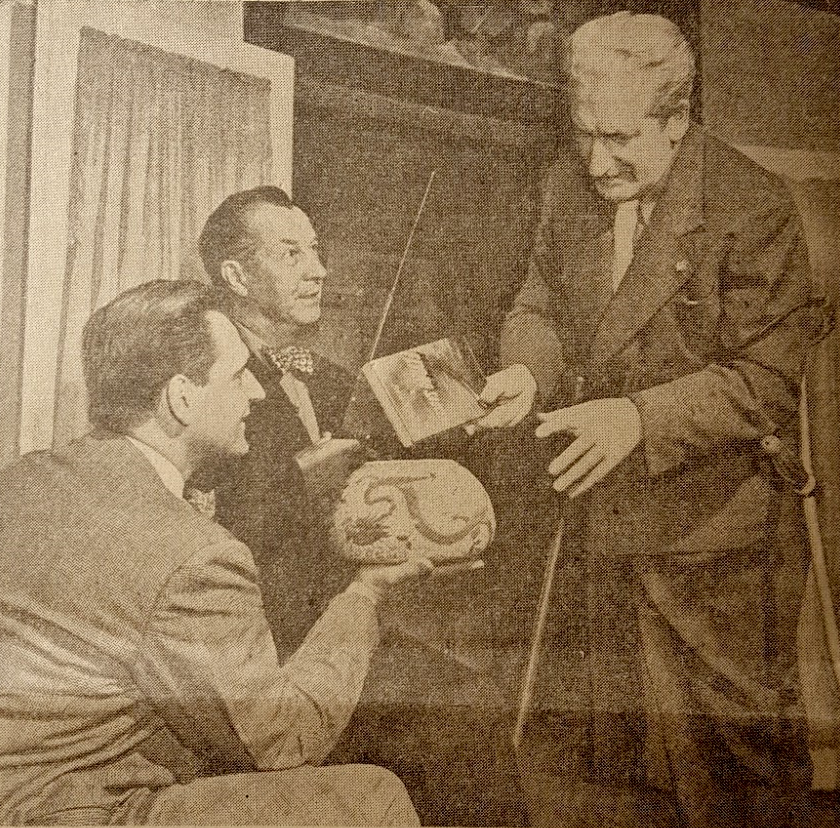
Author Frank Scully (right) and confidence man Silas Newton (center) demonstrate ideas about magnetism and earth's orbit using Scully's book Behind the Flying Saucers (1950) to represent a flying saucer and a bowl held inverted by KMYR radio salesman George Koehler (left) to represent the earth via Wikimedia Commons by David Mathias with usage type - Public Domain. By David Mathias - Denver Post, October 18, 1950, newspaper, scan, 1952 reprinting by New York daily news, Public Domain, https://commons.wikimedia.org/w/index.php?curid=142291219Featured Image Credit
Author Frank Scully (right) and confidence man Silas Newton (center) demonstrate ideas about magnetism and earth's orbit using Scully's book Behind the Flying Saucers (1950) to represent a flying saucer and a bowl held inverted by KMYR radio salesman George Koehler (left) to represent the earth via Wikimedia Commons by David Mathias with usage type - Public Domain. By David Mathias - Denver Post, October 18, 1950, newspaper, scan, 1952 reprinting by New York daily news, Public Domain, https://commons.wikimedia.org/w/index.php?curid=142291219


