
Diamond’s most surprising transformation begins with the “wrong” diamond. Researchers at Skoltech and MISIS University have developed a model explaining why graphite under extreme pressure first forms lonsdaleite, a rare hexagonal carbon structure, rather than immediately becoming the familiar cubic crystal. Their new explanation for diamond’s high-pressure formation resolves a long-standing contradiction between what appears easiest to create and what is ultimately most stable.
The effect occurs when graphite is compressed to roughly 18–22 gigapascals. At that point, carbon atoms begin reorganizing into lonsdaleite, also known as hexagonal diamond because its layers follow a different stacking pattern from conventional diamond. Lonsdaleite is metastable: it can exist without immediately breaking down, but cubic diamond is energetically favored once a sufficiently large crystal forms.
The researchers’ key insight is that crystal formation starts with nucleation rather than a fully developed solid. Their calculations indicate that a lonsdaleite nucleus faces an energy barrier about half as high as the barrier for a cubic-diamond nucleus. The critical lonsdaleite cluster also requires roughly two to three times fewer atoms. In practical terms, the graphite surrounding the first microscopic cluster can accommodate lonsdaleite more easily, giving the hexagonal structure an early advantage. Skoltech’s account of the research identifies Pavel Sorokin, a Skoltech Photonics Center professor and MISIS University professor, as the study’s corresponding author.
That creates a two-stage route rather than a straightforward graphite-to-diamond jump. Lonsdaleite can appear first because its boundary with graphite is easier to establish; as the structure grows, the interface becomes less important and the developing crystal can transform toward cubic diamond. The transition is not automatic in every circumstance, however, which helps explain why experiments can produce mixtures of carbon phases instead of a single uniform diamond.
The result matters beyond settling an elegant materials-science paradox. Understanding how the first atomic clusters form could help researchers control which carbon phase appears during high-pressure synthesis, thin-film growth, and other manufacturing processes. Earlier MISIS work on nanometer-scale lonsdaleite films has also examined their thickness-dependent stability and their tendency to develop graphene-like outer layers, underscoring how strongly the material’s behavior depends on its surroundings.
For now, the finding does not mean that lonsdaleite replaces ordinary diamond as the default supermaterial. Its importance is more fundamental: the most stable destination is not necessarily the easiest first step. By separating the early nucleation stage from the behavior of the finished crystal, the Skoltech–MISIS team offers a clearer map of how carbon takes one of nature’s most dramatic structural transformations.
Image Credits
In-Article Image Credits
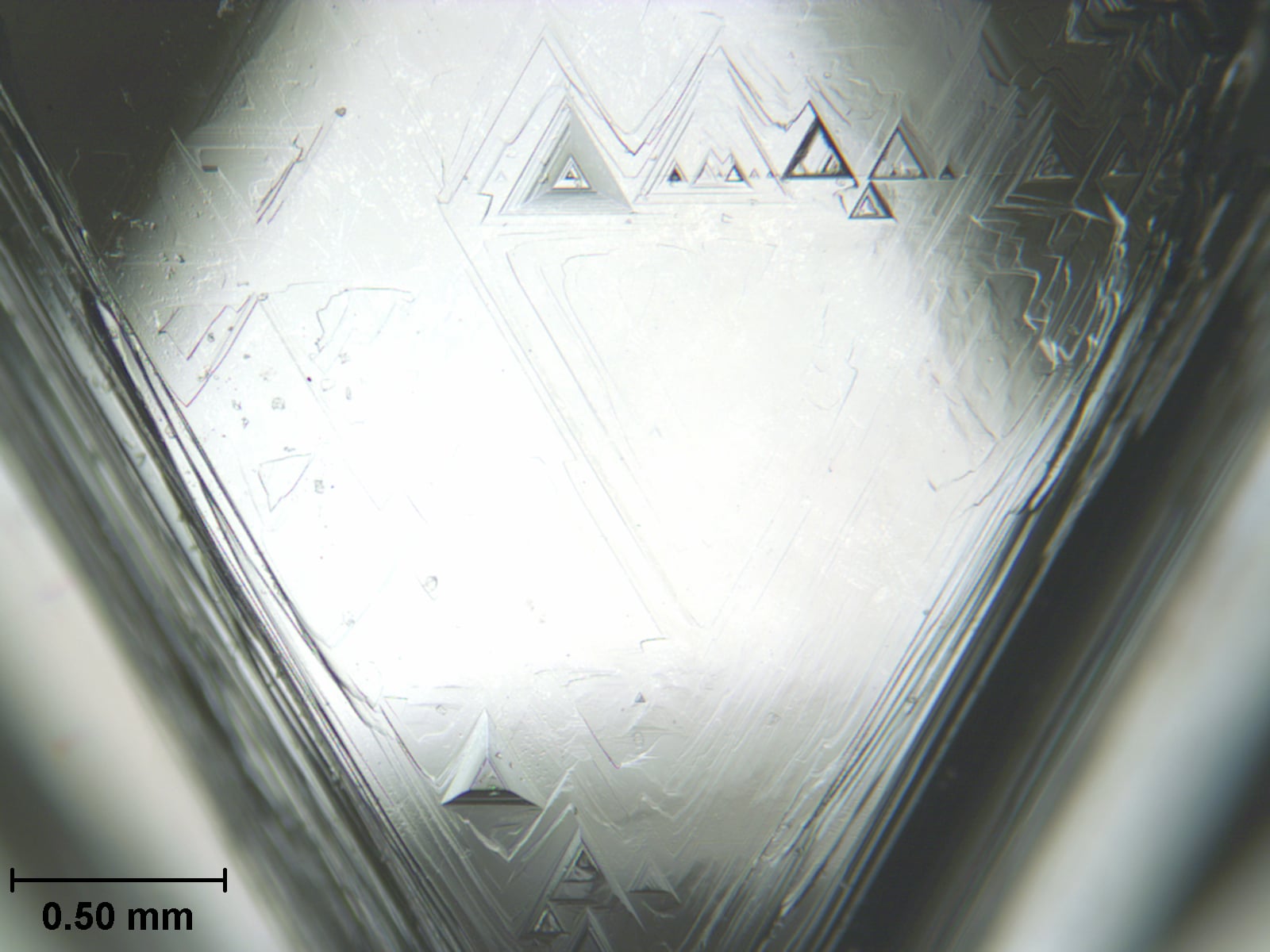
One face of an octahedral uncut (rough) diamond, including scale via Wikimedia Commons by Gump Stump with usage type - CC0 Public Domain. By Gump Stump - Own work, CC BY-SA 3.0, https://commons.wikimedia.org/w/index.php?curid=8971456Featured Image Credit
One face of an octahedral uncut (rough) diamond, including scale via Wikimedia Commons by Gump Stump with usage type - CC0 Public Domain. By Gump Stump - Own work, CC BY-SA 3.0, https://commons.wikimedia.org/w/index.php?curid=8971456


