
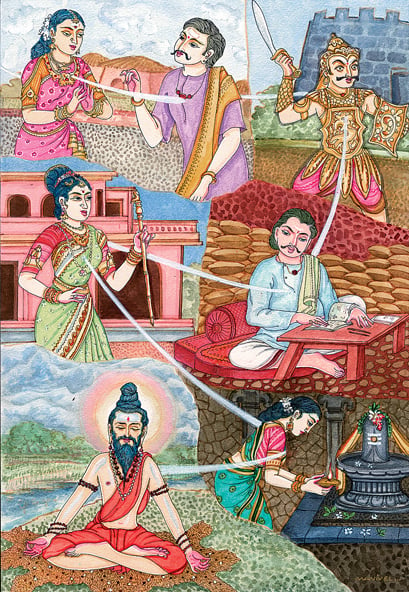
The University of Virginia has spent decades assembling one of academia’s most unusual research archives: thousands of cases involving children who claim memories belonging to someone who lived before them. A new analysis of that material has identified a striking timing pattern, finding that the gap between the earlier person’s death and the child’s birth tended to shrink when the death was unexpected. The newly highlighted findings come from UVA’s Division of Perceptual Studies, the university group that maintains the archive.
The researchers examined 1,678 documented “cases of the reincarnation type,” a label used for reports in which a child describes a previous person whose identity and biography investigators attempt to establish. Their key measurement was “intermission time”: the period separating the identified person’s death from the child’s birth. Among the cases with usable chronological information, the typical interval was 16 months. Deaths classified as completely unexpected were followed by a median gap of about 12 months, compared with roughly 21 months after deaths that had been anticipated.
That difference amounted to a 40-to-45 percent drop between the least and most unexpected categories of death. The association also appeared when the researchers tested whether factors such as the quality of case verification or a family’s belief in reincarnation might be influencing the result, according to UVA’s summary of the work. The paper is attributed to researchers including Saeedeh Sadeghi, Marieta Pehlivanova, and Philip J. Cozzolino, and is published through the journal Psychology of Consciousness: Theory, Research, and Practice.
UVA’s archive grew out of the work of psychiatrist Ian Stevenson, who began systematically investigating these reports in the 1960s. Researchers typically interview the child and relatives, record statements before families have identified a possible deceased individual, and then compare those statements with the person’s life history. The division says it has collected more than 2,500 cases from around the world, with many originating outside the United States.
The results do not establish that reincarnation occurs. They describe a statistical relationship inside a selected collection of reports, and questions about memory, family influence, cultural expectations, investigative methods, and how cases enter the archive remain central to interpreting it. What makes the study notable is narrower but still unusual: even after researchers accounted for several possible sources of bias, the circumstances surrounding the reported previous person’s death continued to correlate with the time before the child was born.
That gives UVA’s long-running project a new direction beyond individual anecdotes. Rather than focusing only on whether a child’s statements match a deceased person’s biography, researchers can now examine the archive for population-level patterns—and test whether those patterns survive broader samples, independent investigators, and competing explanations.
Image Credits
In-Article Image Credits
Reincarnation and Hinduism via Wikimedia Commons by Himalayan Academy Publications, Kapaa, Kauai, Hawaii with usage type - Creative Commons LicenseFeatured Image Credit
Reincarnation and Hinduism via Wikimedia Commons by Himalayan Academy Publications, Kapaa, Kauai, Hawaii with usage type - Creative Commons License


