
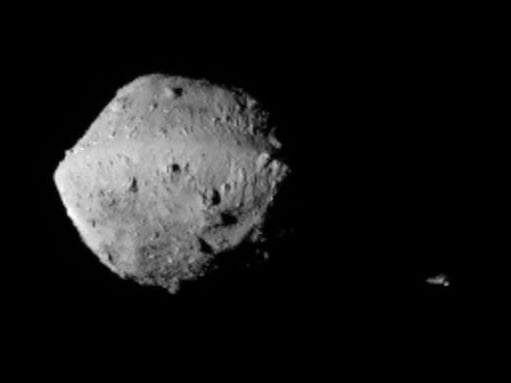
Earth has picked up a very small seasonal companion. Asteroid 2026 QQ8, a space rock roughly 6 feet (2 meters) wide, is temporarily circling our planet after being captured by Earth’s gravity in April. The new minimoon discovery was formally documented by the International Astronomical Union’s Minor Planet Center on October 29, and current calculations suggest it should remain nearby through the holidays before escaping in January 2027.
Hungarian astronomer Krisztián Sárneczky first spotted the object in August. Follow-up observations helped establish that 2026 QQ8 is a natural asteroid rather than a piece of human-made orbital debris. The Minor Planet Center’s official circular, MPEC 2026-U95, describes the object as temporarily captured by Earth, with no known connection to an artificial object.
Calling it a second moon is fun, but 2026 QQ8 is not settling into a permanent lunar orbit. It is currently about one and a half times farther from Earth than the average distance to our familiar moon, and its path around the planet is a loose, temporary loop shaped by the competing gravity of Earth and the Sun. Once it breaks free, it will return to a solar orbit that takes about 359 days to complete.
The asteroid belongs to the Aten family, a group of near-Earth objects whose average orbits lie inside Earth’s path around the Sun. Larger Atens can be challenging to monitor because they may approach from the direction of the Sun, but 2026 QQ8 is far too small to pose a meaningful danger. If an object this size entered Earth’s atmosphere, it would most likely disintegrate as a meteor rather than reach the ground intact.
Temporary satellites like this are less unusual than their headline-friendly nickname suggests. Astronomers believe Earth may have a minimoon at almost any given time, although most are small and remain gravitationally captured for less than a year. The first confirmed object in this category was 1991 VG, estimated at around 10 meters across when it was discovered.
More discoveries could be coming as sky surveys become faster and more sensitive. Chile’s Vera C. Rubin Observatory is designed to repeatedly scan the southern sky, catching objects that move or change brightness and returning to each region roughly 800 times during its planned decade-long survey. That cadence should make it easier to identify fleeting minimoons before they disappear back into the wider solar system—though spotting 2026 QQ8 still required careful follow-up and orbital detective work.


