
Dark energy may have undergone a remarkable transformation in the deep past: an alternative theory of gravity suggests its effective density was negative for billions of years before crossing zero and becoming positive roughly 9.5 billion years ago. The result does not prove that dark energy truly changed sign, but it opens an unusual possibility for explaining how the universe’s expansion evolved. The proposed cosmic reversal emerges from a previously overlooked branch of teleparallel f(T) gravity.
The work comes from an international team led by Özgür Akarsu of Istanbul Technical University, with Bilal Bulduk, Antonio De Felice, Nihan Katırcı, and N. Merve Uzun. Their study, published in Physical Review D in 2025, examines an alternative way to describe gravity in which torsion, rather than spacetime curvature alone, plays the central geometric role. The paper is available through its arXiv version.
Under the branch the researchers investigated, the effective dark-energy density begins below zero in the early universe. It reaches zero at approximately redshift 1.5—a measure of how much cosmic expansion has stretched ancient light—and then becomes positive. That transition corresponds to a period around 9.5 billion years ago, after which the model produces the accelerated expansion observed today.
This is not the same as discovering a substance that physically changed polarity. “Dark energy” is the name given to whatever drives the universe’s late-time acceleration, and in this framework the changing quantity is an effective contribution generated by the gravitational equations. The model is therefore testing whether modified gravity can mimic the behavior normally attributed to a cosmological constant, rather than replacing one confirmed observation with another.
The idea also builds on the team’s earlier sign-switching ΛCDM work, which proposed that the cosmological constant could move from a negative to a positive value during cosmic history. The newer analysis places that behavior inside an alternative-gravity framework and explores a solution that earlier studies commonly excluded by assuming the effective dark-energy density had to remain positive. The authors say the overlooked branch can remain compatible with cosmic microwave background constraints and solar-system gravity tests.
For now, this is a mathematically viable scenario, not a settled revision of cosmology. Its importance will depend on whether future observations can distinguish a changing dark-energy history from standard ΛCDM. Measurements of the expansion rate, baryon acoustic oscillations, supernova distances, and large-scale structure could help determine whether the universe’s acceleration has truly evolved—or whether the apparent sign change is simply one intriguing route through the equations.
Image Credits
In-Article Image Credits
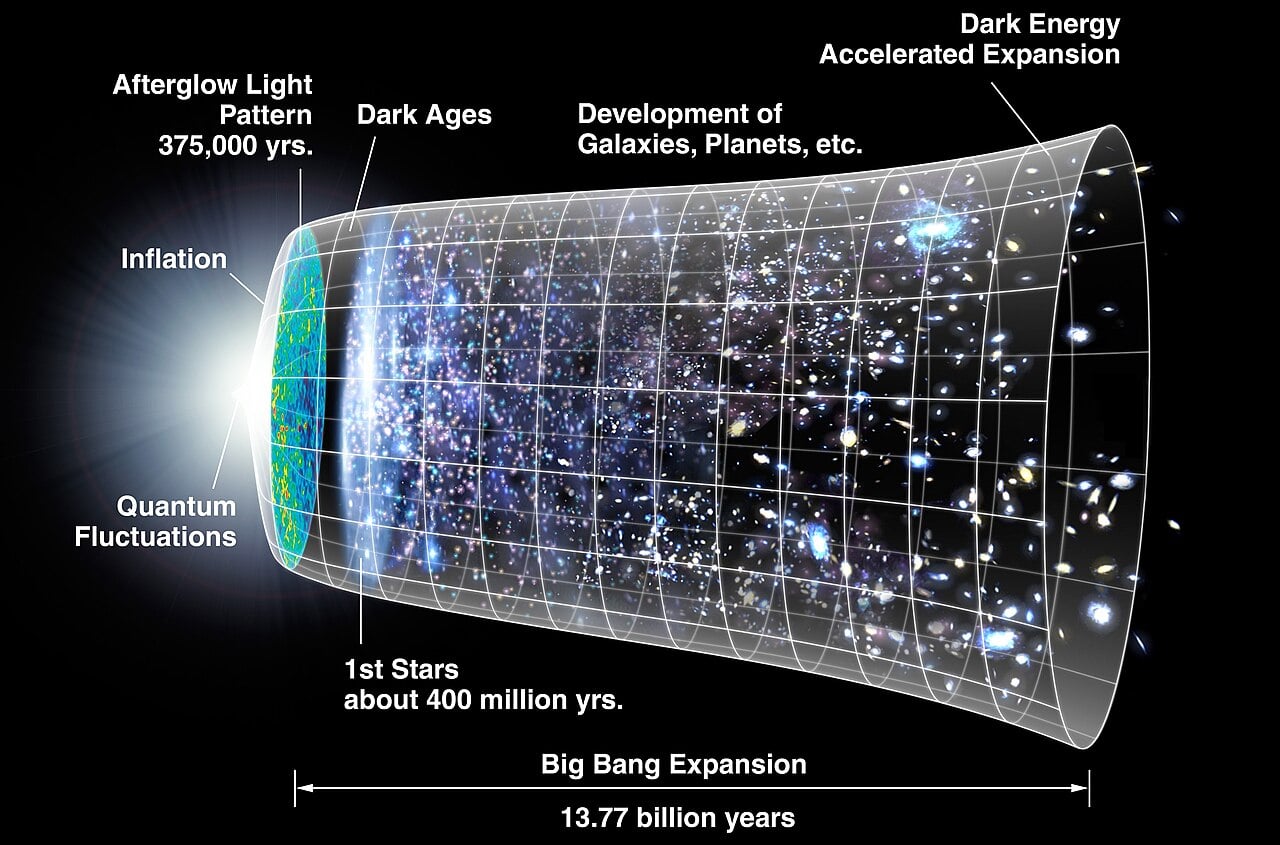
Timeline of the universe including expansion, gravity, and dark energy via Wikimedia Commons by NASA with usage type - Public Domain. By NASA/WMAP Science Team - Original version: NASA; modified by Cherkash, Public Domain, https://commons.wikimedia.org/w/index.php?curid=11885244Featured Image Credit
Timeline of the universe including expansion, gravity, and dark energy via Wikimedia Commons by NASA with usage type - Public Domain. By NASA/WMAP Science Team - Original version: NASA; modified by Cherkash, Public Domain, https://commons.wikimedia.org/w/index.php?curid=11885244


