
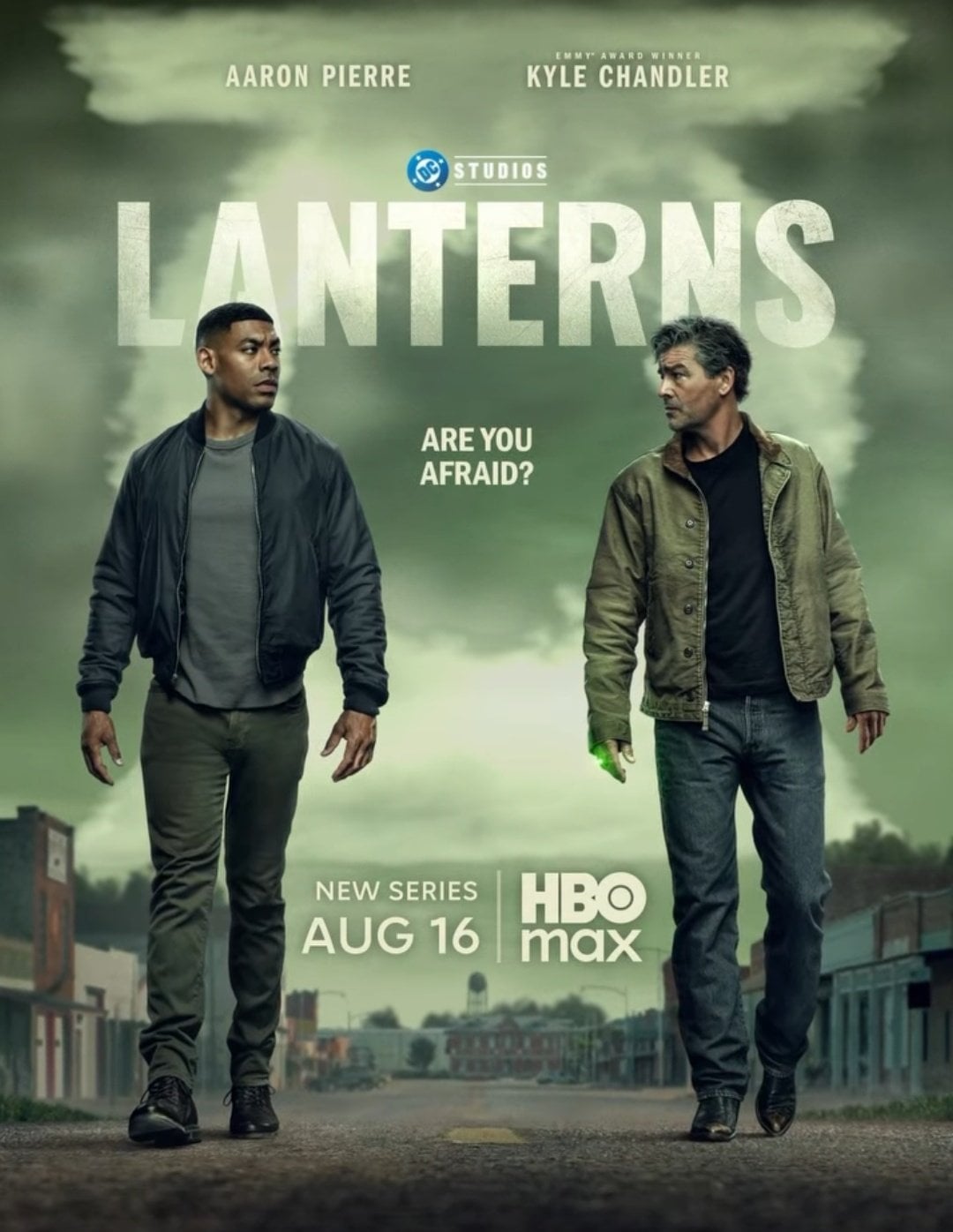
Lanterns just detonated one of its biggest twists yet, reframing Hal Jordan’s family history as a generational tragedy and in the process rewriting a cornerstone of Green Lantern canon while making the mystery of Hal’s own death even murkier.
The HBO DC Studios series opened by positioning itself as a grounded cosmic noir about Hal Jordan and John Stewart, only to end its pilot with a brutal time jump to 2026 and the discovery of Hal’s corpse in a snow-covered high school stadium in Rushville, Nebraska, shot through the head and missing his power ring. Multiple outlets have confirmed that this is no mere hallucination or fake-out, with the present-day timeline treating Hal as definitively dead and his murder as the show’s central question. The series has even floated the idea that a stored “Halogram” inside his ring could allow a construct of Hal to persist, giving the narrative a way to keep him involved while the investigation unfolds. As first reported by ComicBook.com, the latest episode uses that construct to deliver a revelation that hits harder than any ring blast.
To understand why the new reveal is controversial, you have to look at Hal’s long-established origin in the comics, where his father Martin Jordan’s death is a foundational trauma. Since stories like Green Lantern: Emerald Dawn, Martin has traditionally died in what is presented as a tragic test-flight accident, a plane crash that young Hal witnesses from the stands and that severs his connection to fear, setting him on the path toward wielding a Green Lantern ring. Hal himself has a history of dying and returning in DC lore; he becomes the villain Parallax after the destruction of Coast City, sacrifices himself to reignite Earth’s sun in the 1996 event The Final Night, and later returns in various retcons that separate his heroism from the cosmic entity that corrupted him. The idea that Hal’s story is intertwined with death and resurrection is familiar to comics readers, but Lanterns pushes that theme deeper into his family tree.
In the new episode, a flashback to Hal’s youth expands on his bond with Martin, showing the tough, no-nonsense test pilot passing down a “failsafe” safe key that he describes as a Jordan family legacy, echoing how Hal’s grandfather once left behind money and keepsakes before heading off to war. Much later, the construct of Hal generated by his power ring confides in John Stewart that Martin did not actually die in a random accident, but used his final flight to take his own life, gambling that everyone would assume the crash was just part of the job. Inside the safe, Hal found cash, coins, photographs, and a suicide note in which his father describes worsening pain and the belief that his family would be better off without him. Polygon’s breakdown adds that the note reveals Hal’s grandfather also died by suicide, confirming a grim generational pattern that Lanterns deliberately ties to the notion of the “Jordan legacy.” This is a significant departure from decades of comic canon, where Martin’s death has never been framed as an intentional act, let alone as part of a hereditary struggle with mental health.
That shift doesn’t just add tragedy; it reframes Hal’s psychology and potentially his death. If Hal grew up believing his father chose to die, then his own relationship to risk, fearlessness, and self-sacrifice looks more like a reaction against that choice than a simple byproduct of surviving an accident. Polygon notes that the episode also links the revelation to the ongoing murder plot, sketching a chain of connections in which someone secretly freed Sinestro, Hal maintained a hidden route to visit the former Lantern, and Hal was murdered a few months after returning to Rushville. Sinestro may not have pulled the trigger, but the implication is that he knows more about why Hal died, raising the possibility that the Jordan legacy of confronting (or succumbing to) darkness is now entangled with broader DCU politics. By making the Halogram the source of the confession, Lanterns underscores how the Green Lantern ring carries not only light but the weight of its bearer’s unresolved pain.
Unsurprisingly, fandom has exploded with theories. ComicBook.com and other outlets have tracked speculation that the Hal we saw die in the stadium might be a clone or alien duplicate, a theory rooted in early dialogue establishing that some extraterrestrials can perfectly mimic human anatomy. Others zero in on the human suspects around Rushville, with one fan-favorite theory pointing at Noah Macon, whose proximity to both the Kane and Macon families and to the Manhunter conspiracy makes him an intriguing but unproven candidate. At the same time, Sinestro’s off-screen maneuvers and the missing ring suggest a larger cosmic player may have engineered Hal’s death for strategic reasons. Writer Tom King has confirmed in interviews that Hal is genuinely dead in the show’s present-day timeline but emphasized that this is a superhero story, where death is rarely the end and a return is always on the table if it serves the narrative. Nerdist has also pointed out that Hal dying and clawing his way back from the afterlife is entirely consistent with his comic-book legacy, so the series is unlikely to close the door on him forever.
For DC Studios and James Gunn’s emerging DCU, Lanterns is clearly being used as a canon-setting vehicle, and this retcon of Hal’s origin is a deliberate choice that will ripple through any future film or series featuring the Green Lantern Corps. By introducing suicide and generational depression into the Jordan backstory, the show leans into darker, prestige-drama territory while still operating within a superhero framework, mirroring how past comics tied Hal’s fall and redemption to cosmic embodiments of fear and will. As the season barrels toward its finale with Hal’s death unsolved and the implications of his father’s note still sinking in, viewers are left to wonder whether the Jordan legacy is a tragic curse or the crucible that forged one of DC’s greatest heroes. Whatever answers Lanterns ultimately provides, the series has already ensured that Hal Jordan’s story in the DCU will be both more painful and more layered than any live-action Green Lantern version that came before.


