
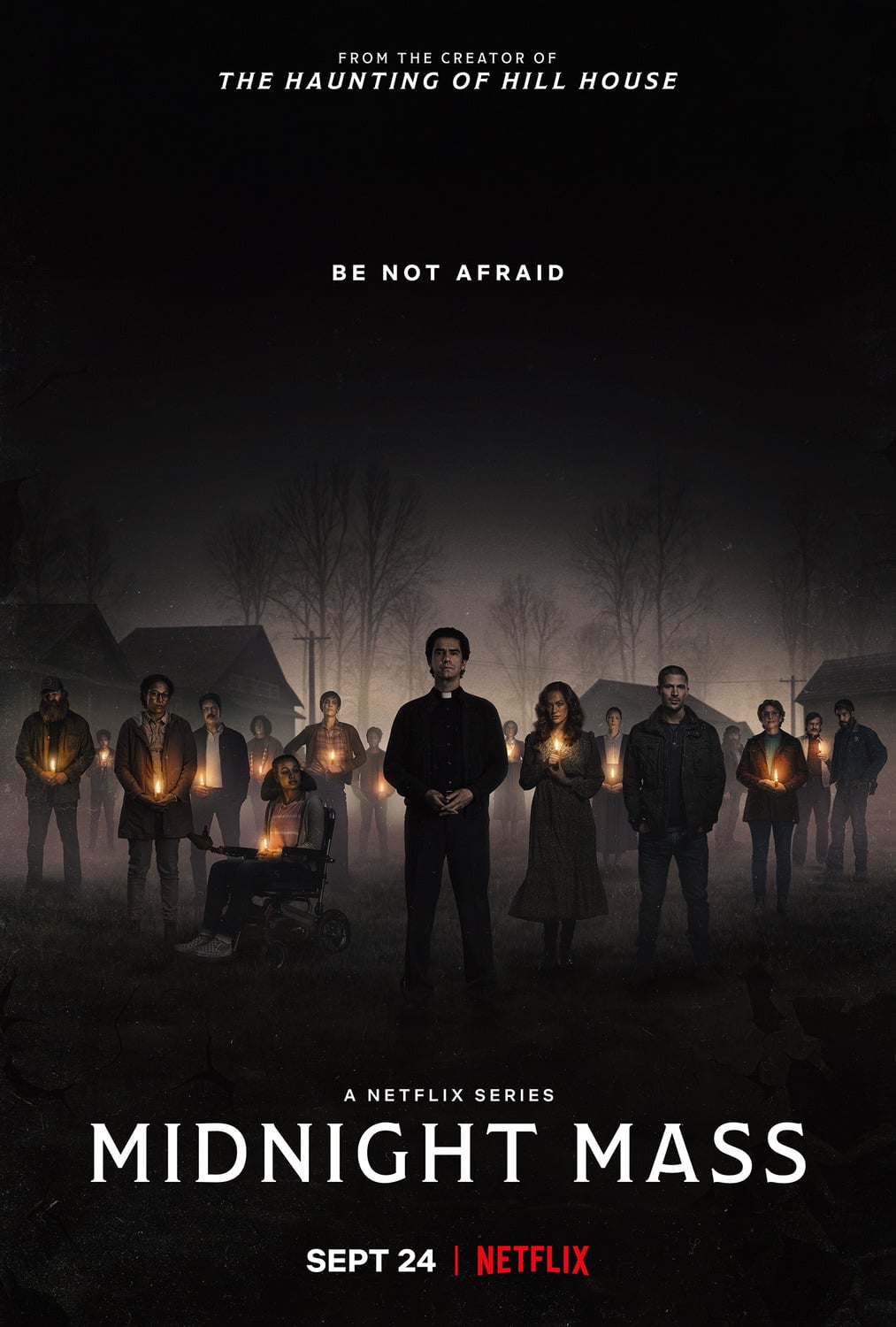
With Midnight Mass, Mike Flanagan distilled years of Stephen King obsession and puzzle-box TV fandom into a seven-episode Netflix miniseries that feels like Salem’s Lot shipwrecked on Lost’s island. The result is a self-contained gothic horror story that begins like a slow-burning character drama and ends as a full-on apocalyptic sermon about faith, addiction, and the monsters people invite into their lives.
Set in the fading fishing community of Crockett Island, the series follows Riley Flynn, a recovering alcoholic returning home after a tragic drunk-driving accident, and Father Paul, a mysterious young priest whose arrival sparks inexplicable miracles and a sudden religious revival. As the congregation’s ailments vanish and an elderly woman appears to grow younger, the islanders interpret these events as divine intervention, even as a series of disappearances and nocturnal attacks hint at a far more predatory source of salvation. Flanagan uses the closed ecosystem of the island and its tightly woven ensemble—played by Zach Gilford, Kate Siegel, Hamish Linklater, Samantha Sloyan, Rahul Kohli, and more—to turn each episode into a pressure cooker where personal secrets collide with escalating supernatural horror.
ScreenRant has highlighted how deeply Midnight Mass taps into Stephen King’s favorite tropes: an isolated town, everyday people grappling with faith and moral failure, and a creeping terror that grows in the dark corners of communal life. Flanagan’s story echoes the spiritual rot of novels like Salem’s Lot and Revival, swapping out traditional vampire lore for something that can be plausibly reframed as an angelic visitation, depending on how desperately characters need to believe. The show’s lengthy monologues about belief, death, and the afterlife turn its horror into theological debate, making the eventual bloodletting feel like the inevitable consequence of doctrines twisted to justify hunger and control.
The Lost comparison comes less from direct plot similarities and more from structure and vibe: this is a mystery-box series that parcels out answers with agonizing deliberation while building a community of flawed, interlocking backstories. Episodes are framed as “Books” with overtly biblical titles, reinforcing the sense that viewers are reading scripture where every revelation recontextualizes the last. Much like Lost’s island, Crockett Island itself functions as a crucible for existential questions, trapping characters in a liminal space where science, religion, and the supernatural all compete to explain what is happening to them. Flashbacks to Riley’s past crime, Sheriff Hassan’s experience of Islamophobia, and Erin Greene’s history of abuse deepen the emotional stakes of the mystery and emphasize that the worst horrors here are human-made, even before anything with wings shows up.
Midnight Mass also slots neatly into the long lineage of televised horror that runs from The Twilight Zone through anthology shows and modern streaming chillers. Where many genre series stretch their story across multiple seasons, Flanagan embraces the limited-run format, crafting a tightly plotted seven-part saga that feels closer to a novel you binge over a weekend than ongoing TV. Critical response has been strong, with Rotten Tomatoes and other aggregators noting high approval scores and praising the performances of Linklater and Sloyan in particular, whose characters embody the seductive and authoritarian faces of religious fervor. That combination of prestige drama tone, theological horror, and contained scale has turned Midnight Mass into a touchstone for conversations about what 21st-century TV horror can do.
For fans of Stephen King and Lost alike, the series offers a rare blend: the intimate, small-town dread King is known for, wrapped in a dense, serialized mystery that rewards close attention and post-episode theorizing. Despite running only seven episodes, Midnight Mass leaves a lingering aftertaste, thanks to its willingness to follow characters all the way through their crises of faith to either transcendence or annihilation. As horror television continues to evolve, Flanagan’s island parable stands as one of Netflix’s most ambitious supernatural projects—a story that argues the scariest thing in the universe might not be monsters in the dark, but the stories people tell themselves to justify inviting those monsters in.


