
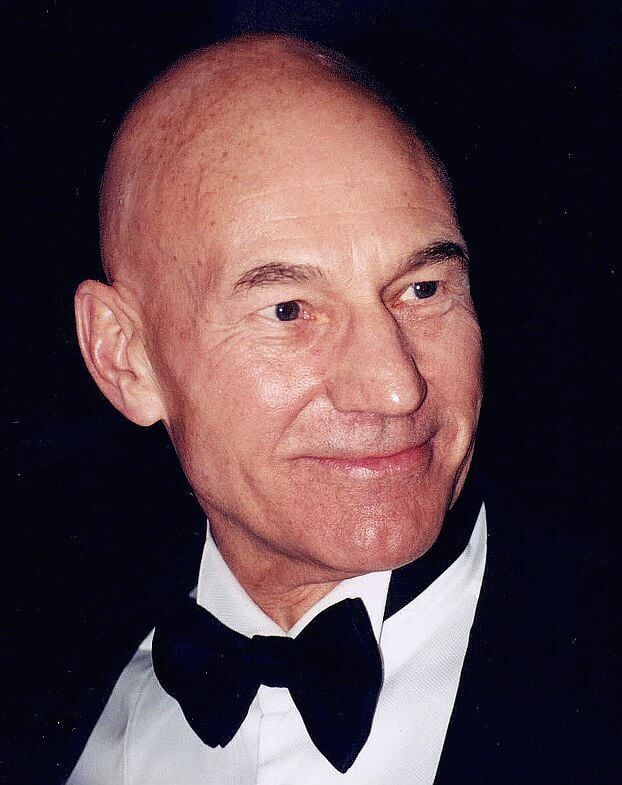
Sir Patrick Stewart, the classically trained British actor who became one of science fiction’s defining stars, has died at 86. Stewart died Wednesday, October 28, at his home in Los Angeles while being cared for by his wife, Sunny, following what his longtime spokesperson described as a brief journey with Alzheimer’s disease and Lewy body dementia. The news marks the loss of a towering pop-culture figure whose work connected Shakespearean theater, prestige television, superhero cinema, and generations of genre fans. NBC News also reported the statement from spokesperson Kelly Bush Novak, which said Stewart died in the loving care of his wife.
For many viewers, Stewart’s most enduring role was Captain Jean-Luc Picard in Star Trek: The Next Generation. Introduced in 1987, Picard brought a different kind of authority to the franchise: measured, literary, diplomatic, and more likely to solve a crisis through argument than bravado. Stewart’s performance helped make the series a landmark of television science fiction, and he carried Picard into four feature films before returning to the character decades later in Star Trek: Picard.
Stewart’s journey to international stardom began long before the bridge of the USS Enterprise. Born in Mirfield, West Yorkshire, in 1940, he spent much of his early career on the British stage, including extensive work with the Royal Shakespeare Company. Encyclopaedia Britannica identifies his 1987 casting as Picard as the turning point that brought him global recognition after years as a respected theater performer. His stage background gave the character a gravity that helped distinguish The Next Generation from more conventional television adventure.
Genre audiences also knew Stewart as Professor Charles Xavier, the telepathic founder of the X-Men. He first played the role in 2000’s X-Men and returned for several sequels, Logan, and Doctor Strange in the Multiverse of Madness. The pairing of Stewart’s Xavier with Ian McKellen’s Magneto became one of the defining actor rivalries of modern superhero cinema, while Logan gave the performer a darker and more vulnerable final chapter with the character.
Stewart was knighted in 2010 for his contributions to drama, but his influence extended well beyond formal honors. He became a familiar presence at conventions, charity events, interviews, and fan gatherings, where his precise voice and dry humor made him instantly recognizable even outside his signature roles. His career demonstrated that a performer could move from classical theater to genre television and blockbuster franchises without treating any of those audiences as lesser.
Stewart’s death leaves Picard and Xavier as unusually lasting screen legacies: two mentors defined not by physical power, but by judgment, empathy, and the ability to imagine a better future. Tributes are expected to continue across the Star Trek, X-Men, theater, and wider entertainment communities as fans revisit the performances that made Sir Patrick Stewart a singular figure in modern geek culture.
Image Credits
In-Article Image Credits
Patrick Stewart 1999 via Wikimedia Commons by Kingkongphoto & www.celebrity-photos.com with usage type - CC0 Public Domain. By Kingkongphoto & www.celebrity-photos.com from Laurel Maryland, USA - Patrick Stewart, CC BY-SA 2.0, https://commons.wikimedia.org/w/index.php?curid=202559869Featured Image Credit
Patrick Stewart 1999 via Wikimedia Commons by Kingkongphoto & www.celebrity-photos.com with usage type - CC0 Public Domain. By Kingkongphoto & www.celebrity-photos.com from Laurel Maryland, USA - Patrick Stewart, CC BY-SA 2.0, https://commons.wikimedia.org/w/index.php?curid=202559869


