
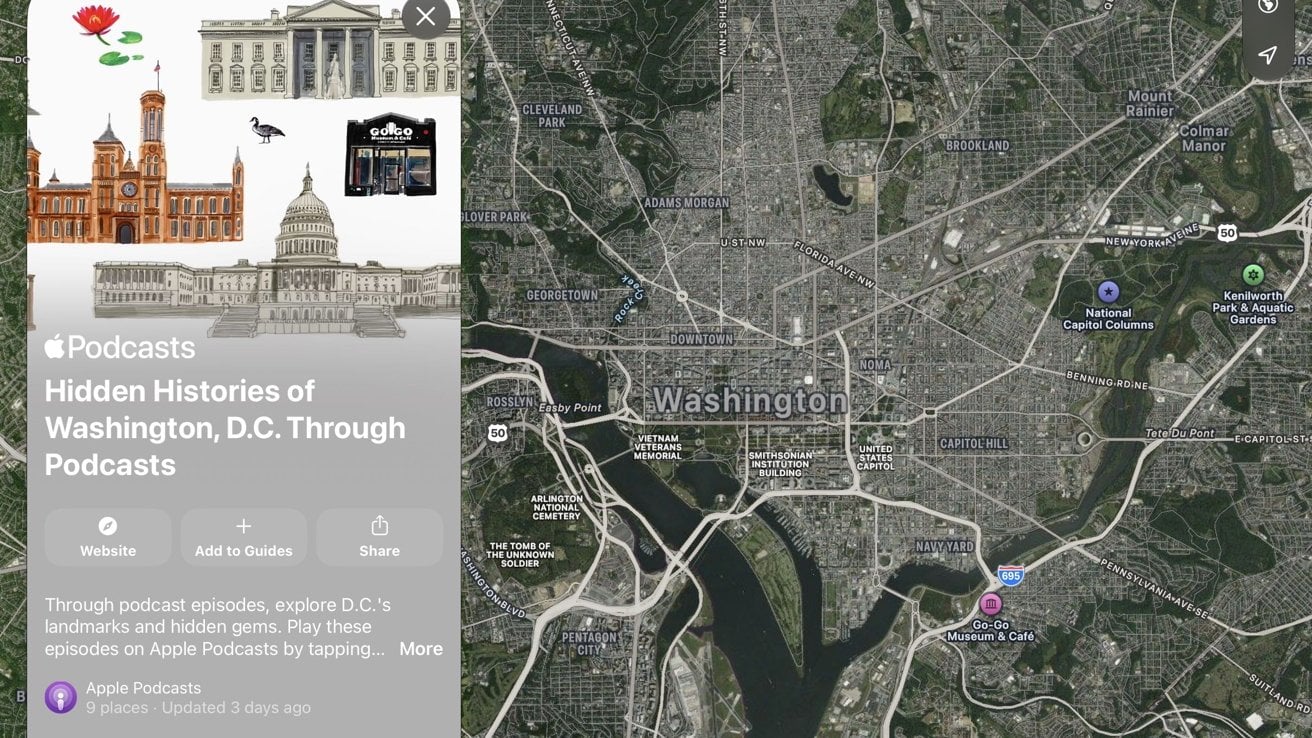
Apple is quietly turning its mapping app into a location-based audio tour platform, rolling out new “Hidden Histories” podcast guides that surface stories tied directly to real-world landmarks in the United States. As first reported by Engadget, select points of interest in Apple Maps now carry prompts that lead users into curated episodes exploring the secret histories behind the places they’re standing in.
The Hidden Histories rollout is built as a series of Maps guides that are powered by Apple Podcasts, connecting specific landmarks and lesser-known spots in five major U.S. cities to themed audio episodes. Coverage of the feature notes that the collection currently focuses on San Francisco, Los Angeles, New York City, Chicago, and Washington, D.C., with each guide acting as a mini “quest log” of sites whose stories go far beyond the tourist brochure. Instead of just listing addresses and opening hours, these guides highlight history, architecture, and notable figures associated with each stop, turning an ordinary map pin into a gateway for narrative deep dives.
To get at the new content, Apple Maps users can browse the full Hidden Histories collection as a set of guides or search for “Apple Podcasts” inside Maps to surface city-specific lists of locations. When you tap into one of those spots, a link appears to a relevant podcast episode, which then opens in Apple Podcasts to let you listen as you walk, commute, or daydream about being there. Social posts promoting the feature pitch it as “a new way to discover history,” framing it less like a static museum audio tour and more like an exploratory feed of stories you unlock as you traverse the urban landscape.
This move slots neatly into Apple’s years-long effort to make Maps feel less like a utilitarian navigation tool and more like a richly layered representation of real-world spaces. Over the past few years, the company has overhauled its basemap in the U.S. with more detailed building shapes, parks, sports fields, and other environmental features, while adding enhanced landmark modeling and extra visual polish in select cities. Features like Flyover and Apple’s high-detail 3D landmark rendering showcase iconic structures such as One World Trade Center or the Golden Gate Bridge as immersive, rotatable miniatures rather than flat icons. Apple has also experimented with personal context layers, such as Visited Places, which tracks where you’ve been and lets you revisit your own movement history with granular control over what’s stored. Hidden Histories fits into this trajectory by adding a narrative layer on top of those visuals, turning points of interest into story nodes.
On the podcast side, Hidden Histories is branded as a curated way to explore the “hidden and often forgotten histories” that make up the places people live and the traditions they share. Rather than being a single, monolithic show, the guides appear to aggregate episodes from various history- and culture-focused podcasts that match specific locations and themes, then tuck those into Maps so they’re discoverable at the exact moment you care about a spot’s backstory. It’s a clever intersection of two existing ecosystems—Apple Maps and Apple Podcasts—that effectively turns city blocks into playlists of micro-history, ready to be queued up whenever curiosity strikes.


