
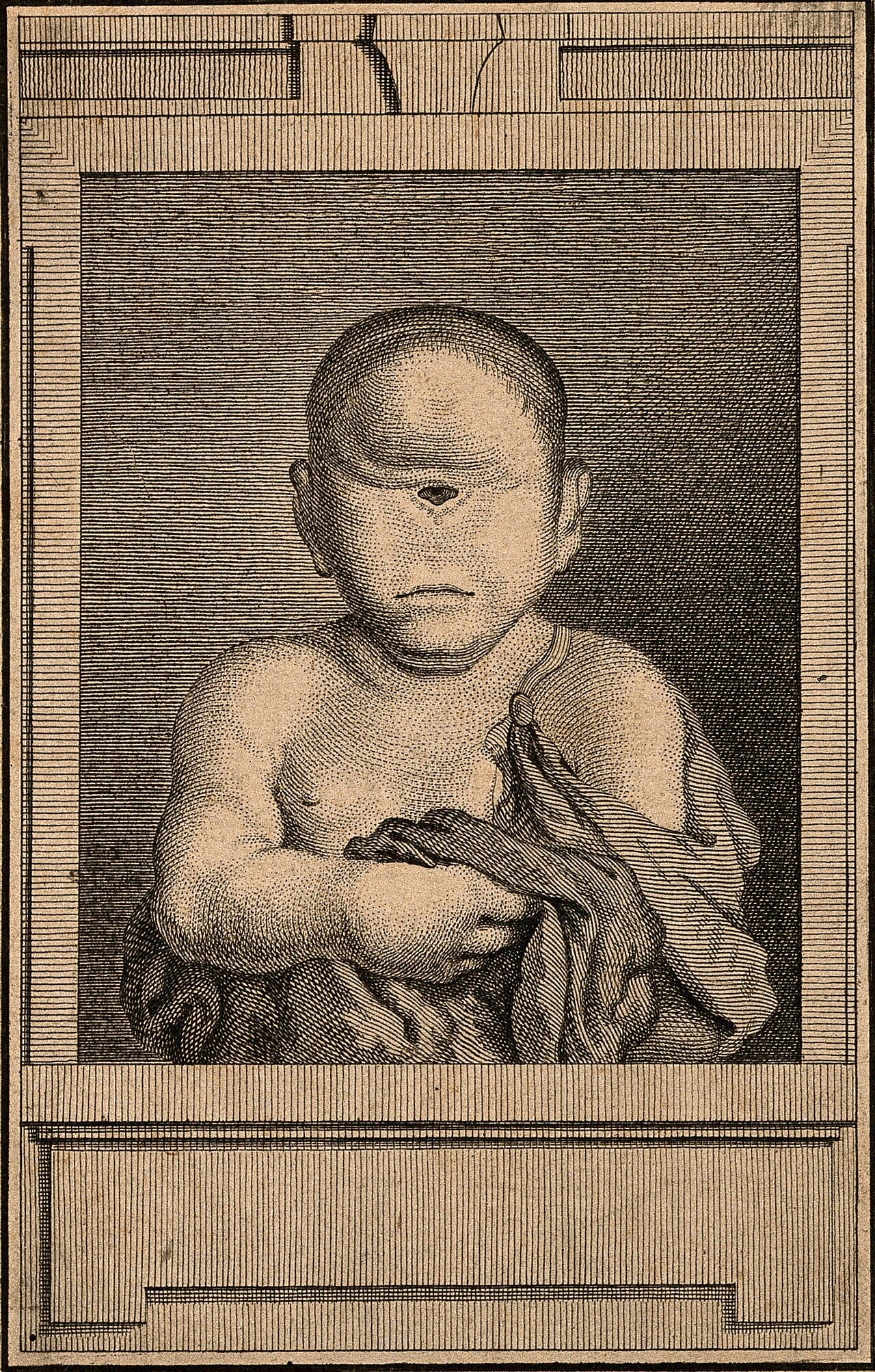
A 1,600-year-old burial in Peru has given archaeologists an extraordinarily intimate glimpse into an ancient family’s experience with severe congenital disease. The remains belong to a female infant whose skull had a single eye socket centered in the face, a condition known as cyclopia, while genetic testing identified an extra copy of chromosome 13. The discovery and genetic diagnosis come from a study published in PNAS on November 9, 2026.
The skeleton, designated JA13A, was recovered at Jauranga in Peru’s Palpa Valley, a region closely associated with the famous Nazca geoglyphs. She had been placed in a ceramic urn with another female infant at a cemetery dating to the Middle Nazca period, approximately A.D. 325 to 440. The second child did not show the same skeletal abnormalities, making the shared burial especially important for understanding how the community handled infant death.
Cyclopia develops extremely early in pregnancy, when the developing forebrain fails to separate into distinct left and right hemispheres. That disruption can also affect the nose and other facial structures. The condition is exceptionally uncommon—roughly one case per 100,000 births—and is generally fatal. In this case, the infant’s unusually small skull and altered cranial bones matched the anatomical pattern recognized by modern medicine. Independent coverage places both infants’ deaths after full-term or near-full-term gestation, suggesting the child may have lived for at least a short period after birth.
Ancient DNA adds another layer to the diagnosis. Researchers found two X chromosomes, consistent with the infant’s biological sex, along with an additional copy of chromosome 13. That genetic condition, trisomy 13—also called Patau syndrome—is a major known chromosomal cause of cyclopia, although only a minority of people with trisomy 13 develop the striking eye abnormality. The result demonstrates how paleogenomics can connect visible skeletal evidence with a specific genetic mechanism more than a millennium after death.
The burial itself may be as revealing as the pathology. The child was interred in the same general manner as other infants at Jauranga rather than being placed in an obviously separate or anomalous context. That does not prove how long she survived or exactly how relatives understood her condition, but it suggests that her death was incorporated into established mortuary practice. It also cautions against assuming that profound congenital differences automatically led to social exclusion in the ancient Andes.
Jauranga sits within a broader archaeological landscape whose geoglyphs, cemeteries, and settlements document the complexity of Nasca society. The Nazca Lines were not the product of a single moment: research places most of the linear geoglyphs in the Nasca period, broadly A.D. 1 to 600, with the Palpa and Nazca valleys forming one of the culture’s central zones. This infant’s remains add a very different kind of evidence to that landscape—one focused not on monumental designs, but on biology, caregiving, and the choices made by ordinary people at the end of a child’s life.


