
Crows have added a new entry to their already formidable intelligence résumé: in a laboratory test of visual judgment, two carrion crows reached an answer in an average of just 235 milliseconds. That is roughly half the time reported for humans and monkeys performing comparable motion-recognition tasks, though the experiment was designed to measure one narrow skill—not general intelligence. The study’s headline result comes from researchers at the University of Tübingen and was published in Science.
Philipp Schmidbauer and Andreas Nieder trained the birds, identified as Iggy and Lemmy in coverage of the research, to watch a touchscreen displaying a cloud of moving dots. Some dots traveled together toward the left or right while the rest moved randomly. The crows had to determine the dominant direction and peck the corresponding side of the screen, earning a mealworm for a correct response. After thousands of trials, they averaged about 235 milliseconds from the appearance of the stimulus to the beginning of their response, with average accuracy reported at 74 percent.
The task is significant because it is based on a visual decision test used for decades in primate research. Earlier, closely matched experiments put monkeys’ response times at approximately 410, 490, and 600 milliseconds, giving the Tübingen team a useful benchmark. The comparison is not a single head-to-head contest involving the same humans, monkeys, and crows under identical conditions, but the result still suggests that avian brains can process certain sensory choices with extraordinary efficiency. Neuroscience coverage of the experiment places the crows’ response at less than a quarter of a second.
Speed did not come at the expense of performance. When the directional signal was clear, the birds could approach near-perfect accuracy; when the dots were difficult to interpret, they performed above chance rather than simply guessing. That distinction matters because the study concerns perceptual decision-making—rapidly extracting a useful answer from visual information—not the slower, reflective kind of decision people associate with planning or deliberation.
The researchers also recorded activity from neurons in the crows’ brains, allowing them to connect the birds’ behavior with the neural processes behind it. The work adds to a growing body of research challenging the outdated idea that complex cognition requires a primate-style brain. Crows have already become important subjects in studies of consciousness, memory, tool use, and planning; this experiment now highlights a different advantage: fast, economical visual processing in a compact avian nervous system.
There is a useful limitation attached to the headline. Only two birds participated, and the primate comparisons came from earlier studies rather than a newly controlled three-species experiment. Even so, the findings give scientists a sharper way to investigate how radically different brains can arrive at accurate choices—and why crows, whose survival depends on quickly reading predators, rivals, and moving objects, may have evolved such an efficient visual response system. The full study is titled Ultrarapid decision-making in an avian brain and appears in Science, volume 394, issue 6822.
Image Credits
In-Article Image Credits
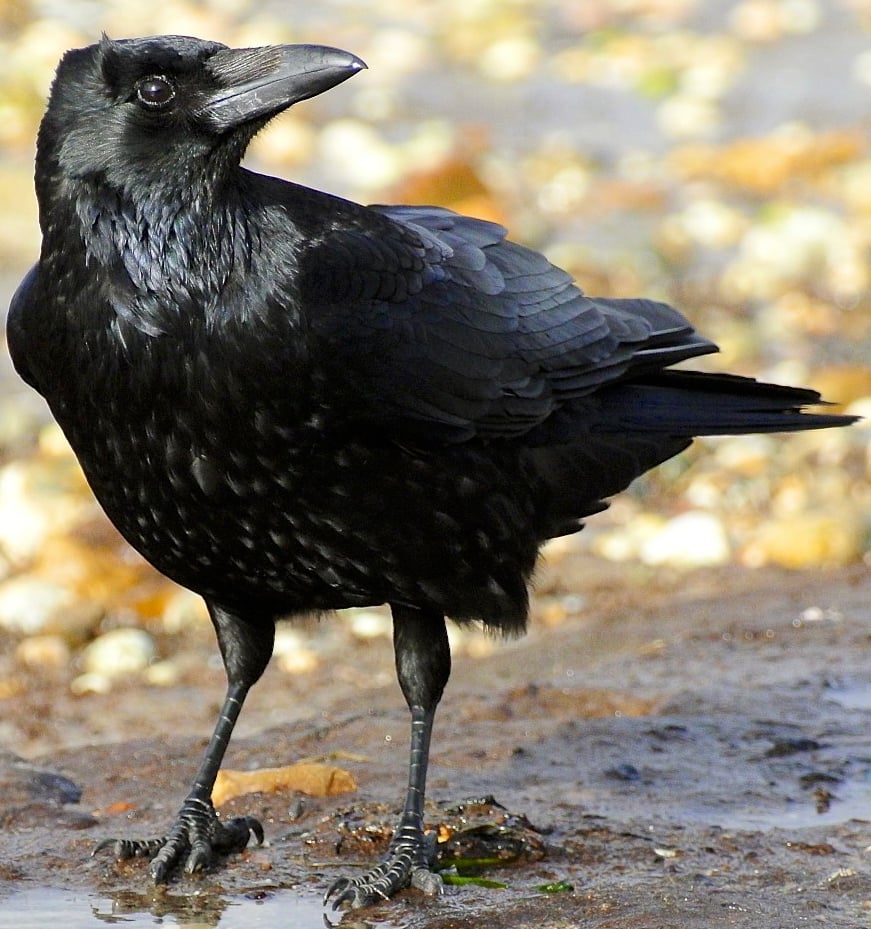
A Carrion Crow scavenging on the beach via Wikimedia Commons by Ian Kirk with usage type - Creative Commons License. By Ian Kirk from Broadstone, Dorset, UK - Carrion CrowUploaded by snowmanradio, CC BY 2.0, https://commons.wikimedia.org/w/index.php?curid=31096061Featured Image Credit
A Carrion Crow scavenging on the beach via Wikimedia Commons by Ian Kirk with usage type - Creative Commons License. By Ian Kirk from Broadstone, Dorset, UK - Carrion CrowUploaded by snowmanradio, CC BY 2.0, https://commons.wikimedia.org/w/index.php?curid=31096061


