
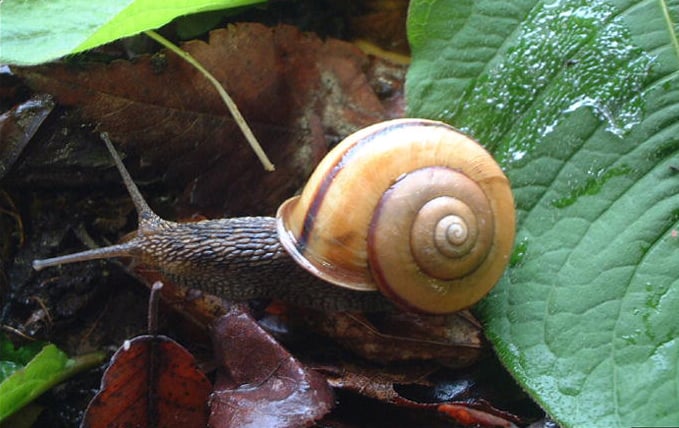
A small genetic difference can turn one Japanese land snail into the mirror image of another. Researchers from the University of Nottingham and Tohoku University have identified a myosin gene that helps determine whether Euhadra snails develop shells that coil clockwise or counterclockwise—a discovery that could sharpen scientists’ understanding of how left-right asymmetry arises across the animal kingdom. Phys.org first reported the finding.
The trait, known as chirality, is established extremely early in development. The team’s evidence indicates that naturally occurring versions of an unconventional myosin I a/b gene alter how embryonic cells twist and reorganize. Those microscopic movements eventually set the orientation of the mature shell, body, and internal organs. Myosin is best known for helping cells move and change shape by interacting with the cellular scaffold, but this particular myosin had not previously been connected to left-right patterning in an animal. The University of Nottingham’s research summary describes the mechanism and its developmental significance.
That makes Euhadra especially valuable to evolutionary biologists. Most snail species overwhelmingly favor one coiling direction, while some Japanese populations preserve both left- and right-coiling forms in the wild. The new study found that the two genetic variants are ancient and that both types can develop normally, without the abnormal embryonic effects seen in some other shell-coiling mutations. In other words, the mirror-image forms are not simply a healthy body plan versus a defective one; both can persist as viable alternatives.
Shell direction also affects more than appearance. Because a snail’s organs and reproductive anatomy follow the same left-right layout, opposite-coiled animals can face mechanical barriers when attempting to mate. Earlier research on Euhadra showed that shell reversal can contribute to reproductive isolation and, potentially, speciation, although later work found evidence that differently coiled snails can still mate and exchange genes. A Nature study on single-gene speciation and subsequent population research provide the broader evolutionary context.
The importance of the result extends well beyond an unusually photogenic group of mollusks. Humans, like other animals, must coordinate a consistent left-right body plan— including the placement of organs—during embryonic development. Snails offer a rare natural experiment because closely related animals can carry opposite versions of the same basic architecture. By comparing the myosin changes in left- and right-coiling Euhadra, researchers now have specific molecular features to investigate in other organisms. The next challenge is determining exactly how those altered amino acids change the myosin motor’s behavior as the first embryonic cells begin to twist.
Image Credits
In-Article Image Credits
Euhadra quaesita snail from Sendai via Wikimedia Commons by Angus Davison and Satoshi Chiba with usage type - Creative Commons LicenseFeatured Image Credit
Euhadra quaesita snail from Sendai via Wikimedia Commons by Angus Davison and Satoshi Chiba with usage type - Creative Commons License


