
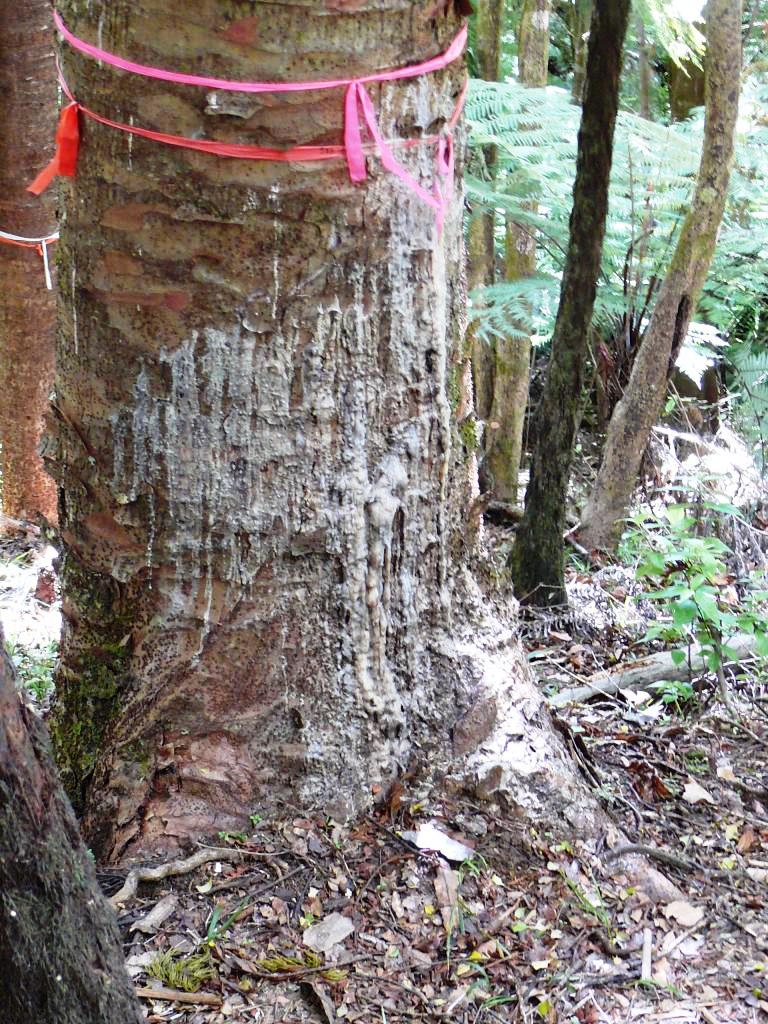
Kauri dieback has long been framed as a biodiversity crisis, but new research highlighted by Phys.org suggests it is also quietly altering how much carbon Aotearoa New Zealand’s forests can lock away. The disease isn’t just felling some of the Southern Hemisphere’s largest trees; it is tipping entire stands from powerful carbon sinks into net sources, reshaping climate math in one of the world’s most carbon-dense forest systems.
To understand why that matters, you have to appreciate what kauri (Agathis australis) are in ecological terms: towering conifers that can live for more than 1,500 years and accumulate massive biomass over centuries. Mature kauri forests sit among the planet’s most carbon-rich ecosystems, with total carbon storage estimated at up to about 990 megagrams (tonnes) of carbon per hectare when you include above-ground biomass and forest floor. Even the soils beneath these slow-decomposing giants are extraordinary, with kauri forest soils reported to hold as much as 670 tonnes of carbon per hectare thanks to woody litter and unique microbial communities. In many stands, kauri themselves contribute the majority of the living carbon, effectively functioning as giant “carbon batteries” inside the forest.
The threat comes from the pathogen Phytophthora agathidicida, a fungus-like organism that infects kauri roots, causes bleeding lesions, canopy thinning and, in many cases, eventual tree death. Using long-term forest plots spanning a gradient from healthy to severely infected stands, researchers found that initial live carbon stocks averaged around 170 tonnes per hectare across surveyed kauri forests. In stands without visible symptoms, trees were collectively adding about 0.8 tonnes of carbon per hectare per year through growth. By contrast, forests with early signs of dieback were already losing roughly 0.1 tonnes per hectare annually, and severely affected stands were shedding around one tonne of carbon per hectare per year as mortality outpaced growth. That represents a swing of about 1.8 tonnes of carbon per hectare per year between healthy and heavily diseased forest—enough to flip mature kauri stands from net carbon sinks to net carbon sources.
Zoom out in time and the picture gets even starker. A separate modelling study suggests that if dieback runs unchecked, kauri forests could experience a median decline in above-ground live carbon storage of up to 55% over the next 500 years compared with undiseased stands. Because so much of the biomass is concentrated in a relatively small number of massive, old trees, their loss drives disproportionate reductions in stand-level carbon stocks. Researchers working on “ecological memory”—the legacy of past species and structures in a forest—warn that severely affected kauri stands may eventually stabilise at much lower biomass with little or no kauri, locking in reduced capacity to store and sequester carbon for centuries. In other words, this isn’t a short-term blip; it’s a long rewrite of the forest’s carbon ledger.
New Zealand policymakers are already treating kauri as more than just charismatic megaflora, recognising them as critical infrastructure in national climate planning. A regulatory impact assessment for managing Phytophthora agathidicida estimated that kauri forests sequester on average about 525 tonnes of carbon per hectare, and warned that functional extinction of kauri could erase roughly NZ$330 million worth of carbon emission mitigation value. That analysis feeds into decisions like track closures, hygiene stations and strict movement controls in kauri regions, all aimed at slowing pathogen spread while scientists scramble for durable management tools. For a climate-conscious geek audience, these forests are less scenic backdrop and more like real-world “servers” in a planetary carbon network—losing them changes how the whole system performs.
Scientists are still piecing together the full cascade of impacts as kauri dieback advances. Work on kauri soils has already shown that dieback and the loss of a keystone tree can trigger secondary effects such as reduced carbon uptake, altered nutrient cycling, faster decomposition and shifts in the soil microbiota that underpins long-term carbon storage. At institutions such as Auckland University of Technology and the University of Auckland, teams are running long-term experiments to track how forest carbon, litter fall and soil processes respond as large kauri decline. The new carbon-budget studies underscored by Phys.org highlight a major knowledge gap: much of the research so far has focused on living vegetation, leaving big questions about how much of the “lost” carbon ends up locked into dead wood, litter or soil—and how quickly the rest escapes to the atmosphere. As more data comes online, kauri forest models are likely to become must-watch tools not just for ecologists, but for anyone trying to predict how real-world ecosystems will behave in the climate stories we usually only see in sci-fi.
Image Credits
In-Article Image Credits
Bleeding resin (“kauri gum”) associated with collar-rot of lower trunk. The advancing lesion will spread laterally, eventually girdling the tree. via Wikimedia Commons by Onco p53 with usage type - Creative Commons LicenseFeatured Image Credit
Bleeding resin (“kauri gum”) associated with collar-rot of lower trunk. The advancing lesion will spread laterally, eventually girdling the tree. via Wikimedia Commons by Onco p53 with usage type - Creative Commons License


