
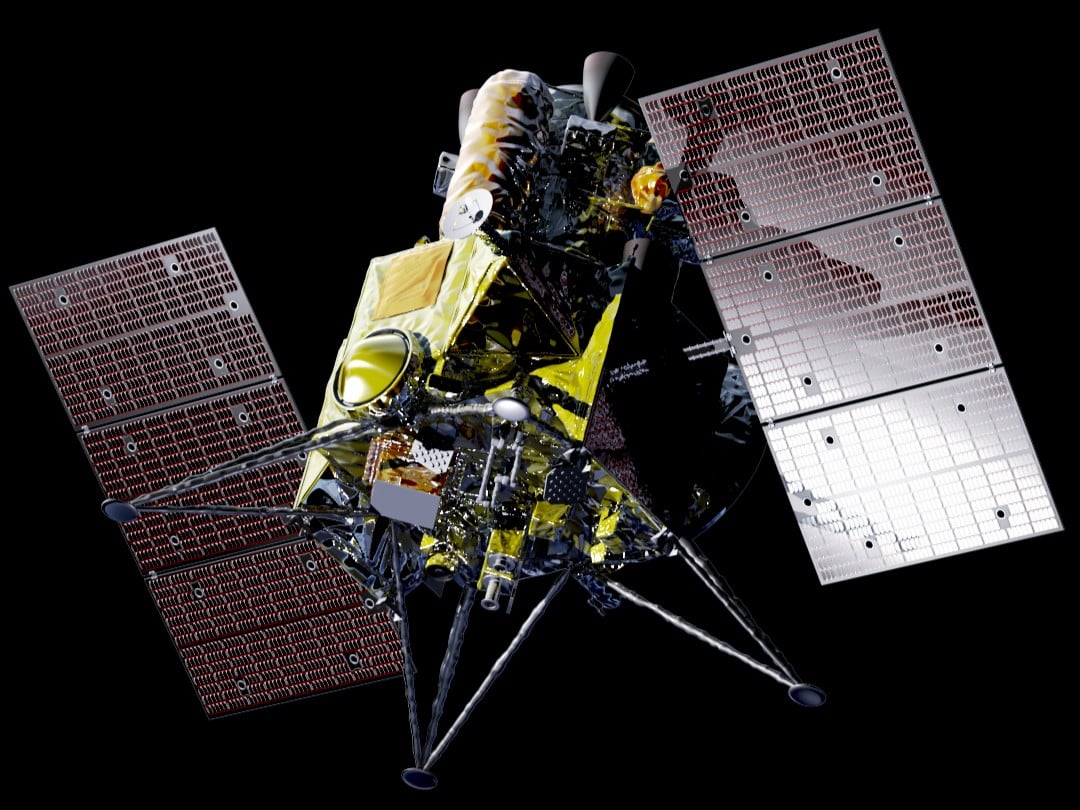
Japan is about to begin one of planetary science’s most ambitious retrieval missions: the Martian Moons eXploration, or MMX, spacecraft is scheduled to launch aboard an H3 rocket and bring material from Phobos back to Earth. The launch is targeted for 4:41 a.m. Japan time on October 20, 2026, from Tanegashima Space Center, with the spacecraft expected to reach the Martian system in August 2027. Phys.org first reported the historic mission’s impending launch.
MMX will spend roughly three years operating in the Martian neighborhood, studying both Phobos and Deimos while focusing its sample-collection efforts on Phobos. The spacecraft is designed to enter a quasi-satellite orbit around Phobos, a small, irregularly shaped moon whose origin remains uncertain. Scientists will use measurements of the moons’ surfaces, interiors, gravity, and composition to investigate whether they are captured asteroids or remnants produced by an ancient impact on Mars.
The mission’s centerpiece is a landing and collection operation planned for 2030. MMX is intended to gather at least 10 grams of material, using sampling hardware that can collect loose surface particles as well as material from below the immediate surface. The sample will be sealed inside a dedicated return capsule, which is expected to reenter Earth’s atmosphere and land in Australia in 2031 before the material is transferred to Japan for cataloging and distribution to researchers.
That timetable gives MMX significance well beyond Japan’s space program. It would become the first mission to return samples from a Martian moon and the first spacecraft to collect material from the surface of any moon other than Earth’s. NASA is contributing scientific and technical support, while France’s CNES, Germany’s DLR, and the European Space Agency are also participating in the international project. NASA says its own contribution includes the P-Sampler, a device mounted on a landing leg to help gather ground material.
Phobos is an especially valuable target because its low gravity makes operations both possible and perilous: a spacecraft must carefully manage its approach, landing, ascent, and eventual departure. MMX will also carry a rover intended to operate on the moon’s surface, adding close-up observations to the spacecraft’s orbital survey. The combined data could help researchers understand how Mars and its moons formed—and improve planning for future robotic or crewed missions in the Martian system.
The immediate milestone is launch, but the scientific payoff lies years ahead. After the H3 flight, MMX must navigate to Mars, conduct its survey, land safely on Phobos, preserve the samples, and complete the return journey. If those steps succeed, laboratories on Earth will finally have pristine Phobos material to analyze, turning one of Mars’s mysterious companions into a physical archive of the Red Planet’s history.
Image Credits
In-Article Image Credits
AXA's explorer MMX. CG on 2019. Rotated and clopped from original via Wikimedia Commons by Government of Japan with usage type - Creative Commons LicenseFeatured Image Credit
AXA's explorer MMX. CG on 2019. Rotated and clopped from original via Wikimedia Commons by Government of Japan with usage type - Creative Commons License


