
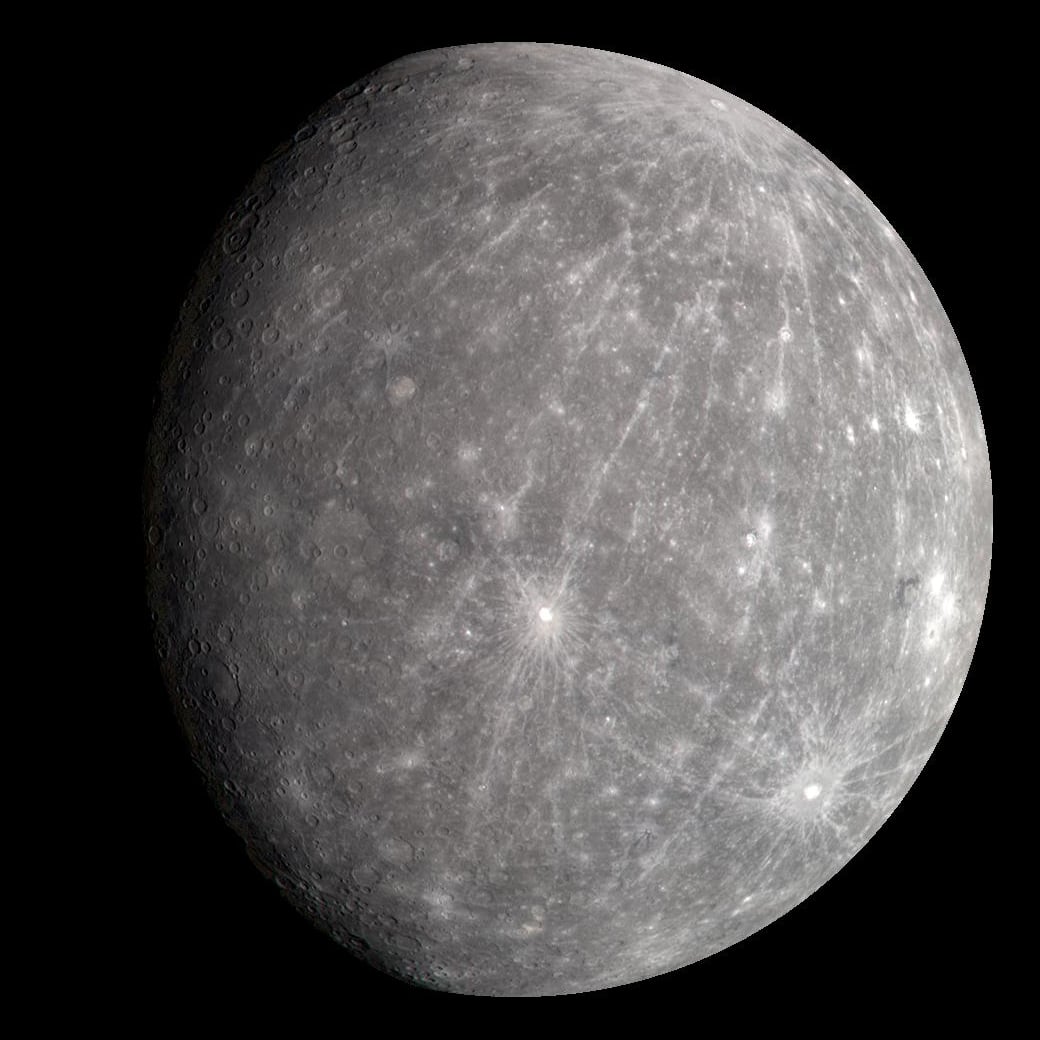
Mercury is about to get its most detailed examination yet, but the innermost planet still has one frustrating limitation: nobody has landed there. As Phys.org reports, scientists believe Mercury’s strangest questions may remain unresolved until a future mission can touch down, analyze the surface directly, and survive long enough to send the results home.
The problem begins with Mercury’s location. The planet orbits an average of less than 60 million kilometers from the Sun, placing spacecraft deep inside the star’s gravitational well. Reaching Mercury requires a probe to shed tremendous velocity before it can settle into orbit; the required change in velocity is roughly 18.5 kilometers per second. The Sun’s heat and radiation then create another set of engineering problems for hardware that must operate close to the star. The European Space Agency describes Mercury as both difficult to reach and unusually harsh for spacecraft.
Humanity has only sent two successful missions to Mercury so far. NASA’s MESSENGER became the first spacecraft to orbit the planet, mapping its surface and studying its magnetic field before the mission ended in 2015. The next major step is BepiColombo, a joint ESA and Japan Aerospace Exploration Agency project launched in 2018. Its two orbiters are designed to examine Mercury’s surface, interior, exosphere, magnetic environment, and history from complementary vantage points. ESA says BepiColombo is scheduled to arrive in late 2026, while JAXA lists November 2026 for arrival.
BepiColombo should dramatically improve the planetary data available to researchers, but orbiters have an unavoidable blind spot: they cannot scoop up a rock, measure its chemistry at arm’s length, or probe the ground beneath their landing site. A NASA-backed white paper on landed Mercury exploration notes that orbital observations cannot directly sample surface materials or investigate the interior in the same way a landed mission could. Instruments on a lander could perform in-situ mineralogical and geochemical measurements, helping determine how Mercury formed and why its metal core is so disproportionately large. NASA’s report also identifies the enormous launch energy and relative velocity as major obstacles to such a mission.
That makes a Mercury lander less a routine follow-up than a major leap in planetary engineering. The spacecraft would need to brake into the planet’s vicinity, descend through an environment exposed to intense sunlight, and keep its electronics and instruments within operating limits on a world known for extreme temperature swings. It would also need to return useful data before the mission’s power, communications, or thermal systems failed.
For now, BepiColombo is the essential bridge between MESSENGER’s discoveries and that more ambitious future. Its orbiters can refine maps, composition measurements, magnetic-field data, and models of Mercury’s interior, potentially revealing which questions are most worth answering on the ground. But as ESA’s mission history makes clear, even the most capable orbital survey cannot replace contact with the surface. Mercury may soon be less mysterious, but a lander is still the mission that could finally turn its remaining puzzles into measurements.
Image Credits
In-Article Image Credits
Mercury in true color: four image mosaic PIA11364: Mercury's "True" Color is in the Eye of the Beholder via Wikimedia Commons by NASA with usage type - Public Domain. By NASA/Johns Hopkins University Applied Physics Laboratory/Arizona State University/Carnegie Institution of Washington - https://photojournal.jpl.nasa.gov/catalog/PIA11364, Public Domain, https://commons.wikimedia.org/w/index.php?curid=83618472Featured Image Credit
Mercury in true color: four image mosaic PIA11364: Mercury's "True" Color is in the Eye of the Beholder via Wikimedia Commons by NASA with usage type - Public Domain. By NASA/Johns Hopkins University Applied Physics Laboratory/Arizona State University/Carnegie Institution of Washington - https://photojournal.jpl.nasa.gov/catalog/PIA11364, Public Domain, https://commons.wikimedia.org/w/index.php?curid=83618472


