
Halley’s Comet will not return to the inner solar system until 2061, but Earth is about to pass through the debris it left behind. The Orionid meteor shower peaks overnight October 21–22, offering skywatchers a chance to see fragments of the famous comet burn up above them.
NASA lists the Orionids as active from October 2 through November 7, with dark-sky observers potentially seeing roughly 10 to 20 meteors per hour at the shower’s maximum. The meteors are exceptionally quick, entering Earth’s atmosphere at about 41 miles per second, or 66 kilometers per second. That speed can produce bright flashes, fireballs, and glowing trails that linger after the meteor itself has vanished.
The source of the display is comet 1P/Halley. Each time the comet swings through the warmer inner solar system, sunlight drives material from its nucleus, leaving ice, dust, and rocky particles scattered along its orbit. Earth intersects that stream twice: the Orionids arrive in October, while the Eta Aquariids appear in May. Halley’s roughly 76-year orbit brought it past Earth in 1986 and will carry it back through the inner solar system in 2061.
This year’s moonlight will make the shower more challenging than usual. The waxing gibbous Moon will wash out many of the fainter streaks during the evening and early overnight hours, but it is expected to set in the early morning. NASA’s October skywatching guide recommends looking during the final hours before dawn, after moonset, when the sky is darkest.
The meteors only appear to radiate from Orion, near the bright star Betelgeuse; that constellation is a useful landmark, not the physical origin of the particles. In fact, viewers should avoid staring directly at the radiant. Looking 45 to 90 degrees away gives the meteors longer, more dramatic paths across the sky, according to NASA’s observing guidance.
For the best chance of seeing the show, find a location far from city lights, give your eyes time to adjust, and scan a broad section of sky with the naked eye. Binoculars and telescopes are unnecessary—and can actually limit the amount of sky visible. Even with the Moon interfering, the Orionids remain one of the year’s most recognizable reminders that a comet last seen by human observers four decades ago is still crossing our skies.
Image Credits
In-Article Image Credits
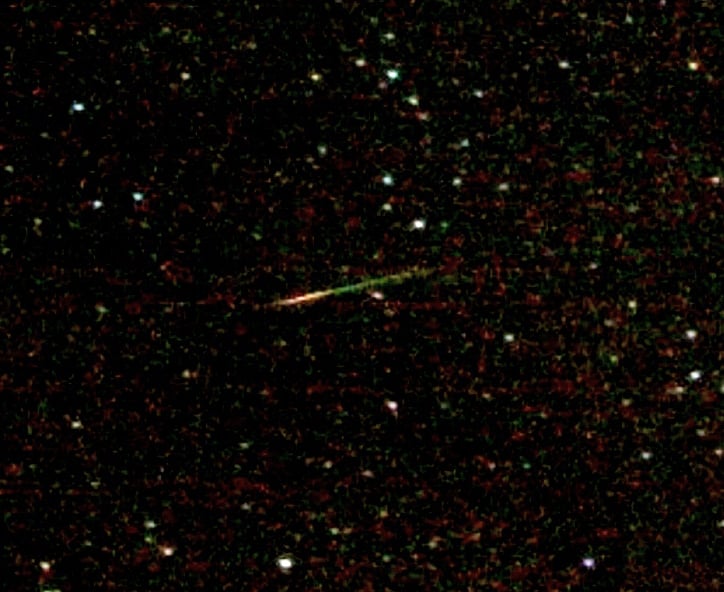
A green and red Orionid meteor via Wikimedia Commons by Brocken Inaglory with usage type - Creative Commons License. By Brocken Inaglory, CC BY-SA 3.0, https://commons.wikimedia.org/w/index.php?curid=17776232Featured Image Credit
A green and red Orionid meteor via Wikimedia Commons by Brocken Inaglory with usage type - Creative Commons License. By Brocken Inaglory, CC BY-SA 3.0, https://commons.wikimedia.org/w/index.php?curid=17776232


