
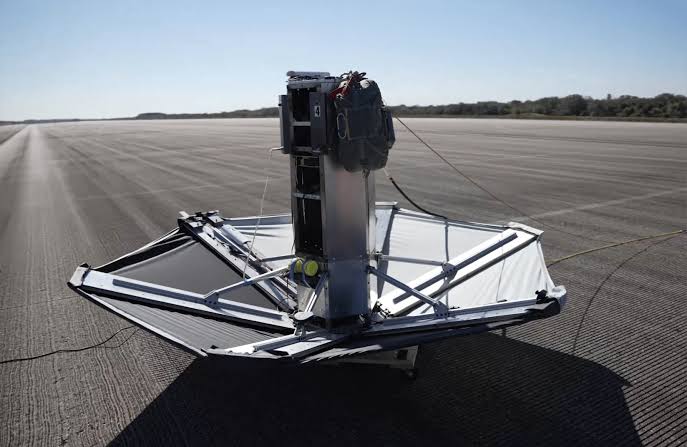
Orbital supply drops that feel ripped straight from a StarCraft II match just took a tangible step toward reality, thanks to Sierra Space’s latest tests of its Ghost reentry vehicle for the U.S. military. The compact cargo pod is being developed to sit parked in orbit for years and then slam back through the atmosphere on demand, delivering up to roughly 5–10 tons of critical gear to almost any point on Earth within about 90 minutes.
As first detailed by outlets including Tom’s Hardware and Aviation Week, Sierra Space recently ran two new drop tests of Ghost during U.S. Space Command’s Apollo Nexus training exercise at Dugway Proving Ground in Utah. Instead of launching from orbit, the team used high-altitude balloons to release the test article from about 35,000 and 68,500 feet, simulating the brutal final leg of an orbital delivery and giving engineers real-world data on descent, impact, and recovery. In a bit of engineering whimsy, the payload was a bottle of whiskey and a software-defined radio, chosen specifically to prove that both liquids and sensitive electronics could survive the trip and be quickly recovered by ground teams.
These trials marked Ghost’s first live exercises in nearly two years and build on an earlier campaign in Florida, where Sierra Space dropped multiple test articles from a helicopter at altitudes up to around 5,000 feet. Those earlier runs included a bare, parachute-less terminal drop to map impact forces, a parachute-assisted descent to nail down flight dynamics and landing precision, and a test that separated the heat-shield section from the payload midair to validate the system’s ability to shed protective hardware and still deliver cargo intact. Taken together, the Florida helicopter drops and the Utah balloon releases form an incremental ladder of risk on the path to full orbital reentry tests.
Ghost itself is described as a low-beta reentry vehicle built around a deployable decelerator system, essentially a high-tech, inflatable braking shield meant to slow the pod without relying on massive traditional heat shields or wings. Sierra Space says it was able to move Ghost from development into flight testing in roughly 90 days, using its Axelerator rapid-prototyping approach—a pace that fits neatly with the Pentagon’s appetite for fast, iterative hardware in contested domains. The pod’s cargo capacity is modest by traditional cargo aircraft standards, but still significant, targeting on the order of several tons for items like ammunition, drones, electronics, medical gear, or counter-drone systems rather than heavy armor or artillery pieces.
Conceptually, Ghost is part of a broader U.S. push to treat space as a logistics node, not just a vantage point, echoing how the military already prepositions supply ships in places like Guam or Diego Garcia for rapid deployment. Under overlapping efforts such as the Air and Space Forces’ Point-to-Point Delivery and Rocket Cargo initiatives, multiple firms—including Sierra Space, SpaceX, Blue Origin, Inversion Space, Outpost, Rocket Lab, and Anduril—are exploring ways to move materiel globally via orbital or near-orbital trajectories. Sierra Space’s angle is less about massive rocket-borne cargo planes and more about small, comparatively low-cost reentry capsules that can quietly loiter in orbit for up to five years and then be “called down” when a commander needs supplies in a denied or contested region.
Sierra Space executives have leaned into the sci-fi parallels, likening Ghost’s envisioned role to StarCraft II’s orbital supply depots: prepositioned assets that drop from the sky on demand when a player—or in this case, a warfighter—hits the proverbial button. For troops cut off from traditional airlift, the appeal is obvious; in areas where sending a C-17 or C-130 would be too dangerous, a small, hard-to-intercept pod streaking in from orbit could provide ammunition, communications gear, or spare parts without putting aircrews at risk. Engineers and outside analysts also note clear potential for non-combat missions, from disaster relief in regions where infrastructure is wrecked to emergency delivery of medical supplies, provided the system can be certified and costed for broader use.
Despite the hype, Ghost is still at the proving-grounds stage rather than full operational readiness. The recent balloon drops exercised only portions of the profile and did not replicate the intense thermal loads, vacuum environment, and high-G forces of true orbital reentry. Future tests will need to demonstrate that the deployable decelerator can survive and perform under those conditions while guiding the pod to precise coordinates on the ground—no easy task when you’re screaming through the atmosphere at orbital speeds. Still, with multiple successful high-altitude tests now logged and a growing constellation of U.S. space logistics programs pushing in the same direction, Ghost has moved from concept art to flying hardware, and the age of real-world “supply drops from orbit” looks less like game fiction and more like an emerging, if still experimental, logistics reality.
Image Credits
In-Article Image Credits
Sierra Space Ghost: Revolutionizing Global Logistics via Sierra Space with usage type - Product photo (Fair Use)Featured Image Credit
Sierra Space Ghost: Revolutionizing Global Logistics via Sierra Space with usage type - Product photo (Fair Use)


