
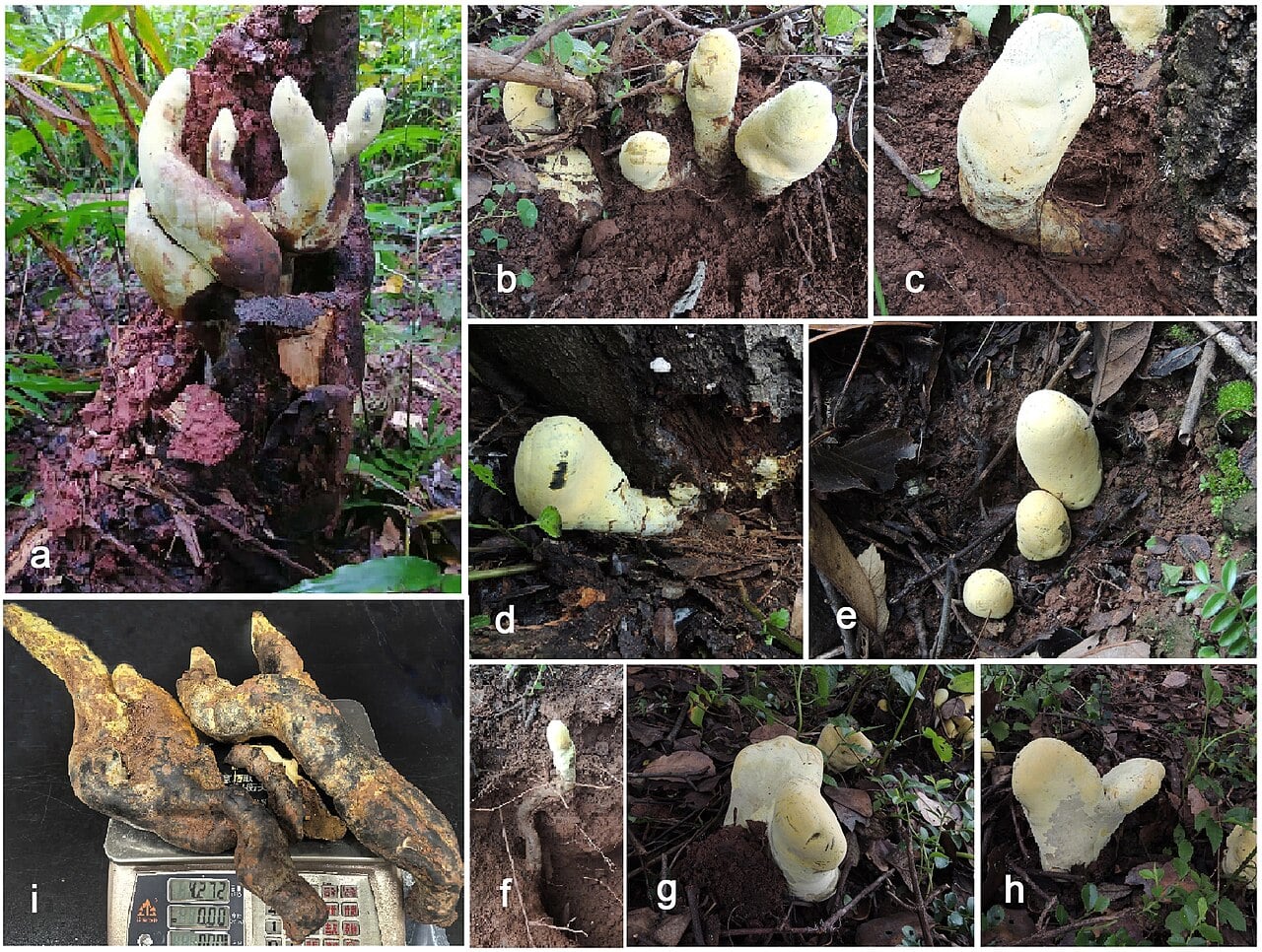
Move over, Tyrannosaurus rex: Yunnan has produced a different kind of giant. Chinese researchers have identified Dianjunus rex, a towering fungus whose reproductive structures can reach 50 centimeters (nearly 20 inches) and weigh as much as 2.2 kilograms (4.9 pounds). The new giant fungus and its remarkably ancient lineage are turning an obscure corner of mycology into a genuinely prehistoric mystery.
The discovery came during fungal surveys conducted in 2024 and 2025 across southwestern China’s Yunnan Province. Scientists from the Kunming Institute of Botany found the pale, upright structures in several habitats, including temperate conifer forests near Damaidi and Yipinglang and tropical rainforest near Nanbang. The specimens grew from the woody roots of dying plants, a clue that this enormous-looking organism belongs to a group of fungi involved in breaking down dead wood.
What makes D-rex especially significant is not simply its size. Genetic analysis and detailed examination of its anatomy showed that the fungus could not comfortably fit into an existing genus or family. The researchers therefore established both the genus Dianjunus and the family Dianjunaceae, placing them within the order Xylariales. The peer-reviewed study, published in Frontiers in Fungal Biology, describes D-rex as the type species of this previously unknown family.
The nickname has a double meaning. “Rex” gestures toward the dinosaur king because of the fungus’s imposing proportions, while Dianjunus references the ancient Dian kingdom associated with the Yunnan region. Its formal classification is even more dramatic than the nickname: the study’s phylogenetic analysis places Dianjunaceae as a distinct sister lineage to Graphostromataceae, rather than as a mere oversized member of a familiar fungal group.
Researchers used a molecular-clock analysis to estimate that the family split from related fungi around 65 million years ago—roughly the Paleocene, soon after the Cretaceous-Paleogene mass extinction. That timing does not prove the dinosaur catastrophe created D-rex, but it raises a compelling possibility: the ecological upheaval that followed the extinction may have opened new opportunities for wood-decomposing fungi. The proposed age also illustrates why evolutionary dates should be read as estimates, not as a fossil timestamp attached directly to the living specimens.
For now, D-rex is known from a limited number of Yunnan locations and remains the sole described species in Dianjunaceae. Its discovery is a reminder that “giant” in biology does not always mean a new animal or plant: fungi can hide most of their bodies underground, while their temporary fruiting structures turn an otherwise invisible organism into something spectacular. Further collecting and DNA sampling may reveal whether D-rex is genuinely rare, restricted to a narrow ecological niche, or simply the first conspicuous member of a much larger ancient lineage.
Image Credits
In-Article Image Credits
stromata of Dianjunus rex via Wikimedia Commons by Song, Jing; Yan, Zhuyue; Pérez-Moreno, Jesús; Zhang, Fengming; Yang, Shimei; Xie, Tao; Su, Luofeng; Liu, Jianwei; Wang, Yanliang; Liu, Dong; Yang, Zhenyan; Yang, Chengmo; Liu, Wei; Shi, Xiaofei; Wan, Shanping; Cheewangkoon, Ratchadawan; Dai, Dongqin; Senanayake, Indunil C.; Yu, Fuqiang with usage type - Creative Commons License. By Song, Jing; Yan, Zhuyue; Pérez-Moreno, Jesús; Zhang, Fengming; Yang, Shimei; Xie, Tao; Su, Luofeng; Liu, Jianwei; Wang, Yanliang; Liu, Dong; Yang, Zhenyan; Yang, Chengmo; Liu, Wei; Shi, Xiaofei; Wan, Shanping; Cheewangkoon, Ratchadawan; Dai, Dongqin; Senanayake, Indunil C.; Yu, Fuqiang - (2026-09-29). "Unearthing a fungal giant: Dianjunaceae fam. nov., a novel Paleocene lineage of Xylariales harboring Dianjunus rex gen. et sp. nov". Frontiers in Fungal Biology 7. DOI:10.3389/ffunb.2026.1940464. PMID 42871054. ISSN 2673-6128., CC BY 4.0, https://commons.wikimedia.org/w/index.php?curid=202159162Featured Image Credit
stromata of Dianjunus rex via Wikimedia Commons by Song, Jing; Yan, Zhuyue; Pérez-Moreno, Jesús; Zhang, Fengming; Yang, Shimei; Xie, Tao; Su, Luofeng; Liu, Jianwei; Wang, Yanliang; Liu, Dong; Yang, Zhenyan; Yang, Chengmo; Liu, Wei; Shi, Xiaofei; Wan, Shanping; Cheewangkoon, Ratchadawan; Dai, Dongqin; Senanayake, Indunil C.; Yu, Fuqiang with usage type - Creative Commons License. By Song, Jing; Yan, Zhuyue; Pérez-Moreno, Jesús; Zhang, Fengming; Yang, Shimei; Xie, Tao; Su, Luofeng; Liu, Jianwei; Wang, Yanliang; Liu, Dong; Yang, Zhenyan; Yang, Chengmo; Liu, Wei; Shi, Xiaofei; Wan, Shanping; Cheewangkoon, Ratchadawan; Dai, Dongqin; Senanayake, Indunil C.; Yu, Fuqiang - (2026-09-29). "Unearthing a fungal giant: Dianjunaceae fam. nov., a novel Paleocene lineage of Xylariales harboring Dianjunus rex gen. et sp. nov". Frontiers in Fungal Biology 7. DOI:10.3389/ffunb.2026.1940464. PMID 42871054. ISSN 2673-6128., CC BY 4.0, https://commons.wikimedia.org/w/index.php?curid=202159162


