
Mammalian fur may look engineered, but its patterning could be far more improvisational. A new study from the University of Geneva argues that hair follicles emerge as mobile cells in developing skin follow chemical cues, offering a simpler explanation for how hair knows where to grow.
The work focuses on chemotaxis: the directed movement of cells toward or away from a chemical signal. During embryonic development, dermal cells move toward an attractant released by the epidermis, the skin’s outer layer. Their gathering creates placodes, the early structures that later develop into hair follicles. Rather than requiring every follicle’s position to be individually prescribed, the pattern can arise from local interactions that repeat across the growing skin.
Researchers led by the University of Geneva’s Michel Milinkovitch laboratory built a mathematical model combining cell movement, chemical signaling and tissue expansion. The simulations reproduced follicle formation in laboratory mice and also captured the unusually orderly arrangement seen in the spiny mouse. The university’s summary of the research says the study appeared in Proceedings of the National Academy of Sciences under the title Chemotactic self-organization captures the dynamics of mammalian hair follicle patterning.
That cross-species result matters because the two animals do not display identical fur architecture. The model suggests their differences can emerge from changes in cellular behavior, chemical properties and the direction or rate of skin growth, rather than from wholly separate developmental programs. In the spiny mouse, anisotropic chemotaxis—cell movement that varies by direction—helps account for the follicles’ long-range order and orientation.
The findings challenge an older “expansion-induction” view, in which an existing follicle pattern spreads through the tissue and neighboring follicles are excluded by inhibitory effects. The Geneva team instead proposes that chemotactic self-organization can generate the spacing rules that made the older theory seem necessary in the first place. In plain terms, a complex biological arrangement may be the consequence of many simple local decisions rather than a microscopic blueprint specifying every final position.
This does not immediately translate into a cure for hair loss, and the study does not claim that every aspect of follicle development has been solved. Its importance is more fundamental: the same kind of pattern-forming logic may help explain how other skin structures, including scales and feathers, organize themselves. The next step is testing how the signaling machinery behaves in more species and determining which molecular changes produce different coat textures, densities and orientations.
Image Credits
In-Article Image Credits
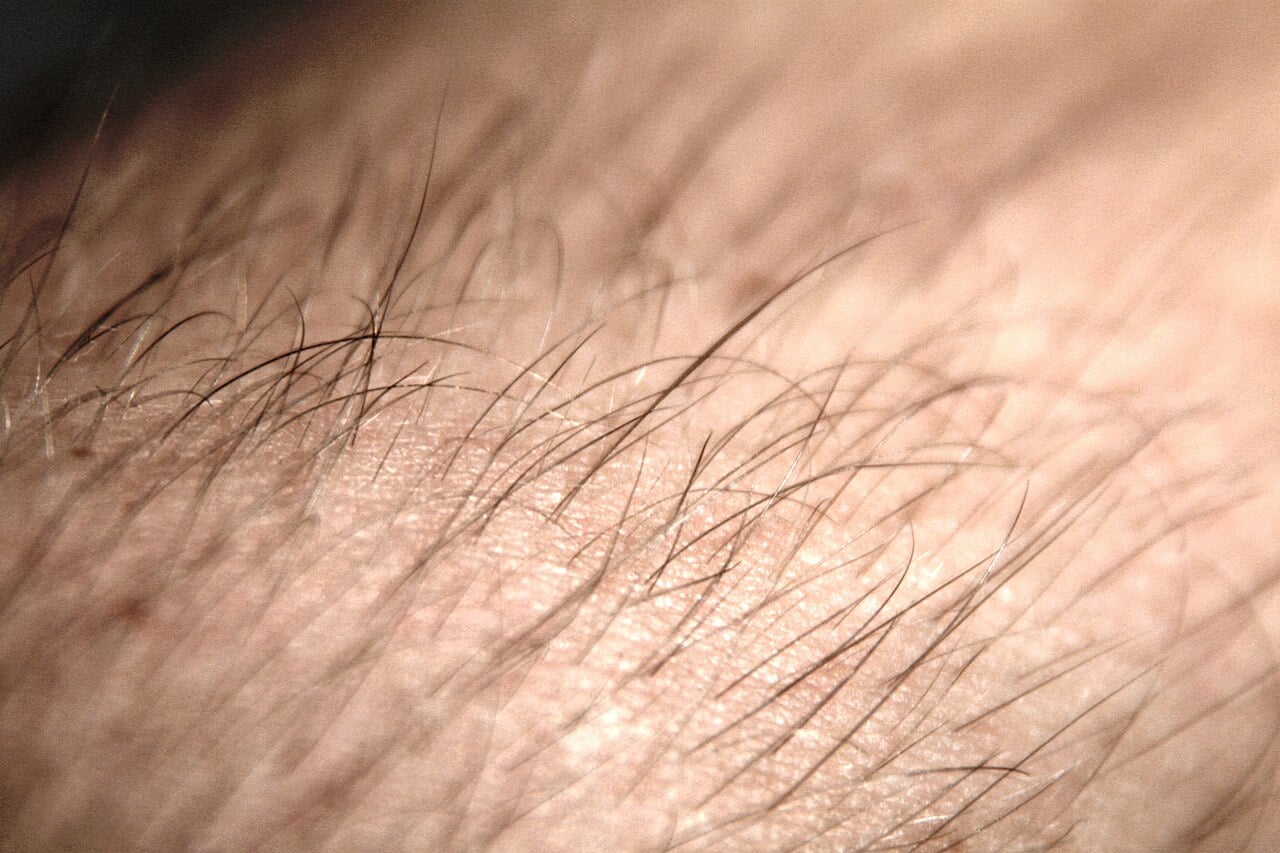
Arm hair on a male human via Wikimedia Commons by Zephyris with usage type - Creative Commons License. By Zephyris - Own work, CC BY-SA 3.0, https://commons.wikimedia.org/w/index.php?curid=10785727Featured Image Credit
Arm hair on a male human via Wikimedia Commons by Zephyris with usage type - Creative Commons License. By Zephyris - Own work, CC BY-SA 3.0, https://commons.wikimedia.org/w/index.php?curid=10785727


