
Low-dose aspirin may have a sharply different effect on dementia depending on a person’s genetics—but the potentially protective signal comes with a serious trade-off. In a new analysis of older adults, aspirin was associated with approximately 70% lower relative dementia risk among participants with genetic profiles linked to higher platelet counts.
The finding emerged from genetic data involving more than 13,500 participants in the ASPREE trial, the large randomized study that compared daily 100-milligram aspirin with a placebo in generally healthy older adults. Researchers screened thousands of polygenic risk scores to see whether inherited biology changed aspirin’s effects on dementia or major bleeding. The strongest signal appeared in the 20% of participants with the highest platelet-count genetic scores.
Within that subgroup, dementia developed in about 1% of people assigned to aspirin, compared with 3.3% of those assigned to placebo. That works out to a hazard ratio of 0.28, or roughly a 70% relative reduction. The absolute difference was much smaller—about 23 fewer dementia cases per 1,000 people—and the analysis was conducted after the original trial, meaning the result needs confirmation in a study designed specifically to test it.
The same genetic group also experienced substantially more major bleeding. Such events occurred in 4.4% of aspirin recipients, compared with 2.1% in the placebo group. That risk is consistent with ASPREE’s broader lesson: among healthy older adults without previous cardiovascular disease, daily aspirin did not extend life free of dementia or disability and increased clinically significant bleeding.
Platelets help blood clot, so the result offers a plausible biological direction for future research: aspirin’s anti-platelet action might matter more in people whose inherited biology affects platelet production or behavior. The association did not appear to be explained by APOE, one of the best-known genetic factors linked to Alzheimer’s disease, suggesting that platelet biology may represent a separate pathway rather than another conventional Alzheimer’s risk marker.
For now, the study is better viewed as a clue than a prescription. It does not establish that people should begin taking aspirin to prevent dementia, particularly because the apparent benefit and bleeding hazard occurred together. Any decision about aspirin should account for cardiovascular history, ulcer and bleeding risk, other medications, and a clinician’s advice; the next step is prospective research to determine whether platelet-related genetic testing can reliably identify people for whom the balance of benefit and harm is favorable.
Image Credits
In-Article Image Credits
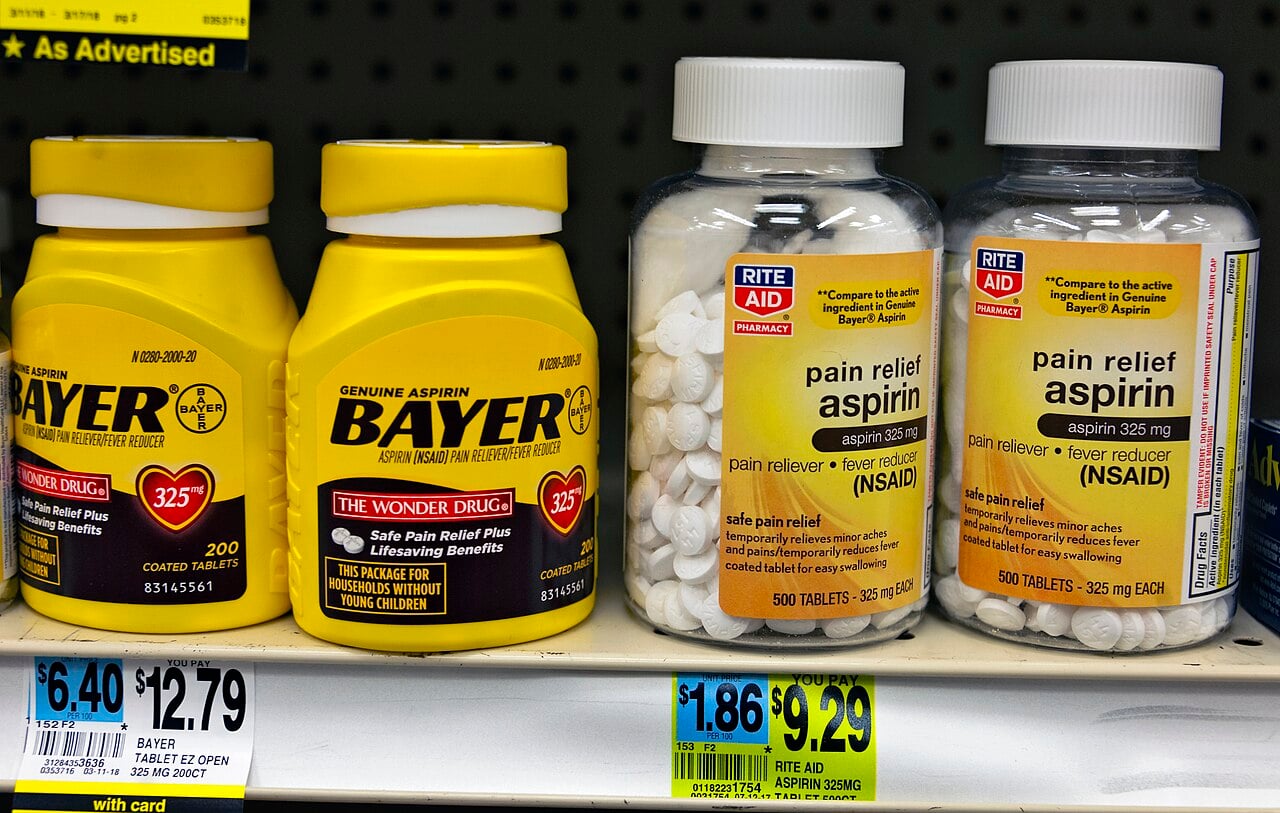
Bottles of Aspirin, made by Bayer and Rite Aid, side-by-side on a store shelf in Montgomery, NY, USA. Both manufacturers may use the brand name generically since aspirin is not a protected trademark in the U.S. via Wikimedia Commons by Daniel Case with usage type - GNU Free. By Daniel Case - Own work, CC BY-SA 3.0, https://commons.wikimedia.org/w/index.php?curid=75270738Featured Image Credit
Bottles of Aspirin, made by Bayer and Rite Aid, side-by-side on a store shelf in Montgomery, NY, USA. Both manufacturers may use the brand name generically since aspirin is not a protected trademark in the U.S. via Wikimedia Commons by Daniel Case with usage type - GNU Free. By Daniel Case - Own work, CC BY-SA 3.0, https://commons.wikimedia.org/w/index.php?curid=75270738


