
CBN has become a popular shortcut to a better night’s sleep, but new research suggests the cannabis compound deserves more scrutiny before it is treated like a harmless herbal supplement. In experiments from the University of Connecticut, repeated cannabinol exposure produced tolerance and physical-dependence warning signs in mice. The findings raise concerns about CBN’s potential risks even as its long-term effects in people remain unclear.
Researchers administered CBN to mice twice a day over several days and then measured how strongly the animals responded to the compound. Its effects weakened with repeated dosing, a classic sign of tolerance. When the researchers interrupted the exposure—or used a cannabinoid-receptor blocker—the animals displayed behaviors including head twitching and paw fluttering associated with physical withdrawal.
The study, led by Olivia Vanegas with UConn professor Steven Kinsey, appears in Drug and Alcohol Dependence. The team also found that CBN could substitute for THC in an established mouse test, suggesting that the supposedly milder cannabinoid activates some of the same biological pathways. That does not mean CBN produces the same subjective experience in humans, but it complicates marketing that presents the ingredient as fundamentally risk-free.
CBN, or cannabinol, occurs naturally in cannabis alongside THC and CBD. It is frequently sold in gummies, tinctures, and capsules promoted for sleep, despite limited evidence about whether it improves sleep quality or how repeated use affects the body. UConn researchers additionally observed anti-inflammatory activity at lower, non-psychoactive doses, while warning that one immune-response test suggested CBN could weaken the body’s defense during a simulated bacterial challenge.
The most important limitation is also the simplest: these were mouse experiments, not a clinical trial. The dosing schedule and biological responses cannot be directly translated into the amount of CBN in a particular gummy, and the study does not establish that people who use CBN will develop dependence or experience withdrawal. Human research will be needed to determine whether the compound’s effects differ by dose, formulation, frequency, or individual health factors.
For consumers, the result is less a declaration that every CBN product is dangerous than a warning against assuming that “natural” means consequence-free. Until researchers know more about sustained use, product dosing, and the quality of CBN-induced sleep, the new evidence gives regulators and manufacturers another reason to distinguish promotional claims from demonstrated benefits.
Image Credits
In-Article Image Credits
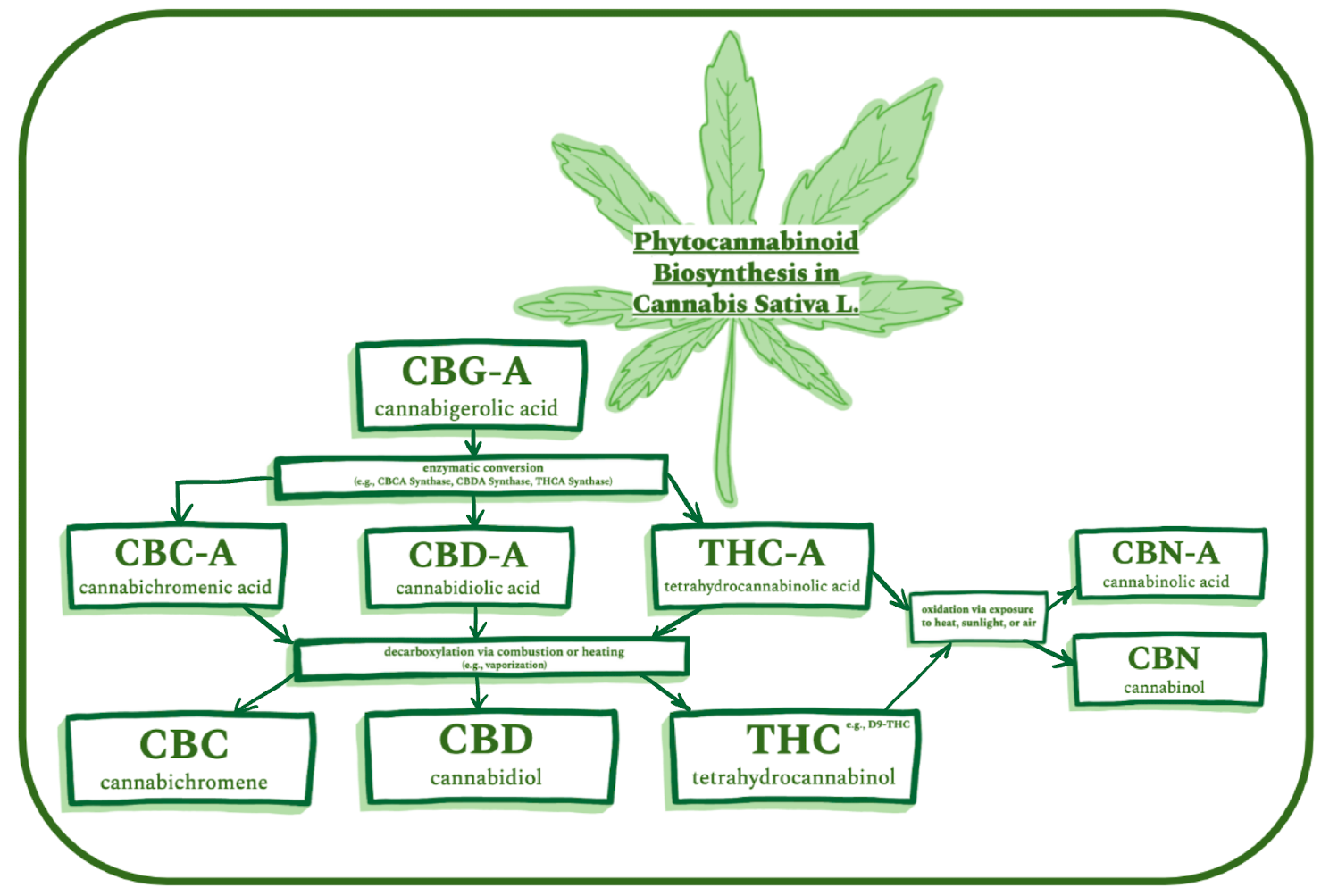
This diagram represents the biosynthetic and metabolic pathways by which phytocannabinoids (e.g., CBD, THC, CBN) are created in the cannabis plant. Starting with CBG-A, the acidic forms of certain phytocannabinoids are generated via enzymatic conversion. From there, decarboxylation (i.e., combustion or heat) yields the most well-known metabolites present in the cannabis plant. CBN is unique in that it does not arise from a pre-existing acidic form, but rather is generated through the oxidation of THC. via Wikimedia Commons with usage type - Creative Commons License. By Mkf pm801 - Own work, CC BY-SA 4.0, https://commons.wikimedia.org/w/index.php?curid=125743704Featured Image Credit
This diagram represents the biosynthetic and metabolic pathways by which phytocannabinoids (e.g., CBD, THC, CBN) are created in the cannabis plant. Starting with CBG-A, the acidic forms of certain phytocannabinoids are generated via enzymatic conversion. From there, decarboxylation (i.e., combustion or heat) yields the most well-known metabolites present in the cannabis plant. CBN is unique in that it does not arise from a pre-existing acidic form, but rather is generated through the oxidation of THC. via Wikimedia Commons with usage type - Creative Commons License. By Mkf pm801 - Own work, CC BY-SA 4.0, https://commons.wikimedia.org/w/index.php?curid=125743704


