
In a move that sounds straight out of eco-sci-fi, researchers at Murdoch University’s Bioplastics Innovation Hub are using artificial intelligence to trawl through millions of naturally evolved enzymes in search of the perfect molecular tools to break down plastic and other stubborn pollutants. Instead of engineering fantasy “super-enzymes” from scratch, the team is betting that nature has already written most of the code—they just need machine learning to decode which existing proteins can be deployed against today’s waste stream.
The project, first detailed in a recent report on pollution-fighting enzymes, hinges on massive global databases that catalogue enzyme sequences and structures from bacteria, fungi and other microbes collected over decades of biological research. Scientists at the Hub are building machine-learning pipelines that train on previously characterized enzymes so they can predict how a given protein’s 3D structure will interact with target pollutants like plastics and industrial chemicals, and whether it’s likely to chop those molecules into safer pieces. Lead researcher Mina Boctor argues that “overengineering” ignores millions of years of evolution that have already produced promising candidates, and that AI is best used as a searchlight—mining unexplored biological data to flag enzymes that are worth bringing into the lab for real-world testing.
This AI-driven hunt for enzymes plugs directly into the Bioplastics Innovation Hub’s broader mission to end plastic waste by redesigning both materials and cleanup tools. The Hub is a collaboration between Murdoch University, Australia’s national science agency CSIRO, and industry partners, set up to develop compostable bioplastics that break down cleanly in land, water or industrial compost, while also investigating how existing plastics degrade and what that does to ecosystems. Murdoch’s own coverage of the program notes that conventional fossil-fuel plastics can linger for centuries—sometimes up to a thousand years—without meaningful breakdown, which is why researchers there are exploring “safe and useful” ways to degrade those materials and potentially repurpose the byproducts. Under the leadership of Professor Daniel Murphy, the Hub’s team is now channeling much of its energy into validating AI-identified enzymes in the lab and figuring out how to scale any success stories into industrial bioremediation and recycling processes.
If this feels like the opening act of a planet-wide cleanup montage, that’s because the Murdoch work fits into a growing wave of AI-meets-biology projects aimed at turning microbes into precision pollution-fighters. At a recent Ending Plastic Waste symposium, CSIRO and Murdoch scientists highlighted how data mining high-temperature microorganisms had already uncovered novel bioplastic-degrading enzymes with impressive thermal stability, ideal for industrial reactors that need to run hot without denaturing their molecular tools. Classic examples like PETase from Ideonella sakaiensis—an enzyme that can attack polyethylene terephthalate (PET)—and Lip1 from Pseudomonas chlororaphis, which chews through several bioplastics, have already been improved using a mix of ancestral sequence reconstruction, AI-guided modeling and rational protein engineering to boost activity and thermostability. Recent research using protein “language models” and generative AI has further shown that machine learning can sift through thousands of enzyme sequences to pick out candidates that likely target PET, PLA and nylon, and even design new PET-degrading enzymes in silico before any wet-lab work begins.
Murdoch’s approach also echoes tools like XenoBug, a machine-learning framework developed by Vineet K. Sharma and colleagues to predict which bacterial enzymes can tackle a wide range of xenobiotics—everything from pesticides and petroleum byproducts to plastics and pharmaceutical residues—by training on more than 3 million enzyme sequences and over 140,000 biochemical reactions. XenoBug can take a single pollutant as input and output likely enzymes, reactions and microbial species capable of transforming or degrading it, effectively turning metagenomic data into a searchable index of potential bioremediation strategies. In parallel, other teams have introduced models such as ToxZyme, an ensemble system that uses Random Forest and deep neural networks to classify enzymes by their toxin-degrading ability with reported precision of around 95 percent, underscoring how AI classifiers can rapidly narrow vast enzyme universes down to a shortlist of plausible detox candidates. Together, these efforts sketch a near-future where environmental scientists use AI dashboards to select off-the-shelf or lightly engineered enzymes tailored to specific contamination scenarios.
For now, the Bioplastics Innovation Hub is focused on the less flashy but absolutely crucial work of proving that AI-selected enzymes actually perform under real-world conditions—inside reactors, soil, waterways and complex waste streams—and then figuring out how to deploy them at scale. If they succeed, the payoff isn’t just cleaner beaches or slightly greener packaging; it’s the foundation for circular systems where plastics are chemically recycled by enzymes into reusable feedstocks instead of lingering as microplastic smog. It’s the kind of “bio-hacking the planet” storyline geek culture has been riffing on for years, from nanobot scrubbers in cyberpunk futures to self-healing ecosystems in eco-fantasy sagas—only this time the protagonists are AI models and microbes quietly co-starring in the battle against pollution.
Image Credits
In-Article Image Credits
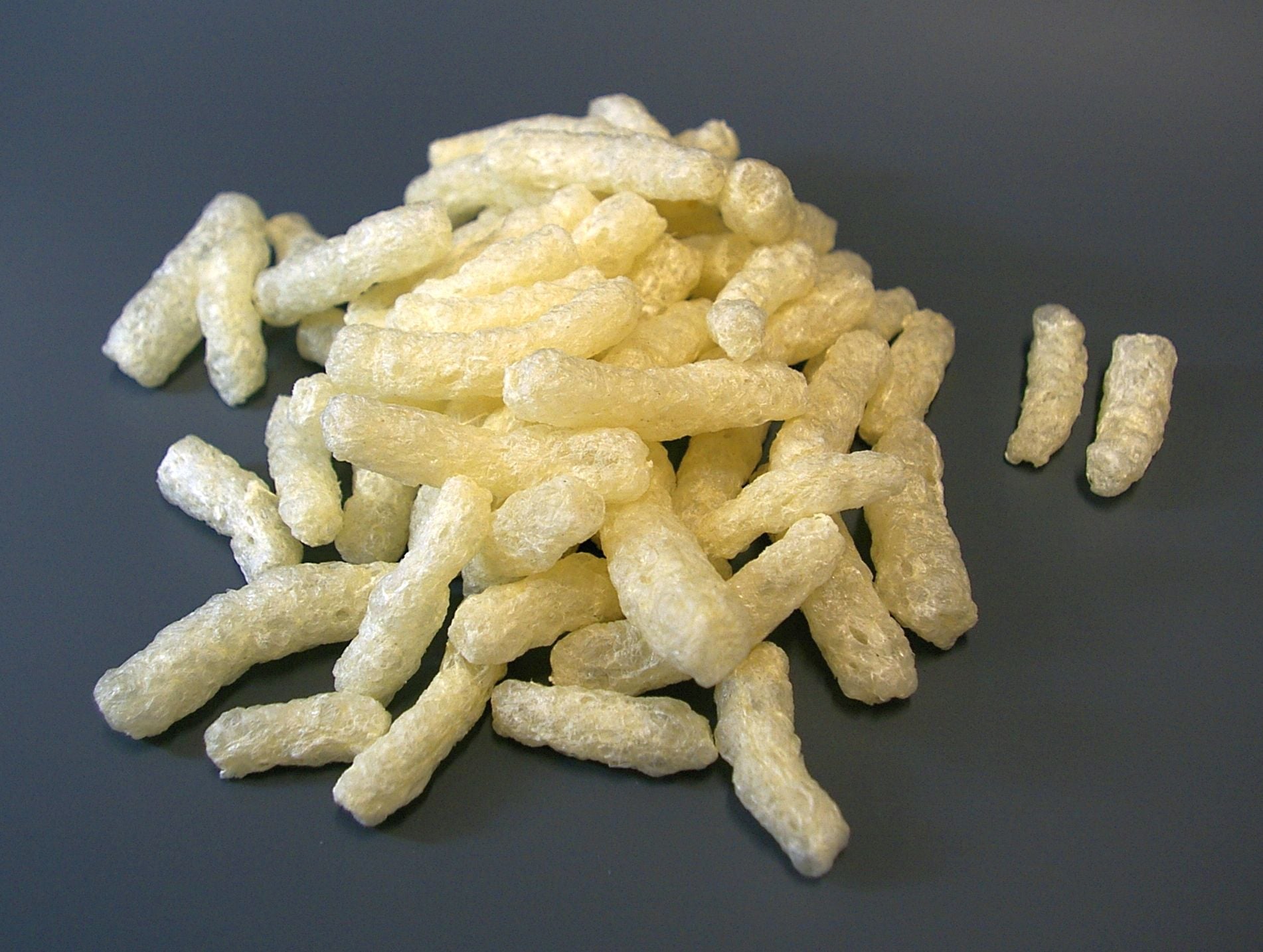
Packaging chips made by bioplastics (Thermoplastic Starch) via Wikimedia Commons by Christian Gahle, nova-Institut GmbH with usage type - Creative Commons LicenseFeatured Image Credit
Packaging chips made by bioplastics (Thermoplastic Starch) via Wikimedia Commons by Christian Gahle, nova-Institut GmbH with usage type - Creative Commons License


