
Vienna just became home to the world’s first self-stabilizing nuclear clock, a bleeding-edge timekeeper that aims to push past the performance of today’s atomic clocks. The prototype, developed at TU Wien’s Institute of Atomic and Subatomic Physics, can maintain stable operation for more than 24 hours without being locked to a conventional atomic clock. ScienceDaily describes the achievement as a major step toward a new era of ultra-precise timekeeping that could eventually redefine how humanity measures time itself.
Traditional atomic clocks measure time by watching electrons jump between energy levels in atoms such as cesium, rubidium, or ytterbium. The Vienna nuclear clock instead tracks transitions inside the nucleus of thorium-229, a radioactive isotope whose nuclear energy levels are far less sensitive to outside disturbances like electromagnetic fields. Thorium-229 is unusual because it has two nuclear states separated by an exceptionally small energy gap, small enough that laser light in the ultraviolet range can drive transitions between them. By counting these nuclear oscillations, the device can—in principle—surpass the stability and accuracy of the best electron-based atomic clocks in use today.
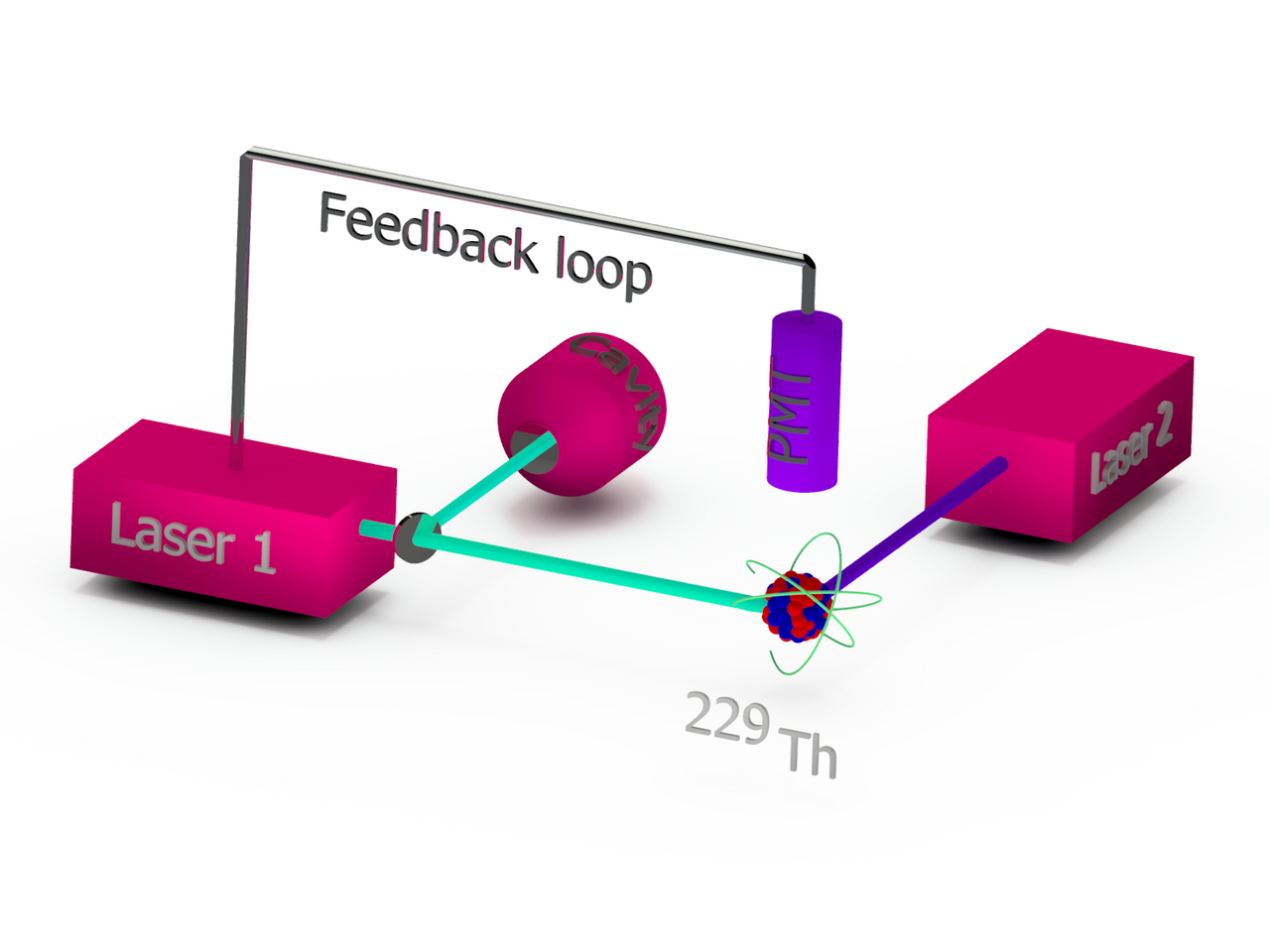
Earlier nuclear clock prototypes relied on an external atomic clock to keep their lasers correctly tuned, but the new design closes the loop: the thorium nuclei themselves tell the system when the laser frequency drifts. When the laser is perfectly matched to the thorium nuclear transition, the nuclei absorb light strongly; if the frequency slips, absorption drops, and a feedback circuit automatically nudges the laser back into alignment. TU Wien reports that this self-stabilizing setup stays locked for more than a day and reaches a relative precision of about 10⁻¹⁵—roughly an error of one second over 30 million years. That level of performance already rivals some leading optical atomic clocks, and researchers expect nuclear clocks to improve substantially as the technology matures.
Getting to this point took years of painstaking work to pin down the thorium-229 nuclear transition that theory had predicted but no one had ever seen directly. In April 2024, a team led by Thorsten Schumm at TU Wien and Ekkehard Peik at Germany’s Physikalisch-Technische Bundesanstalt (PTB) finally succeeded in exciting the thorium nuclei with lasers, confirming the long-sought nuclear transition. Just months later, researchers at TU Wien and JILA/NIST in the United States demonstrated the world’s first nuclear clock by coupling an optical atomic clock to a thorium-doped crystal and using the nuclei as an ultra-stable time reference. Two new papers in Nature—one from the Vienna group, one from a team in Beijing—mark what the American Nuclear Society calls a “milestone” in metrology, describing fully operational thorium-229 nuclear clocks with feedback loops. The Beijing device, developed at Tsinghua University under Ding Shiqian, independently realizes a working thorium nuclear clock, underscoring that this is not a one-lab curiosity but the beginning of a broader research race.
Why does any of this matter beyond the lab? For one, nuclear clocks could sharpen experiments that probe whether fundamental constants of nature, like the fine-structure constant, slowly change over cosmic time. Because nuclear energy levels respond differently to gravitational potential than electronic transitions, networks of nuclear clocks could map tiny variations in Earth’s gravity field or test general relativity with unprecedented sensitivity. Ultra-stable nuclear timekeeping would also feed directly into practical systems geeks care about, from GPS and future satellite navigation to secure communication networks and long-baseline telescopes that need clocks synchronized to absurd precision.
For sci-fi fans, this is the kind of enabling tech that quietly makes starship navigation, planetary-scale internets, and quantum networks feel less like hand-wavy magic and more like plausible engineering. If nuclear clocks live up to their promise, future deep-space probes may carry thorium timekeepers to keep their onboard systems in sync over decades-long missions, while Earth-bound infrastructure leans on nuclear-timed networks to coordinate everything from autonomous vehicles to global research facilities. The TU Wien prototype is still a lab instrument rather than a gadget, but it’s a clear signal that the age of nuclear timekeeping has ticked from theoretical possibility into working hardware—and the countdown to replacing atomic clocks has officially begun.
Image Credits
In-Article Image Credits
A Thorium-229 nucleus is irradiated with stabilized laser light (Laser 1). A second Laser (Laser 2) is used to probe the atomic shell's hyperfinestructure in order to determine via the change of the nuclear spin state if the nucleus was successfully excited. A photomultiplier tube (PMT) is used to probe if Laser 2 is on resonance. Based on the PMT signal Laser 1 is actively stabilized to the nuclear transition via a feedbackloop. In this way the frequency of Laser 1 will exactly match the frequency of the nuclear excitation. The frequency of Laser 1 can be accurately measured with the help of a frequency comb and therefore used as a time and frequency standard. via Wikimedia Commons by LarsvdW with usage type - Creative Commons LicenseFeatured Image Credit
A Thorium-229 nucleus is irradiated with stabilized laser light (Laser 1). A second Laser (Laser 2) is used to probe the atomic shell's hyperfinestructure in order to determine via the change of the nuclear spin state if the nucleus was successfully excited. A photomultiplier tube (PMT) is used to probe if Laser 2 is on resonance. Based on the PMT signal Laser 1 is actively stabilized to the nuclear transition via a feedbackloop. In this way the frequency of Laser 1 will exactly match the frequency of the nuclear excitation. The frequency of Laser 1 can be accurately measured with the help of a frequency comb and therefore used as a time and frequency standard. via Wikimedia Commons by LarsvdW with usage type - Creative Commons License


