
Light has taken on one of matter’s strangest forms. An international team has created a supersolid state that combines crystal-like order with frictionless flow at room temperature—a result that could make exotic quantum behavior far easier to study and eventually use.
The experiment brought together researchers from the University of Warsaw, Poland’s Military University of Technology, IBM Research Zurich, and France’s CNRS. Their findings, published in Science Advances under the title Observation of a supersolid phase in a spin-orbit coupled exciton-polariton Bose-Einstein condensate, center on exciton polaritons: hybrid particles created when light and matter become strongly coupled inside a microscopic optical cavity.
Supersolidity is unusual because it combines two properties that normally belong to different phases of matter. Like a crystal, the system develops a repeating spatial pattern. Like a superfluid, it can support collective flow without ordinary friction. In this case, the researchers produced the state using a microcavity filled with a specially engineered nematic liquid crystal and coated with the organic semiconductor MeLPPP.
The setup avoided the near-absolute-zero temperatures typically associated with Bose-Einstein condensates. Instead, the liquid-crystal microcavities functioned at room temperature and can reportedly operate at temperatures approaching 60 degrees Celsius. The University of Warsaw describes the achievement as a room-temperature supersolid in an exciton-polariton condensate, rather than a conventional atomic supersolid cooled in a cryogenic laboratory.
The researchers identified the supersolid phase through striped density patterns in the emitted light. Those bright fringes did not settle into one permanently fixed position: each laser pulse could produce a different arrangement, demonstrating spontaneous breaking of translational symmetry. The system also showed superfluid signatures, including randomly appearing vortices, while its light displayed a repeating polarization pattern known as a persistent spin helix.
That combination makes the platform more than a one-off physics demonstration. The liquid-crystal cavity is electrically tunable, allowing researchers to change the optical environment with an applied voltage. Such control could help scientists investigate how quantum states form and respond without rebuilding an experiment around cryogenic equipment for every adjustment.
Practical devices are still a long way off, and the researchers’ samples had a limited working lifetime because the organic semiconductor gradually reacted with the liquid crystal. Even so, a room-temperature, electrically adjustable quantum fluid could eventually inform photonic computing, neuromorphic processors, quantum-light platforms, and sensors designed to detect extremely small changes in intensity or polarization. The immediate next step is likely to improve the material’s durability and determine how reliably the supersolid state can be controlled outside carefully timed laboratory measurements.
Image Credits
In-Article Image Credits
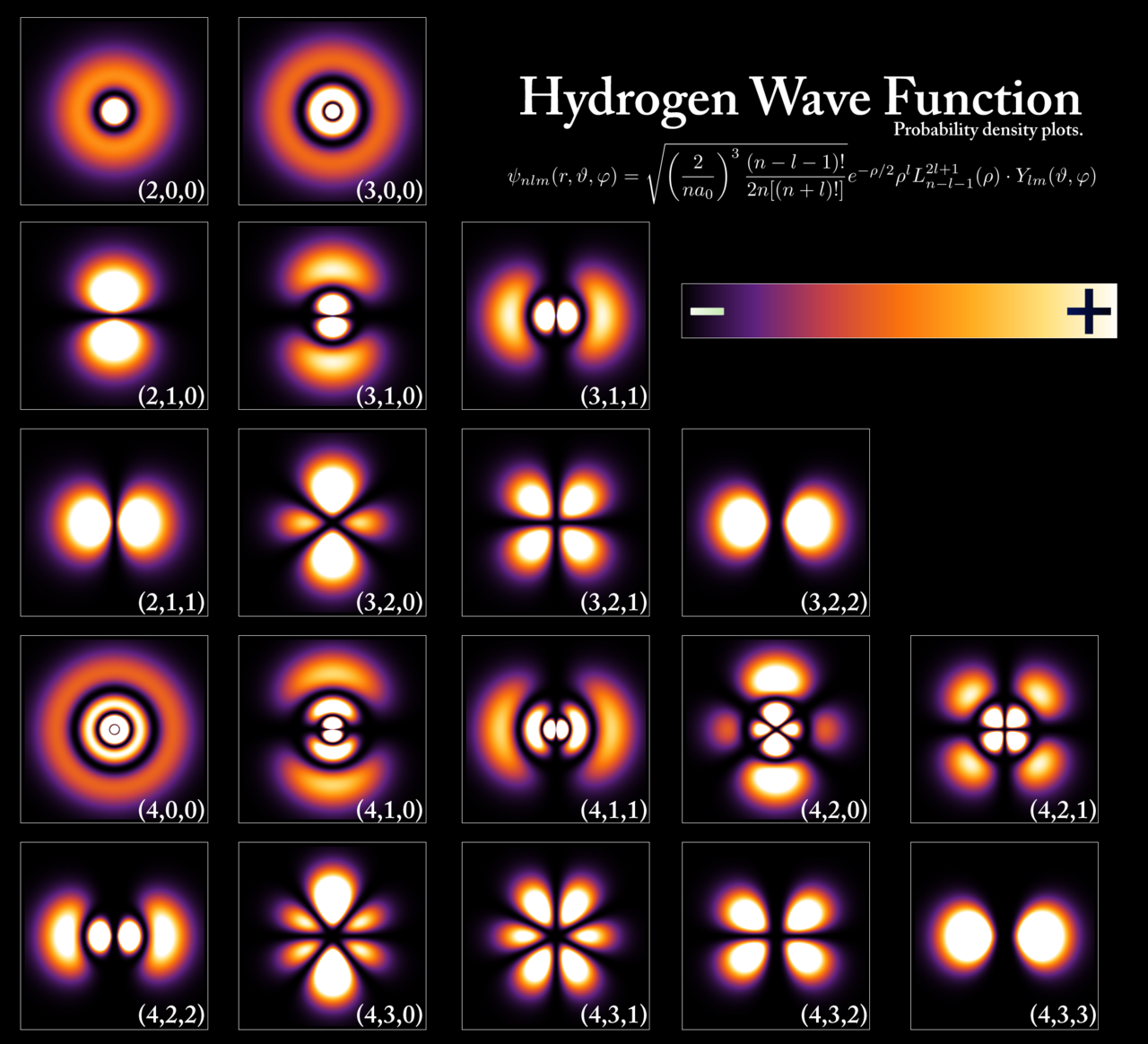
Hydrogen density plots for n up to 4. Wavefunctions of the electron in a hydrogen atom at different energy levels. Quantum mechanics cannot predict the exact location of a particle in space, only the probability of finding it at different locations. The brighter areas represent a higher probability of finding the electron. via Wikimedia Commons by PoorLeno with usage type - Public Domain. By PoorLeno (talk) - the English language Wikipedia (log).Original text: I created this work entirely by myself. References:Forinash, Kyle. Hydrogen W Simulation. Indiana University Southeast. Retrieved on 2008-12-18.Tokita, Sumio; Sugiyama, Takao; Noguchi, Fumio; Fujii, Hidehiko; Kobayashi, Hidehiko (2006). "An Attempt to Construct an Isosurface Having Symmetry Elements". Journal of Computer Chemistry, Japan 5 (3): 159–164. DOI:10.2477/jccj.5.159., Public Domain, https://commons.wikimedia.org/w/index.php?curid=5854697Featured Image Credit
Hydrogen density plots for n up to 4. Wavefunctions of the electron in a hydrogen atom at different energy levels. Quantum mechanics cannot predict the exact location of a particle in space, only the probability of finding it at different locations. The brighter areas represent a higher probability of finding the electron. via Wikimedia Commons by PoorLeno with usage type - Public Domain. By PoorLeno (talk) - the English language Wikipedia (log).Original text: I created this work entirely by myself. References:Forinash, Kyle. Hydrogen W Simulation. Indiana University Southeast. Retrieved on 2008-12-18.Tokita, Sumio; Sugiyama, Takao; Noguchi, Fumio; Fujii, Hidehiko; Kobayashi, Hidehiko (2006). "An Attempt to Construct an Isosurface Having Symmetry Elements". Journal of Computer Chemistry, Japan 5 (3): 159–164. DOI:10.2477/jccj.5.159., Public Domain, https://commons.wikimedia.org/w/index.php?curid=5854697


