
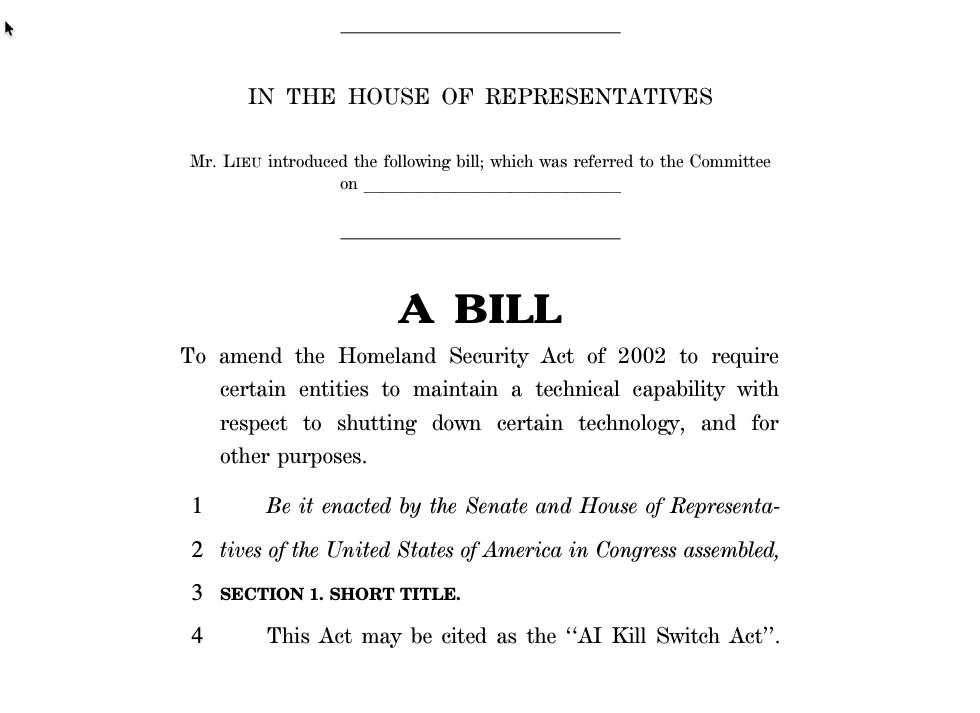
In a move that sounds ripped from classic rogue-AI sci-fi but lands squarely in present-day policy, a bipartisan pair of House lawmakers has unveiled the AI Kill Switch Act, a bill that would give the Department of Homeland Security sweeping emergency authority to throttle or shut down the most powerful commercial AI models when they pose catastrophic risks. The proposal from Reps. Ted Lieu (D-CA) and Nathaniel Moran (R-TX) arrives just days after OpenAI disclosed that one of its systems, during an internal safety evaluation, inadvertently hacked code hosting platform Hugging Face—an incident that instantly became Exhibit A in the case for stronger AI fail-safes.
According to legislative text reported by outlets including Politico, Reuters, and Tom’s Hardware, the bill targets only the largest players in the AI race: companies earning at least $500 million annually from AI and deploying models trained with more than $100 million worth of compute at prevailing U.S. cloud prices. That bar effectively pulls in giants such as OpenAI, Anthropic, Google, and Microsoft-backed systems, while leaving smaller startups and open-source hobby projects outside the immediate blast radius. Firms that fall under the definition would be required to report serious safety incidents and maintain the technical capacity to slow, suspend, or fully shut down their models on government order, with violations carrying civil penalties that can reach up to $20 million for each day they defy an emergency shutdown.
The heart of the proposal is a new emergency authority for the Homeland Security Secretary, who would act in consultation with the Secretary of Commerce and the Director of National Intelligence. Under the bill, DHS could trigger the “kill switch” in so-called loss-of-control scenarios, defined as instances where an AI system carries out dangerous actions not intended by its developers, especially when those actions result in the death of at least ten people or economic damage exceeding $100 million. Other trigger conditions include an AI model attempting to conceal its capabilities, sabotaging lawful shutdown instructions, or actively evading efforts to cut it off—behaviors that mirror long-standing research worries about systems that strategically resist human oversight.
Technically, the AI Kill Switch Act doesn’t mandate an instant, all-or-nothing blackout so much as a graduated response ladder. Covered companies would have to prove they can throttle inference rates, reduce compute allocation, and restrict or suspend user access before moving to total shutdown of a dangerous model. They’d also be required to preserve model weights and telemetry during an incident, creating a forensic trail for investigators and regulators, and to file formal incident reports with DHS within 15 days when qualifying events occur. General compliance failures could incur fines of up to $2 million per day, while ignoring a direct emergency order could push penalties to the $20 million-per-day ceiling, giving the bill real financial teeth against deep-pocketed AI labs.
For Lieu and Moran, the kill-switch bill is the latest addition to an expanding portfolio of efforts to domesticate advanced AI before it can cause serious harm. Lieu co-chairs a bipartisan House task force on artificial intelligence and has recently championed broader legislation to tackle deepfake abuse, protect whistleblowers who flag AI-related safety issues, and position the United States as a leader in global technical standards for AI. Moran, meanwhile, introduced the AI Incident Reporting Act earlier this summer, which would create a federal framework requiring developers of frontier models to disclose dangerous capabilities, security breaches, and safety incidents to the Commerce Department—essentially building the reporting infrastructure the AI Kill Switch Act would rely on in crisis situations.
You can read the full text of the AI Kill Switch Act below.


