
China’s AI infrastructure race has produced a formidable new contender: Envision’s Galaxy campus in Ulanqab, Inner Mongolia, is designed to reach up to 800 megawatts of IT capacity by the end of 2027. Its first 120MW phase arrived within a year and at roughly one-fifth the cost of comparable US construction, according to coverage of the Galaxy buildout. The scale puts it close to the approximately 820MW of critical IT capacity associated with OpenAI’s Stargate campus in Abilene, Texas. SemiAnalysis’s site visit described Galaxy as a four-phase, built-to-suit development for two unnamed internet companies.
The comparison is striking because the projects represent two different answers to the same problem: how to supply enormous quantities of electricity quickly enough for AI computing. Abilene relies on the public grid alongside on-site gas generation, while Galaxy is being built around a dedicated power ecosystem. Envision is developing wind farms, battery storage and transmission infrastructure alongside the computing halls rather than treating electricity as a service to be secured later.
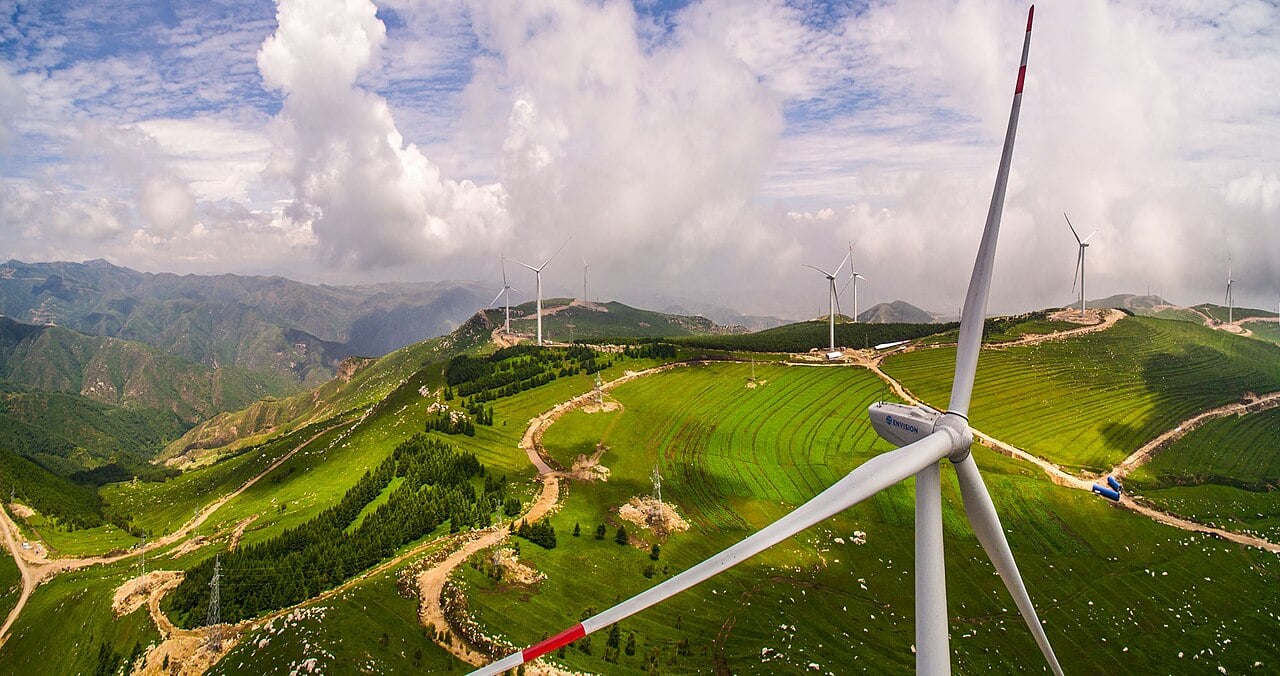
For Galaxy’s first two phases, Envision is targeting more than 60% renewable electricity from two wind farms roughly 80 kilometers away. Together they provide 420MW of installed generation against an expected 240MW data-center load. Ulanqab’s wind farms typically operate at a 35–40% capacity factor, so the turbines will not supply their rated output continuously; four-hour battery systems are intended to shift excess generation into calmer periods. The approach follows China’s source-grid-load-storage model, which connects generation, storage and computing through a dedicated power system instead of depending entirely on the regional grid.
The campus also offers a glimpse at how AI data-center power delivery may change. In a 5MW hall, solid-state transformers convert 10kV alternating current directly into an 800V direct-current bus for the racks. That architecture removes several conventional conversion stages, including low-voltage transformers, UPS equipment and rack-level rectifiers. Envision says its integrated system is already supporting live computing workloads, combining the transformers with battery energy storage and controls designed to respond to rapid GPU power fluctuations. The company’s announcement calls the deployment a commercial first for this particular 800V DC arrangement.
The 800V experiment is small compared with the eventual campus, but it aligns with the direction of high-density accelerator hardware. As rack power climbs, distributing electricity at higher voltage can reduce current, cabling requirements and conversion losses. Nvidia is also pushing 800V DC distribution for future AI systems, making Galaxy a useful real-world test of technology that remains early in the US market. SemiAnalysis notes that the pilot reaches live racks, although the specific hardware and customer workloads have not been disclosed.
Cooling is similarly shaped by the region’s climate and infrastructure. Galaxy uses liquid- and air-cooled servers on a shared water loop without a central chiller plant, a design suited to northern China’s colder conditions. Envision’s broader vertical integration extends from wind turbines and batteries to power electronics, software and prefabricated substations, allowing much of the equipment to be configured before arriving at the site.
There is one important capacity wrinkle: Envision’s latest descriptions have discussed a much larger long-term development that could reach 3GW and support up to one million AI accelerators, while the current Galaxy phase described by SemiAnalysis targets 800MW by the end of 2027. Those figures may refer to different buildout horizons rather than a contradiction, but the distinction matters. For now, Galaxy’s significance is clear even at 800MW: it demonstrates how pairing AI compute with renewable generation, storage and specialized power conversion can shorten construction timelines while reducing exposure to grid bottlenecks.
Image Credits
In-Article Image Credits
Galaxy Envision Wind Farm in Guangling County, Shanxi, China via Wikimedia Commons by Hahaheditor12667 with usage type - Creative Commons License. By Hahaheditor12667 - Own work, CC BY-SA 4.0, https://commons.wikimedia.org/w/index.php?curid=44784099Featured Image Credit
Galaxy Envision Wind Farm in Guangling County, Shanxi, China via Wikimedia Commons by Hahaheditor12667 with usage type - Creative Commons License. By Hahaheditor12667 - Own work, CC BY-SA 4.0, https://commons.wikimedia.org/w/index.php?curid=44784099


