
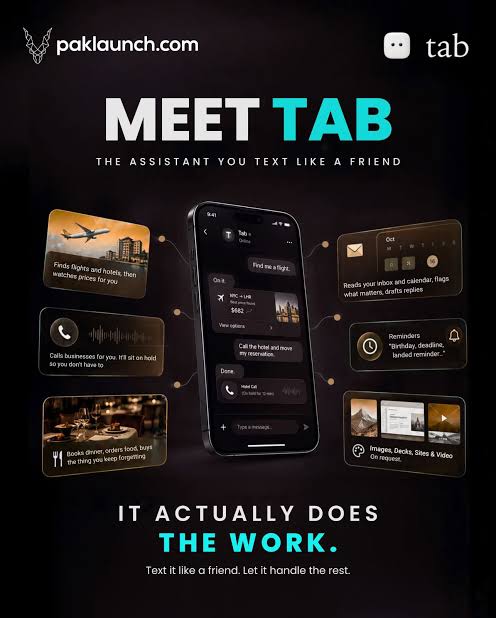
Personal AI just added another heavyweight to the roster. Tab, a San Francisco–based startup building a new personal AI assistant, has quietly come out of stealth with a reported valuation of around $300 million following a pre-seed raise, signaling that investors are still willing to place big bets on always-on digital companions despite a crowded field.
Details on Tab’s product are still thin, but the positioning is clear: this is pitched as a personal AI assistant rather than a generic chatbot, part of the broader push to turn AI from something you occasionally query into something that lives with you, understands your context, and helps run your day. In other words, Tab is chasing the same “AI sidekick” dream currently being explored by dedicated devices, AI-powered computers, and software assistants baked into phones, PCs, and productivity suites.
The name “Tab” might sound familiar because there is already a different AI startup using it: the wearable Tab pendant created by young technologist Avi Schiffmann. Schiffmann’s version is a small circular device that hangs around the neck, uses a microphone and Bluetooth to capture ambient conversations, and ships that audio to the cloud where ChatGPT and other models transcribe and analyze what you say. Early coverage described it as a “clarity machine” that can act as companion, coach, or therapist, evolving with the user over time. That hardware Tab raised roughly $1.9 million in seed funding at a valuation in the tens of millions, and took in about $100,000 in preorders for $600 units that bundle a year of service at $50 per month, with initial shipments targeted for 2024.
By contrast, the new Tab emerging from stealth is a much larger financial bet with its $300 million valuation, and it is being framed as a personal AI assistant platform rather than a single pendant-style gadget. The two companies are unrelated, but their coexistence underscores how “personal AI” is less a single product category and more a spectrum—from wearables that capture every conversation to software-first services that promise deep personalization without dictating the hardware form factor. It also hints at looming brand confusion: two ventures chasing similar ideas, both named Tab, each trying to claim mindshare in the same emerging niche.
Tab’s debut lands in a moment when major tech players are racing to bake similar capabilities into mainstream devices. Samsung’s newly announced Galaxy Tab S12 tablets ship with an upgraded Galaxy AI assistant and a six-month trial of Google’s premium AI service, giving users fast summaries of meetings, automated note-taking, translation, and document help straight from the slate. In the enterprise world, Salesforce has rolled out its Einstein Copilot assistant across tools like Slack and Tableau, promising tailored AI that can summarize calls, answer customer questions, and draft campaign emails. Against that backdrop, a standalone startup like Tab needs to prove it can offer a more intimate, more useful relationship with users than whatever ships by default on their phone or tablet.
For geek-culture fans tracking the rise of AI sidekicks, Tab’s stealthy emergence at such a lofty valuation suggests that the “personal AI computer” dream is far from cooling off, even as early wearables ignite concerns over privacy and constant recording. The hardware Tab pendant has already sparked questions about how much of our lives we’re willing to put on the record, and any new assistant operating at similar intimacy will face the same scrutiny. If Tab’s software-first approach can deliver the feeling of a persistent, context-aware companion without requiring a mic hanging around your neck all day, it could carve out a distinctive role in the ecosystem—one where your AI follows you across devices, remembers what matters, and feels less like a gadget and more like a quiet, ever-present co-pilot.


