
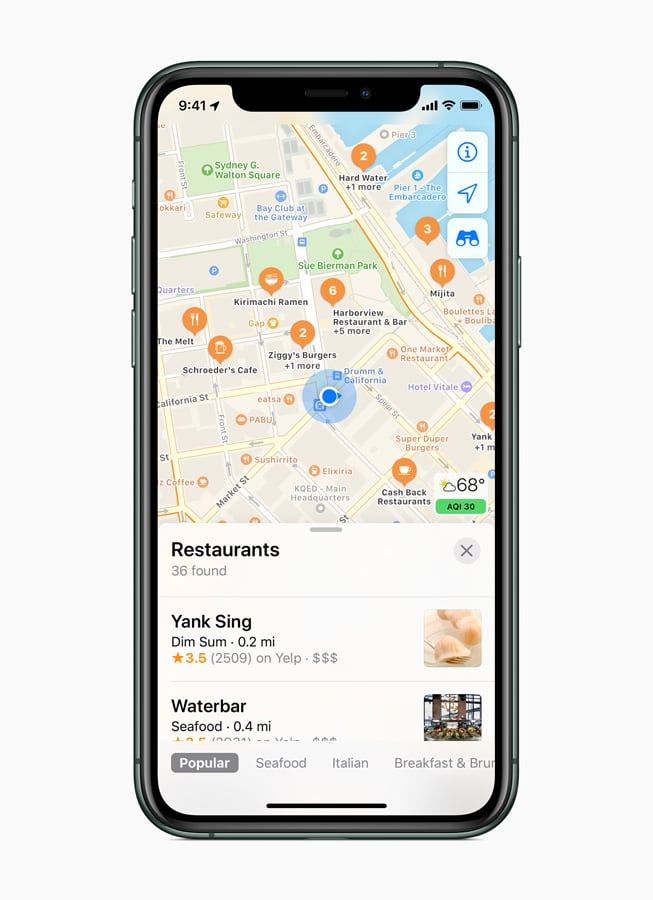
Ford and Apple are turning Apple Maps into the built-in brain of Ford’s next-generation Universal Electric Vehicle (UEV) Platform, debuting in 2027 with a roughly $30,000 midsize electric pickup as its first showcase. As first reported by The Verge, Apple Maps will no longer be just a CarPlay projection on Ford dashboards—it will be the native navigation stack powering both everyday routes and Ford’s upcoming evolution of its BlueCruise hands-free driving system.
At the core of the partnership is Apple’s new MapKit for Automotive SDK, which lets automakers embed and customize Apple Maps directly into their in-vehicle displays while keeping Apple’s privacy protections intact. Ford says the UEV platform will deliver turn-by-turn directions in natural language, real-time traffic and incident data, richer search with detailed place cards, and flexible routing options tailored to where and how drivers want to travel. On the EV side, the integration adds intelligent routing that accounts for battery state, along with automatic battery preconditioning so the pack is at optimal temperature when approaching a fast charger. Crucially, all of this will work even if the driver doesn’t own or connect an iPhone, though CarPlay remains available for those who want the familiar phone-centric experience.
The Universal Electric Vehicle Platform itself is Ford’s next big bet on scalable EV architecture, aimed at spreading common hardware and software across an entire lineup instead of one-off electric models. That lineup begins with a midsize pickup in the neighborhood of $30,000, positioned as an attainable EV option from a legacy truck brand rather than a luxury tech toy. By baking Apple Maps into the platform from day one, Ford ties its navigation and driver-assistance roadmap to Apple’s continuously updated, road-level map data—fuel for both smarter routing and more precise automated driving behavior. Ford’s Latitude AI team, created to accelerate its driver-assistance tech, will lean on that data to tune the next generation of BlueCruise for smoother, more confident highway drives.
BlueCruise is Ford’s answer to GM’s Super Cruise and Tesla’s Autopilot—a system that allows hands-free driving on approved stretches of highway while the car handles steering, speed, and lane centering under driver supervision. With Apple Maps feeding in detailed road geometry, lane information, and ramp layouts, Ford is promising a more seamless “on-ramp to off-ramp” experience where the car better anticipates merges, exits, and complex interchanges instead of reacting at the last second. Apple’s mapping data will help BlueCruise stitch together navigation and driver assist, so following a route and letting the car do more of the work feel like parts of the same stack rather than two separate systems. It’s a subtle but important shift for drivers who’ve grown used to juggling a built-in nav system, a phone map, and an assist suite that doesn’t always know what the route planner is trying to do.
For Apple Maps, the deal is a statement that Apple intends to challenge Google Maps and Android Automotive not only on phones but in the dashboard itself. Until now, Apple Maps has mostly lived in the car via CarPlay, mirroring the phone’s interface while the vehicle’s native software stayed in control. MapKit for Automotive flips that hierarchy, giving Ford a way to wrap Apple’s data and core UI patterns in Ford branding while still meeting Apple’s privacy standards that avoid tying map data directly to individual drivers. In markets where Google’s automotive stack has been gaining ground, this Ford deal gives Apple a flagship partner to show it can power EV navigation and driver-assist at the platform level rather than just as a smartphone add-on.
The move also builds on Ford’s existing history as an early adopter of Apple Maps EV routing. The Mustang Mach-E and F-150 Lightning were among the first vehicles to support Apple Maps EV Routing via CarPlay, letting the app estimate state of charge, insert charging stops, and route directly to compatible fast chargers along the way. Ford later announced that NACS (North American Charging Standard) stations—including many Tesla Superchargers—would show up inside Apple Maps routing for those EVs, further reducing range anxiety for drivers planning long trips. On 2026 model year Mach-E vehicles, Apple Maps already supports automatic battery preconditioning when navigating to fast chargers, warming or cooling the pack for quicker, more efficient charging. The UEV platform integration essentially takes those features, removes the phone requirement, and ties them into Ford’s broader software strategy for mass-market EVs.
For tech-savvy drivers and EV geeks, the significance is twofold: Ford is betting that tight integration with a familiar consumer platform will make its EVs feel less intimidating, and Apple is betting that cars are the next frontier for its mapping ambitions. If the 2027 midsize pickup lands at its targeted price point with robust native Apple Maps and an upgraded BlueCruise experience, Ford could have a compelling answer for buyers who want a mainstream truck that still feels like a high-tech gadget. Questions remain—such as how Android users will be accommodated and how quickly Ford can roll these capabilities across its lineup—but the direction is clear. The automaker isn’t just slapping a phone UI on a screen; it’s re-architecting its EV platform around a modern navigation and data layer, with Apple Maps sitting at the center of the stack.


