
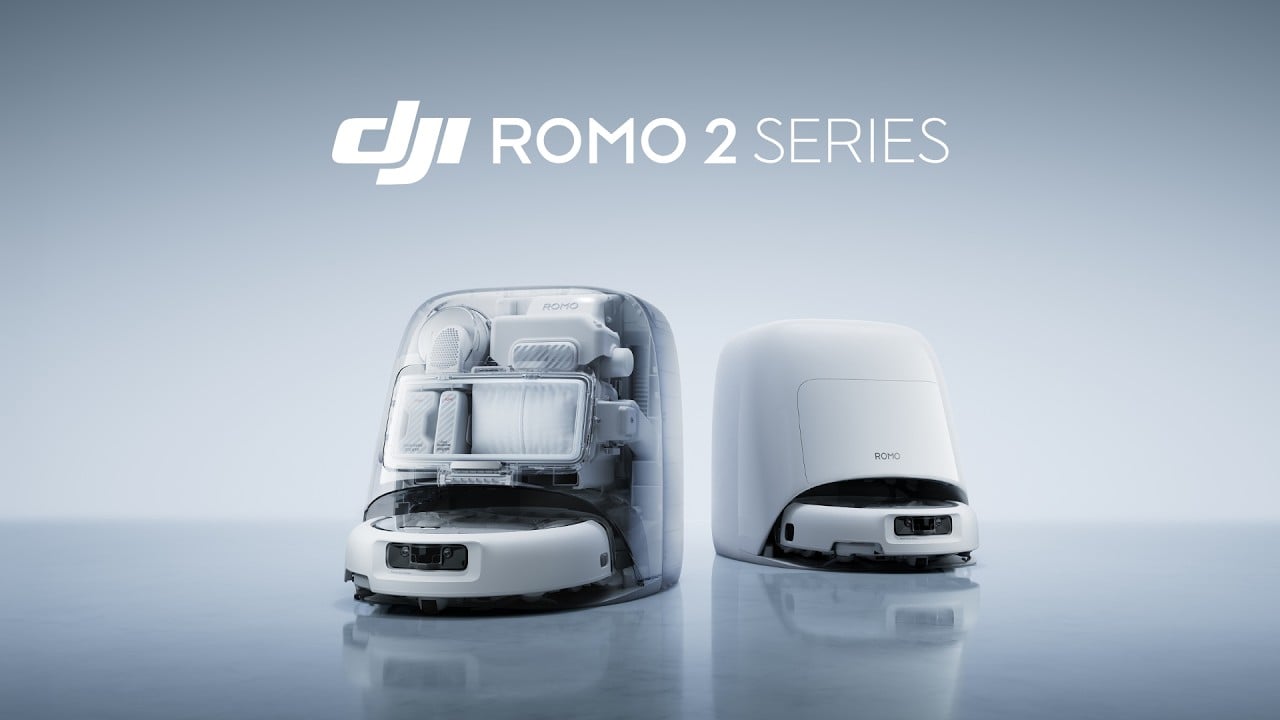
DJI is doubling down on its quest to turn your living room into a sci-fi test lab with Romo 2, a second-generation robot vacuum line that promises stronger suction, better obstacle-climbing “legs,” and, crucially, a new local-only data mode meant to address the privacy backlash from the original Romo. The Romo 2 series made its global debut on September 3, 2026, tied to DJI’s presence at IFA 2026 in Berlin, after rolling out earlier in China this summer.
The lineup is split into two models: the transparent Romo P2, which shows off its internals like a piece of modded PC hardware, and the opaque Romo A2 for anyone who prefers their cleaning bots a little less flashy. Under the shell, both share the same core hardware, including up to 36,000Pa of suction—well above most mainstream robot vacs—and a dual-brush system designed to resist hair tangles. They also lean into DJI’s robotics chops with dynamic, adaptive mechanical “feet” that can clamber over single steps up to around 4cm and even tackle two-step transitions totalling about 8.5cm, letting the bot traverse thresholds that would strand typical pancake-shaped vacuums.
Where many robovacs just bump and map, Romo 2 is built like a downsized autonomous rover, combining solid-state LiDAR, twin fisheye cameras, and time-of-flight sensors into what DJI markets as millimeter-level obstacle recognition. According to early coverage, the system can spot hazards as tiny as 2mm—think stray cables or LEGO pieces—while also recognizing transparent surfaces like glass doors and mirrors that routinely trip up lesser bots. For mopping, a radar-guided swing arm can rotate about 123 degrees and extend further under furniture, while a base station uses high-temperature water to scrub the mop and automatically empties the dust bin for mostly hands-off maintenance between runs.
The first Romo made headlines not just as DJI’s surprise leap from drones to floor care, but for a camera-security meltdown that raised serious concerns about how much of your home life was being piped back to the cloud. Romo 2 is clearly framed as a do-over: alongside the usual cloud-connected smart-home hooks, DJI is adding a new local-only data mode that, according to reporting, keeps cleaning data and camera processing on-device instead of continuously uploading it to remote servers. The system also supports PIN-gated access to the live camera feed, two-way audio, and tighter app-side controls, giving privacy-conscious users more tools to lock down who can peek through the bot’s sensors and when.
For smart-home tinkerers, Romo 2 slots into DJI’s app ecosystem and supports standards like Matter and popular voice assistants, so the same company that powers aerial photography rigs can now be invoked to mop the kitchen after movie night. Coverage of the Chinese launch notes that configurations range from stand-alone water-tank versions to packages with an ultra-thin auto-fill base, with prices in China starting around 5,499 RMB and scaling up to 6,499 RMB depending on model and dock features. In Europe, early listings put the Romo A2 at a suggested 1,199 euros, with launch promos pushing that down for early adopters, while global availability is slated to expand from October via DJI’s online store and retail partners.
All of this arrives less than a year after the original Romo, signaling that DJI is iterating at drone-like speed in the home-robot space and is willing to react quickly to criticism from security researchers and smart-home geeks alike. Whether the new local-only mode and PIN protections fully redeem the brand for the earlier camera fiasco will ultimately be decided by independent audits and teardown-hungry enthusiasts, but on paper Romo 2 looks like exactly the kind of overengineered, semi-terrifying robo-critter that genre fans might actually want patrolling their halls—provided it really keeps its data where it belongs.


