
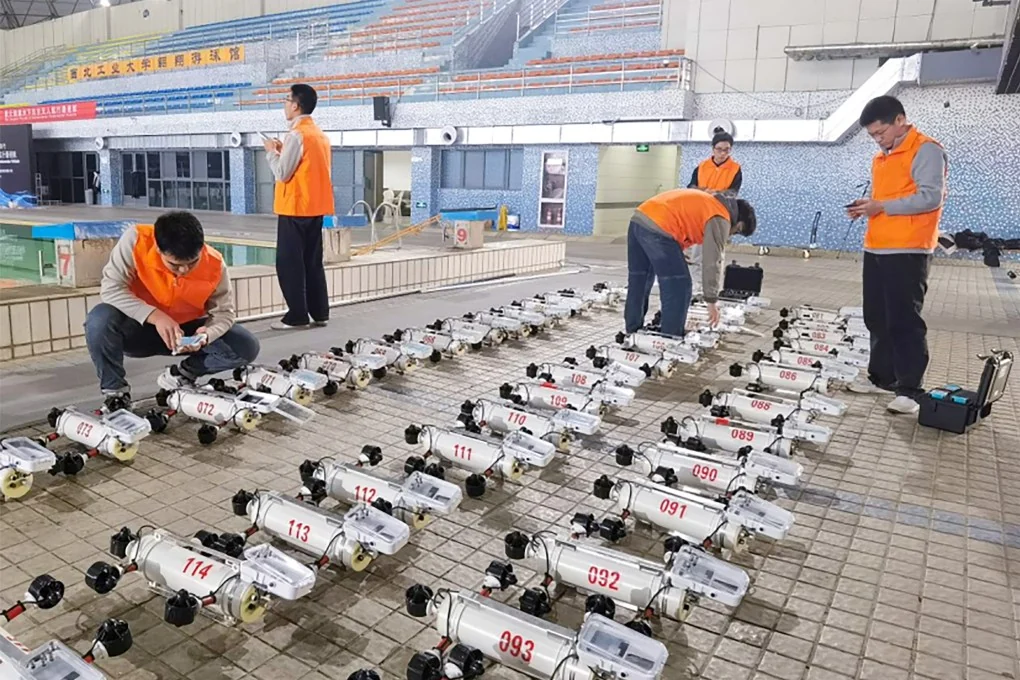
China has turned a swimming-pool demonstration into a striking milestone for autonomous marine technology. On August 29, 2026, researchers deployed 116 TH-618 underwater vehicles in a coordinated swarm, setting the Guinness World Records title for the most autonomous underwater vehicles operating simultaneously. The test was recognized as a new underwater-drone swarm record after the machines navigated without direct human control. The Independent reported that Guinness officials supervised the trial and later certified it.
The feat came from a collaboration between Northwestern Polytechnical University and Xi’an Tianhe Maritime Technologies. The university’s researchers placed the compact vehicles into a 50-by-20-meter pool one at a time, then allowed the swarm to follow a preset route for roughly 34 minutes. Together, the drones traveled about 500 meters while maintaining coordinated movement and executing formation maneuvers.
What makes the demonstration notable is the absence of a conventional remote-control tether. The TH-618s reportedly relied on onboard cameras and real-time visual data to understand their surroundings, stay on course, and move as a group. Coverage from Interesting Engineering described the vehicles as operating through their own autonomous systems after deployment, rather than being individually piloted throughout the run.
The hardware is small, but the underlying challenge is substantial. Radio signals do not travel effectively underwater, GPS is unavailable below the surface, and murky water can make sensing difficult. A large swarm therefore needs reliable localization, collision avoidance, timing, and behavior-sharing systems that can continue working when communication is intermittent. A controlled pool cannot reproduce ocean currents, low visibility, or complex seafloor terrain, but it does provide a repeatable environment for proving that many vehicles can coordinate at once.
The choice of partners also gives the record a significance beyond laboratory spectacle. Northwestern Polytechnical University has been identified by the U.S. government as an institution involved in developing technology for China’s People’s Liberation Army, while Xi’an Tianhe Maritime Technologies is linked to the defense sector. That background makes the swarm relevant to the wider contest over autonomous systems, even though the public test itself was a contained demonstration rather than an announced military deployment.
In civilian applications, fleets of small underwater robots could eventually inspect ports, map infrastructure, monitor ecosystems, search wreckage, or survey large areas more efficiently than a single expensive vehicle. In security applications, the same basic approach could support distributed sensing and reconnaissance. The next question is whether the TH-618 system can move from a carefully arranged pool to open water, where navigation errors, obstacles, currents, and unreliable visibility will test the technology far more severely than a Guinness attempt.


