
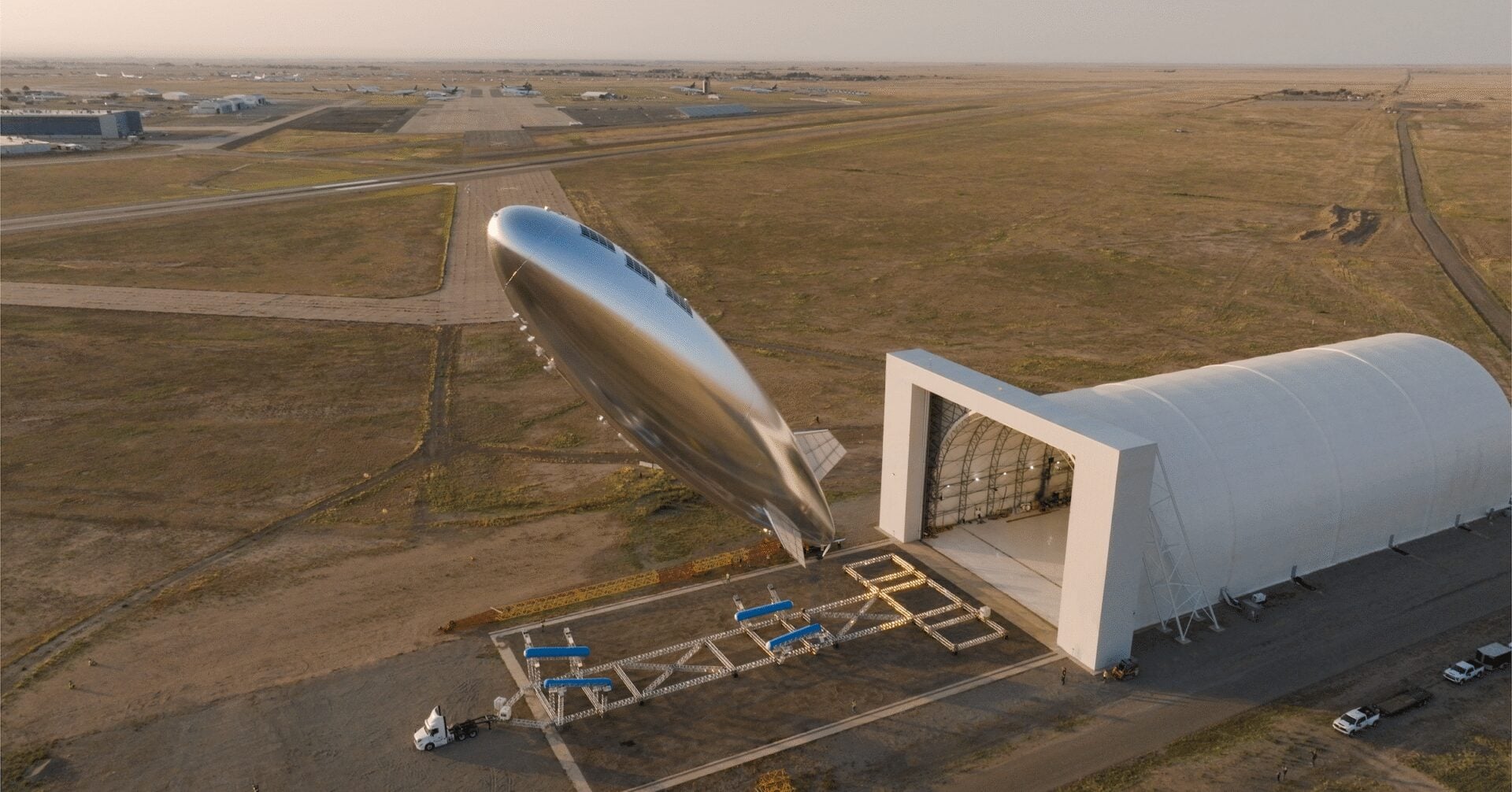
Sceye has brought a new kind of cell tower down to Earth—figuratively speaking. The New Mexico aerospace company’s uncrewed stratospheric platform completed a round trip between the United States and Japan after spending part of its mission testing whether a balloon-like aircraft can provide mobile service from the sky.
The mission, called Sceye Service Test 1, launched from New Mexico on August 9 and reached Japanese airspace 13 days later after traveling more than 15,000 kilometers across the Pacific. Once over Japan, the platform operated at roughly 16.5 kilometers—well above commercial aviation and the jet stream—while holding its position within a tight operating area. It later returned toward the United States, completing the most ambitious demonstration yet of Sceye’s high-altitude platform system, or HAPS. Sceye’s mission announcement details the flight.
The aircraft carried SceyeCELL, a communications payload designed to function as a “cell tower in the sky.” In partnership with Japanese carrier SoftBank, the system connected ordinary, unmodified devices through SoftBank’s core network. The trial included text messages, voice calls, internet access, video streaming, and emergency calls, demonstrating that the concept is intended to work with the phones people already carry rather than requiring specialized satellite hardware. SoftBank’s account of the trial describes the HAPS-mounted equipment as a 4G LTE-equivalent base station.
The partners also tested scenarios where the platform could matter most: places where terrestrial infrastructure is damaged, overloaded, or simply unavailable. An emergency-alert messaging system was part of the exercise, alongside communications with drones. SoftBank said the trial represented Japan’s first service test from a stratospheric platform in Japanese airspace, while the companies framed the work as a step toward a three-dimensional network linking ground systems, aircraft, drones, and space-based infrastructure. The company’s press release also identifies the operating area off Cape Muroto in Kochi Prefecture.
Sceye’s pitch is that HAPS could occupy the middle ground between towers and satellites. Solar panels and batteries support day-and-night operation, while electric propulsion helps the helium-filled craft resist winds and remain over a target zone. The company says a full-scale platform could eventually cover an area comparable to about 500 terrestrial towers, although that is a design goal rather than a claim that this single test replaced 500 live networks.
The Japan flight went beyond radio coverage. A server aboard the HAPS processed data at the edge, with Sceye reporting an average round-trip response time of 68 milliseconds—more than 40 percent lower than internet-based cloud processing during the demonstration. The companies now plan to continue developing HAPS for disaster communications, AI, IoT, drone connectivity, climate monitoring, and potential 6G applications. SoftBank invested in Sceye in 2025, making this flight both a technology test and an early look at a possible commercial partnership between conventional mobile networks and persistent stratospheric infrastructure.


