
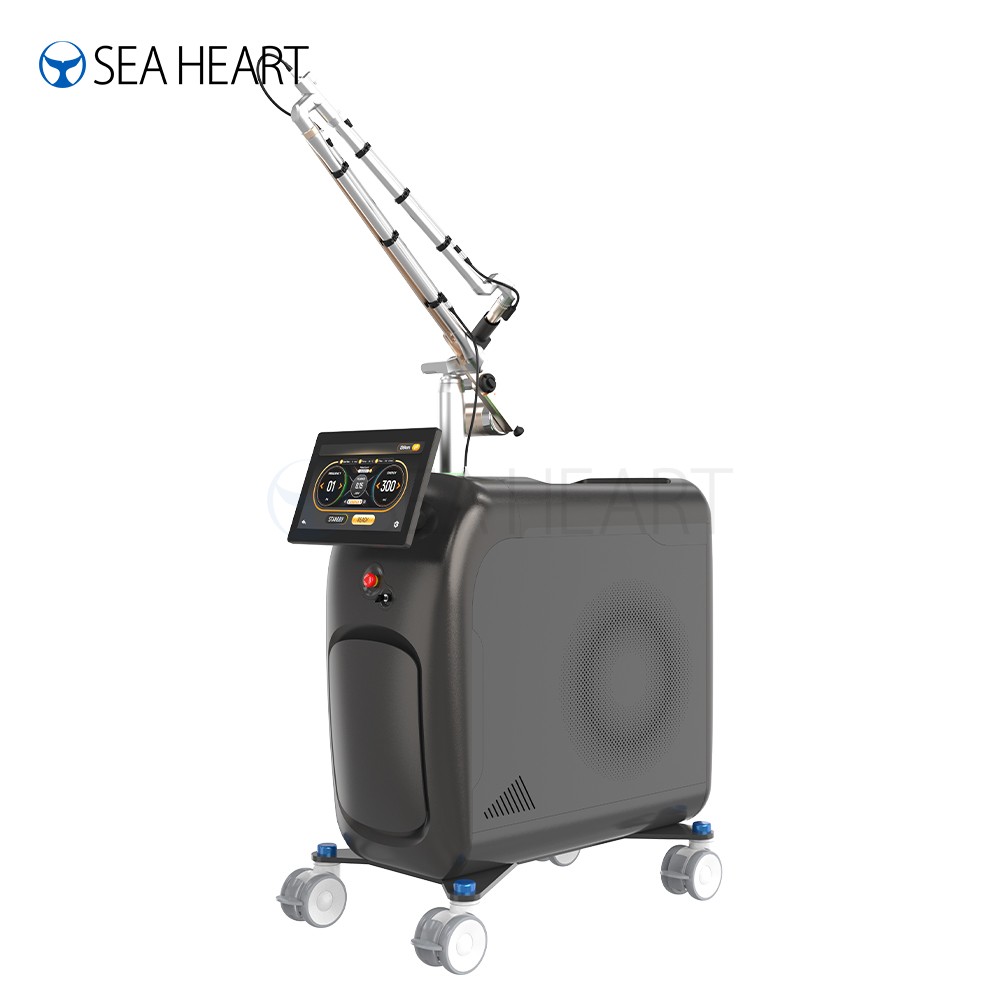
Benchtop laser hacking just escalated dramatically: experimenter Les’ Lab has driven a tabletop tattoo-removal rig to megawatt peak power by pushing its pulsed output through carefully tuned Q-switch crystals. The project, highlighted in a recent Hackaday feature, shows how deliberate optical engineering can turn bargain medical hardware into a serious playground for pulse physics and extreme-intensity experiments.
Pulsed solid-state lasers already deliver energy in short bursts, so their average output can look modest even while the instantaneous power inside each pulse is enormous. A Q-switch — in this case, a chromium-doped yttrium aluminum garnet (Cr:YAG) crystal mounted inside the resonant cavity — acts as a controllable loss element, preventing the laser from reaching resonance while the gain medium quietly “charges up” and then dumping that stored energy in one ultra-short spike. In practical terms, the total energy per shot does not increase, but the pulse duration collapses from microseconds to nanoseconds, driving the peak power up by orders of magnitude.
To quantify what that looks like on the bench, Les’ Lab instrumented the modified laser with a pyroelectric energy sensor to capture pulse energy and a fast photodiode to map the temporal profile. In its more conventional configuration without a Q-switch, the repurposed tattoo unit produced roughly 137 mJ in a ≈150 µs pulse, which works out to just under one kilowatt of peak optical power. Dropping the Cr:YAG Q-switch into the cavity shortened the pulse dramatically to about 14 ns while the total energy fell to around 77 mJ, pushing the peak power to roughly 1.3 megawatts. By building an absorption meter and characterizing crystals with different optical densities, Les showed that higher-absorbing Q-switches could drive the peak to about 2.25 MW at around 92% absorption, albeit with trade-offs in how often and how cleanly the laser would fire.
Those megawatt spikes sound like weaponized sci-fi hardware, but the Hackaday write-up notes that the real-world effects depend heavily on what you aim at. When focused on metal, the ultra-short pulses mostly ablate and pit the surface rather than carve deep cuts, because the interaction time is too brief for the material to soak up enough energy to melt and flow. At the beam’s focal point in air or glass, though, the intensity is high enough to ionize the air and even fracture glass, classic optical breakdown behavior that you would normally associate with dedicated high-energy research lasers rather than something that started life as a bargain tattoo-removal tool.
This megawatt upgrade builds directly on Les’ earlier work rehabilitating a cheap eBay tattoo-removal system, where he cleaned up the internals, designed a custom high-voltage power supply, and experimented with swapping the original Nd:YAG rod for a different lasing medium to boost performance. In that prior project, Hackaday reported that the stock Nd:YAG configuration delivered about 72.8 mJ pulses, while a yellow-laser setup in the same chassis managed roughly 153 mJ, more than doubling the output and laying the groundwork for the current deep dive into Q-switched peak power.
For the wider maker community, projects like this sit right at the intersection of garage tinkering and legit optics lab techniques, offering a hands-on look at the same Q-switched physics behind commercial tattoo-removal systems, industrial micromachining rigs, and various scientific instruments. They are also a pointed reminder that peak power numbers do not map directly to danger levels: megawatt-class pulses at low repetition rates and modest energies are manageable with the right eyewear, beam dumps, and controlled setups, whereas continuous multi-kilowatt cutting lasers demand very different safety regimes. With the Q-switched benchtop “beast” now characterized, the door is open for Les’ Lab to explore nonlinear optics, plasma formation, and maybe future experiments in harmonic generation and wavelength conversion — exactly the kind of mad-science frontier that keeps geeky hardware fans glued to this corner of the internet.


