
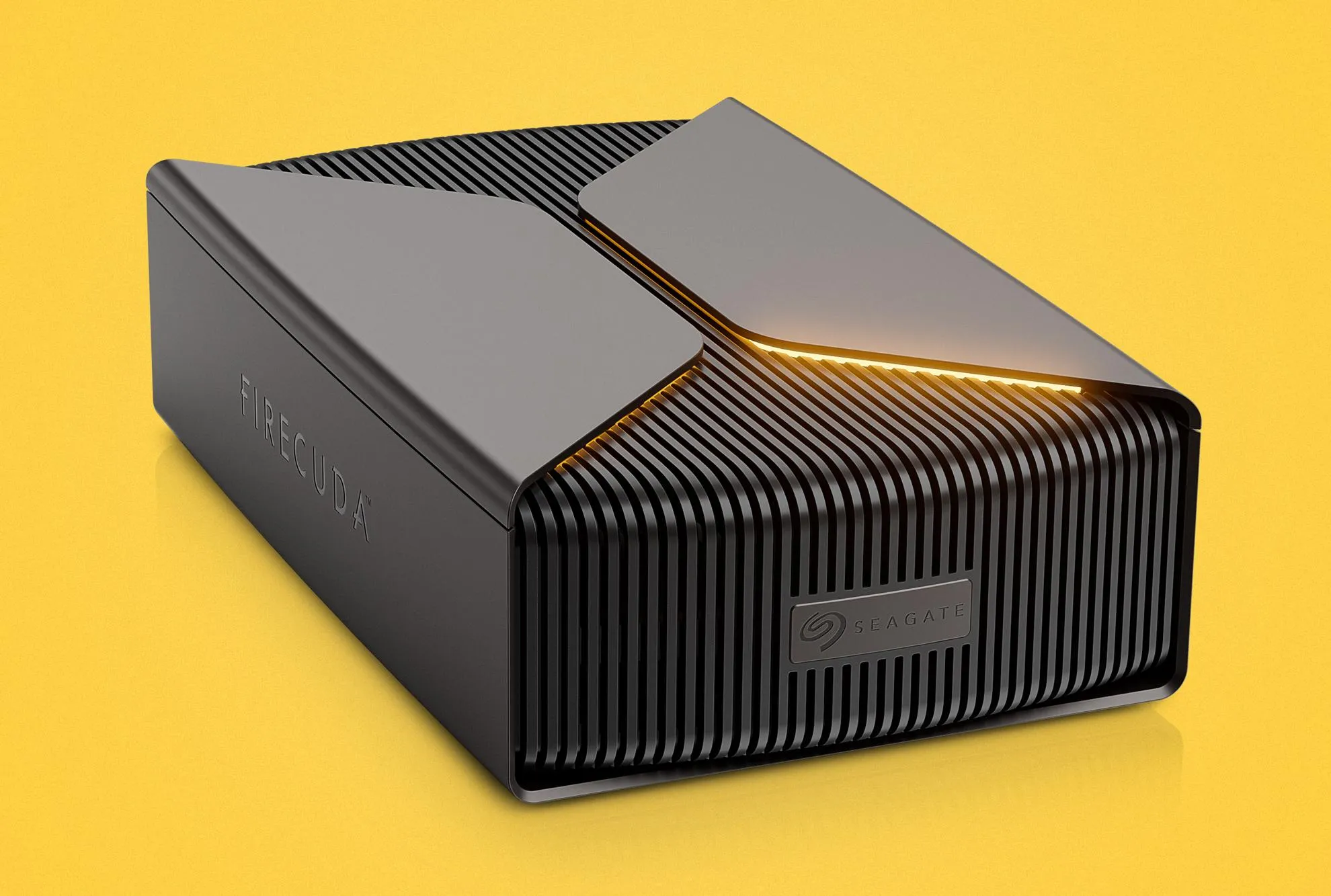
Seagate is reviving the hybrid-drive idea for a new generation of enormous game libraries and creative projects. The FireCuda Forge is an external storage system that combines an 8TB or 20TB hard drive with an NVMe SSD supplied and installed by the owner.
That unusual arrangement is central to the product rather than an optional upgrade: the Forge will not operate without an M.2 2280 NVMe drive inside it. Seagate recommends a DRAM-equipped SSD of up to 1TB, with PCIe Gen3 or faster drives supported, although newer PCIe 4.0 hardware will not make the enclosure itself perform beyond its limits. The company’s qualified drives include Samsung’s 990 Pro, WD or SanDisk’s SN850X and GX Pro 850X, and the SN710 or GX7100 family.
The payoff is Alkemi, Seagate’s new on-device storage platform. It monitors usage patterns and automatically places frequently accessed files on the SSD while leaving less-active data on the hard drive. To Windows or a supported Mac, the two devices appear as one volume rather than a manually managed SSD-and-HDD pair. Seagate says the system learns from real-time workloads, allowing frequently played games, active creative projects, captures, and other current files to receive priority without constant drag-and-drop housekeeping.
The concept echoes Seagate’s hybrid-storage experiments from the early 2010s, but the scale is dramatically different. Older hybrid drives typically paired hard disks with a small flash cache measured in single-digit or low-double-digit gigabytes. FireCuda Forge instead gives users the choice of a substantially larger NVMe cache, while retaining the cheap capacity and potential replaceability of a mechanical drive. The enclosure connects over USB4 and includes programmable RGB lighting, positioning it as much for gaming desks as for video-editing and capture setups.
Seagate launched the FireCuda Forge on November 10, 2026, through its online store and authorized retailers. The 8TB model starts at $699, while the 20TB version starts at $899; those prices do not include the SSD required to make either unit functional. The hard drive can also be replaced later with a larger compatible model, giving the design a degree of longevity that ordinary sealed external drives lack.
Early hands-on use suggests installation is straightforward but unconventional: buyers must open the enclosure, remove several screws with the included tool, and mount the SSD before connecting it. Seagate advertises read speeds of up to 2,500MB/s and write speeds of up to 2,000MB/s on compatible Windows 11 and macOS 26 systems, though real-world results will depend on how much data Alkemi can keep on the user-selected SSD.


