
Russia’s Cosmos 2612 has conducted a remarkably close approach to ICEYE-X36, a U.S.-registered synthetic-aperture radar satellite operated by Finnish-founded ICEYE. The Russian spacecraft moved from more than 200 miles away to within roughly three miles, and later tracking suggested the separation may have narrowed to only hundreds of meters—or possibly less. The maneuver has prompted concern because the approach appears deliberate and was not authorized by ICEYE.
Commercial space-tracking company LeoLabs described the movement as an approach that “appears to be deliberate,” while warning that its purpose remains unclear and the behavior requires continued monitoring. Independent analysts identified orbital changes on October 16 that left Cosmos 2612 stationkeeping within about five kilometers of ICEYE-X36. Later tracking reports indicated an even tighter pass, with one analysis placing the spacecraft within approximately 26 meters on October 19.
The path to that encounter required more than a simple drift. Cosmos 2612 was one of six Russian military satellites launched in April 2026, and several members of the Cosmos 2609–2614 group adjusted their inclinations in May to match ICEYE-X36’s orbital plane. Cosmos 2612 subsequently made additional burns between late September and October, aligning its altitude, eccentricity, orbital period, and plane with the commercial satellite. The Center for Strategic and International Studies called the activity a possible rendezvous and proximity operation, noting that propellant is a limited resource for spacecraft and that the maneuvers therefore deserve serious attention. CSIS
ICEYE-X36 is a particularly sensitive target because synthetic-aperture radar can produce imagery through clouds and darkness, making it useful for observing military activity regardless of weather or time of day. The satellite was launched in March 2024 aboard a SpaceX Falcon 9 and is registered to ICEYE US, the company’s American arm. ICEYE has supplied Ukraine with access to its radar-imaging capabilities since 2022, and the company said in October that it had agreed to transfer the full capabilities of an already-orbiting satellite for the Ukrainian government’s use over the region. ICEYE
There is no universally enforced minimum distance separating satellites, but operators generally avoid unnecessary proximity because a malfunction, collision, or intentional interference could create consequences far beyond the two spacecraft involved. Russia has previously drawn international condemnation for suspicious on-orbit behavior, including a 2020 incident in which Cosmos 2543 released an object at high relative velocity. That history makes the current encounter more alarming than a routine inspection maneuver, even though Russia has not publicly explained what Cosmos 2612 is carrying or why it approached ICEYE-X36.
For now, the most important question is what Cosmos 2612 does next. It could depart after collecting information about ICEYE-X36, remain nearby to observe or interfere with the satellite, or perform another maneuver that increases the risk of a collision. The incident also highlights how commercial spacecraft have become part of modern military infrastructure—and how an attack or harassment campaign in orbit could involve privately operated satellites without looking like a traditional act of war. Western governments and satellite operators will now have to decide whether continued tracking is enough or whether the approach warrants a public response.
Image Credits
In-Article Image Credits
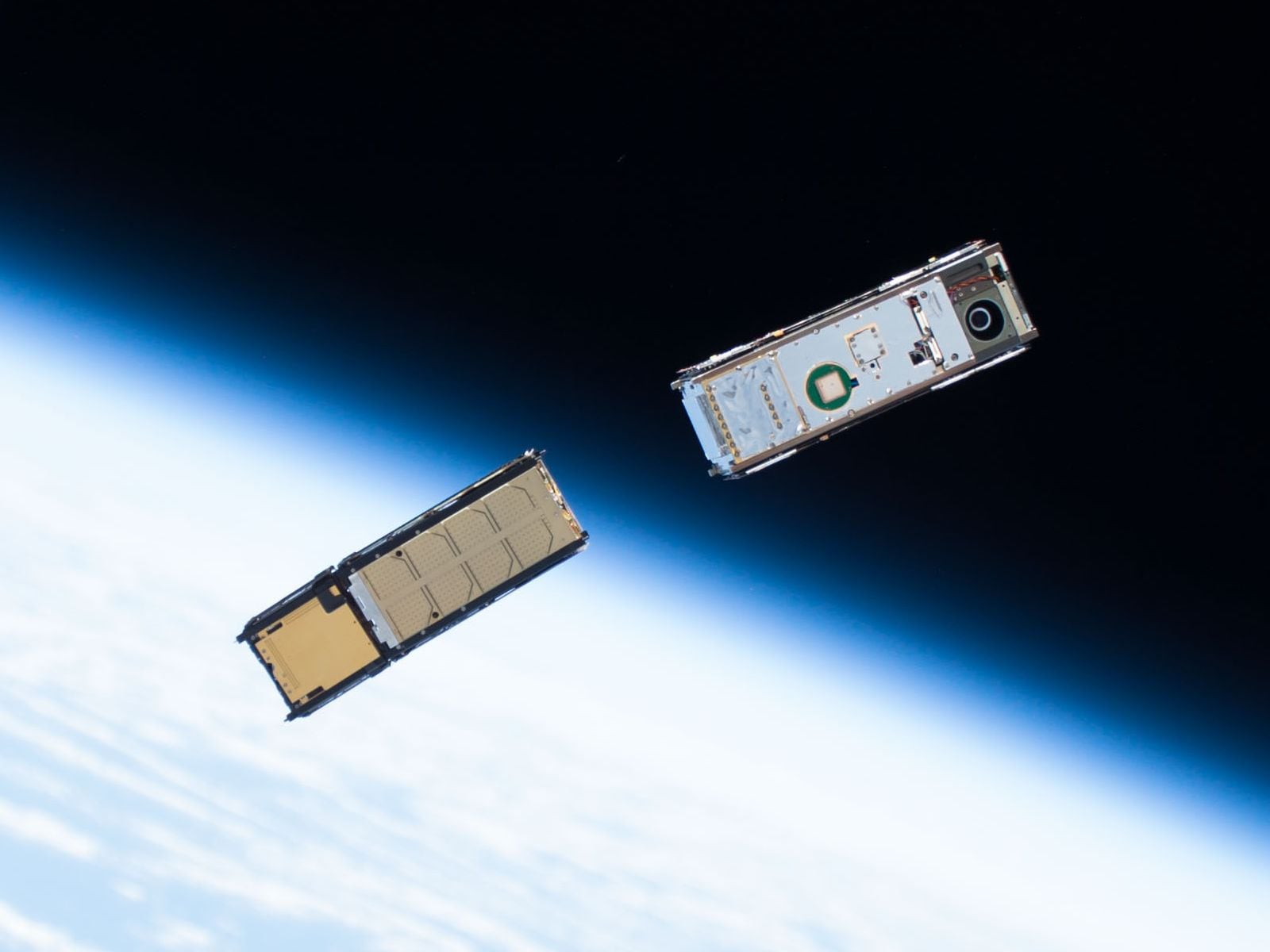
Cropped from original. Original description: A pair of CubeSats, with the Earth's limb in the background, is seen moments after being ejected from a small satellite deployer outside of the space station's Kibo lab module. via Wikimedia Commons by NSASA with usage type - Public Domain. By NASA - File:ISS-51 CubeSat deployment - A pair of CubeSats.jpg, or https://www.flickr.com/photos/nasa2explore/34354400620/, Public Domain, https://commons.wikimedia.org/w/index.php?curid=120805927Featured Image Credit
Cropped from original. Original description: A pair of CubeSats, with the Earth's limb in the background, is seen moments after being ejected from a small satellite deployer outside of the space station's Kibo lab module. via Wikimedia Commons by NSASA with usage type - Public Domain. By NASA - File:ISS-51 CubeSat deployment - A pair of CubeSats.jpg, or https://www.flickr.com/photos/nasa2explore/34354400620/, Public Domain, https://commons.wikimedia.org/w/index.php?curid=120805927


