
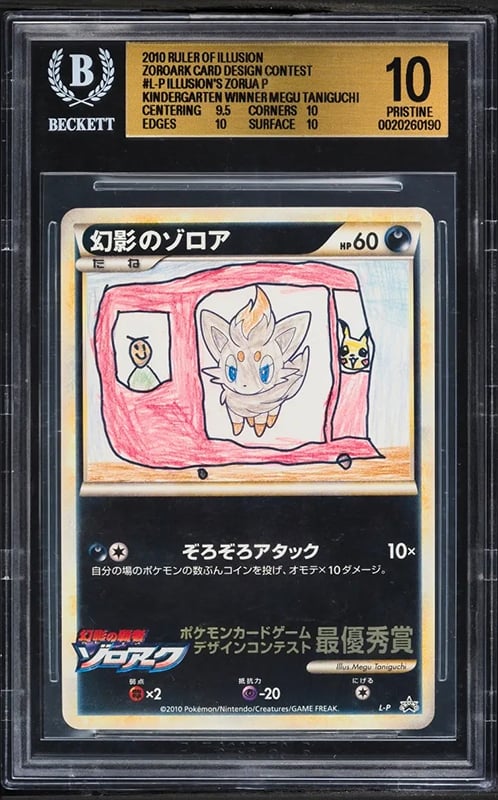
Pokémon’s latest “holy grail” isn’t a chase foil from a modern set or a secret rarity from the 30th anniversary—it’s a kindergartener’s fan art that just hammered for a jaw-dropping $156,000. On September 27, the 2010 Japanese “Illusion’s Zorua” Design Contest Promo, specifically the Kindergarten Winner version illustrated by then-six-year-old Megu Taniguchi, sold on Fanatics Collect for $156,000, instantly vaulting the card into elite trophy territory in the Pokémon TCG market. The card was originally created as part of a promotional illustration contest tied to the theatrical release of Zoroark: Master of Illusions, making its rise from cinema tie-in freebie to six-figure collectible one of the wildest glow-ups in Pokémon history. In a year already defined by high-profile auctions and the frenzy around Pokémon’s thirtieth-anniversary products, this sale stands out precisely because it isn’t an official pack-in card, but a tiny print-run prize born from a child’s drawing contest. For high-end collectors, it’s a reminder that the true endgame of Pokémon collecting isn’t just rarity—it’s story, provenance, and the human fingerprints on the hobby’s most elusive pieces.
The origin story of Illusion’s Zorua reads like a feel-good anime episode. In 2010, The Pokémon Company and the “Pikachu Project” animation team partnered with Shogakukan’s family of magazines to run a Pokémon Card Design Contest in Japan, inviting fans to submit hand-drawn designs of Zorua or Zoroark using pre-printed templates. Entries were accepted across multiple magazines from February 20 to April 2, 2010, with winners announced that summer ahead of the release of Zoroark: Master of Illusions in theaters. According to archival breakdowns, hundreds of entrant illustrations were selected to receive a standard prize card featuring art by the Pikachu Project team, but only a tiny handful of category winners—covering age groups and magazine-specific contests like Televi-Kun and Pucchigumi—had their own art turned into exclusive promo cards. Megu Taniguchi’s winning design, the Kindergarten Winner variant, shows a charming scene of Zorua and Pikachu riding a bus, with the young artist herself depicted in the illustration, giving the card a distinctly personal, almost scrapbook-like feel compared to traditional TCG art. What began as a childhood dream fulfilled—prize money, bragging rights, and a stack of personally illustrated cards—has now become one of the most coveted pieces in the entire Pokémon promo ecosystem.
The key driver behind the card’s meteoric price is scarcity, and here the numbers get truly brutal. Contest documentation and hobby research suggest that each of the top winners received a very small personal print run of their card, somewhere in the neighborhood of 100–200 copies depending on the category and source. Fanatics Collect’s own auction descriptions for Illusion’s Zorua emphasize that Taniguchi’s Kindergarten Winner card exists in a run of only about 100 copies, making it comparable in concept to the famed “Pikachu Illustrator” trophies in terms of low population and winner-only distribution. Bulbapedia’s breakdown of the promotion notes that, across the various magazines and contest tiers, design contest winners were granted stacks of their custom cards rather than any kind of public retail release, effectively turning these promos into quasi-private issues that only entered the broader market when winners (or their families) decided to sell. Sites that track obscure releases, like Pokeboon and Pokumon, classify Illusion’s Zorua alongside other illustration contest promos and emphasize its status as a winner-prize card rather than something pack-pulled. With such a narrow initial distribution, every copy that surfaces today feels less like a standard collectible and more like a recovered artifact from a tiny, one-shot printing event.
What makes this latest sale even more striking is how it dwarfs earlier known auction results for similar cards. Fanatics Collect previously sold a PSA 10-graded copy of the Kindergarten Winner Illusion’s Zorua promo in October 2022 for $8,700 with buyer’s premium, a strong figure at the time but nowhere near six-figure territory. In February 2023, a PSA 9 example of the same card realized $3,720, signaling healthy demand but suggesting that the market for these promos was still in the high four-figure to low five-figure range. Other Illusion’s Zorua winners—like the Televi-Kun and Pucchigumi variants—have seen notable but comparatively modest prices, with heritage-style auction listings and price-tracking sites logging five-figure sales for graded copies as collectors gradually catch on to the set’s rarity. PriceCharting data for the 2nd Grade winner version shows at least one sale hitting the $15,000 mark, underscoring that the entire Illusion’s Zorua family has moved into the realm of serious trophy hunting. Against that backdrop, the $156,000 hammer for Taniguchi’s card looks like a watershed moment—a signal that at least part of the market now views these design contest promos on the same tier as the hobby’s legendary grails.
Adding to the card’s mystique are the long-running rumors and community speculation around “extra” or privately printed copies of the contest winners’ cards. For years, collectors traded stories that, beyond the officially awarded stacks given to each winner, a smaller batch of Illusion’s Zorua promos may have been quietly produced and circulated, perhaps through internal channels or secondary promotions tied to Zoroark: Master of Illusions screenings. Documentation is patchy, and the idea was often dismissed as urban legend within the TCG scene, but as more variants and magazine-specific winners have surfaced in grading populations and auction catalogs, the line between official contest prizes and near-mythical side-printings has blurred. Heritage-style listings for cards like the Televi-Kun winner Illusion’s Zorua, for example, highlight low PSA populations—only a few dozen Gem Mint copies certified—which amplify the sense that many of these cards never left winner households or were lost entirely. Meanwhile, registry and population reports cited in high-end auction descriptions note that PSA has graded fewer than 50 examples of certain Illusion’s Zorua promos across all variants, reinforcing how tiny the surviving pool really is. In that context, every new high-profile auction isn’t just about money—it’s about confirming that another piece of the promotion actually exists and survived the last decade and a half.
For Pokémon fans and collectors, the Taniguchi sale lands at an interesting cultural moment. The franchise’s 30th anniversary has already fueled a surge of nostalgia, speculation, and renewed interest in older promos, and coverage of this six-figure auction frames 2026 as a banner year for high-end Pokémon collecting. While modern sets and flashy chase cards still dominate social media, the hobby’s most serious money increasingly gravitates toward pieces like Illusion’s Zorua: cards that marry extreme scarcity with a unique narrative anchored in the franchise’s history. Design contest promos also resonate with fans because they embody the idea that Pokémon belongs to its community; these cards literally insert young fans’ imagination into the official canon, then immortalize that moment in cardboard. The Taniguchi auction effectively validates that emotional premium, as the market assigns enormous monetary value to what was once just a kid’s drawing and a stack of keepsakes. For anyone rifling through old Japanese promotional binders or tracking down forgotten movie tie-ins, the message is clear: in Pokémon, some of the most powerful cards are the ones drawn by people who loved the game long before they knew it could be worth this much.


