
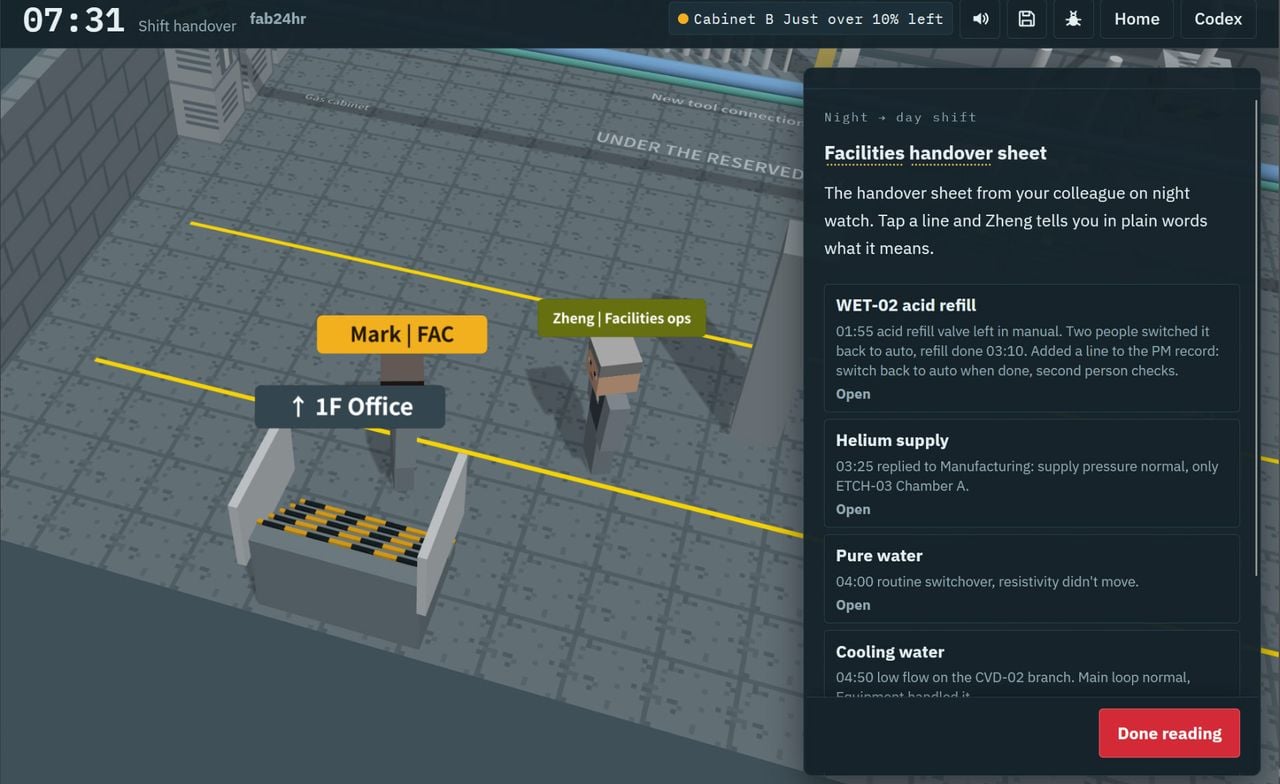
A tiny browser game about semiconductor manufacturing has become an unlikely hit in Taiwan—and its appeal may be that it feels less like escapism than unpaid overtime. fab24hr puts players inside a fictional wafer factory, where a routine shift can collapse into equipment failures, production emergencies, phone calls in the middle of the night, and paperwork after something goes wrong. Tom’s Hardware reports that some Taiwanese fab workers have compared the experience to a horror game or even a prison.
The free project launched on October 4, 2026, and was made by independent creator mrclty—identified on the project’s site as one author working with AI, rather than a company or officially licensed semiconductor product. It runs directly in a browser on computers and phones, requires no installation or sign-in, and supports Traditional Chinese, English, and Japanese. The official FAQ also makes clear that its factories, tools, procedures, people, and products are fictional, even though the game’s terminology and workplace situations draw from public technical material and semiconductor-industry knowledge.
There are two ways to clock in. A Day in the Fab is the shorter workplace simulation, assigning players to roles such as process engineer, equipment engineer, lithography engineer, facilities engineer, manufacturing staff, or research-and-development personnel. The shift changes depending on when the player opens the game: a late-night session may begin with a call about a failed tool, while a morning shift starts with a handover report and an uncomfortable question about when production will resume. TVBS describes scenarios involving the ETCH-03 etching machine, process adjustments, production delays, and reports required after operational mistakes.
The longer mode, The Life of a Chip, follows a fictional hearing-aid chip called Glowmere across 12 chapters. Instead of stopping at the factory floor, the story traces the chip from an R&D line through wafer fabrication, testing, packaging, shipping, and—eventually—the person who uses it. Decisions can lead to one of three endings, ranging from an on-time delivery to a batch returning months later. That structure gives fab24hr a wider purpose than simply reproducing technical jargon: it shows how a single production decision can ripple through an entire supply chain.
That educational angle is important because a wafer fab is not just a high-tech office with expensive machines. The game introduces concepts including etching, lithography, wafer maps, gas cabinets, overlay errors, wire bonding, final testing, and quality reviews, then explains the terminology in plain language. Taiwanese coverage from Inside emphasizes how the simulation lets outsiders see the coordination between process, equipment, manufacturing, and integration teams—jobs that are usually invisible when semiconductor success is reduced to company earnings or chip shortages.
The joke, of course, is that the game’s most convincing feature may be its ability to make players want to go home. Its blocky isometric presentation looks approachable, but the pressure comes from the decisions: whether to trust a handover, take a shortcut, rework a wafer, answer the 2:47 a.m. call, or leave a problem for the next shift. The official site says the project is still being updated with new roles, shifts, and random events, giving fab24hr room to grow from a viral curiosity into an unusually specific piece of interactive workplace storytelling.


