
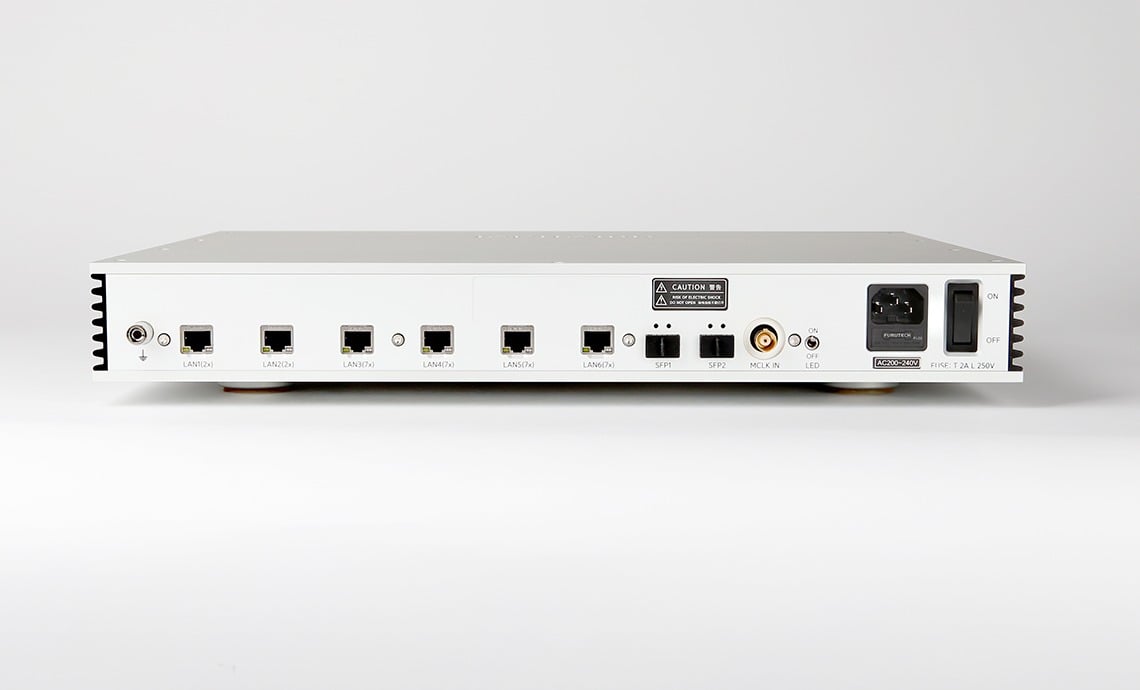
Aurender is asking audiophiles to spend $4,700 on the NH10, an eight-port network switch designed to make streamed music sound quieter, more precise, and—according to the company—more emotionally impactful. The premium hardware arrives in a full-width aluminum chassis, but its headline specification is still gigabit Ethernet rather than 10GbE. The NH10’s ambitious audiophile claims put it squarely in the long-running debate over whether network hardware can change digital audio playback.
The NH10 has six RJ-45 copper connections and two SFP ports capable of accepting fiber or copper transceivers. Aurender divides the copper ports into two tiers: LAN1 and LAN2 receive two stages of filtering, while LAN3 through LAN6 receive seven stages each. The company also touts a pure linear power supply, an LED shutoff switch intended to reduce interference, galvanic isolation, and a machined aluminum enclosure. Its official specifications list 100Mbps and 1000Mbps operation across both the LAN and SFP connections.
Clocking is the centerpiece of the design. Aurender says the switch uses an oven-controlled crystal oscillator with frequency stability below 0.005 parts per million, coordinated by an FPGA, while a rear-panel BNC connection accepts a 10MHz external master clock. The company describes that arrangement as a way to minimize jitter and synchronize internal operations, and says its engineers settled on seven filtering stages after comparing them by listening rather than simply maximizing the number of components.
That rationale runs into a basic distinction between moving digital data and converting it into sound. Ethernet frames carry a CRC-based integrity check; the IEEE describes the mechanism as an error detector that identifies corrupted data, while TCP adds sequence tracking, checksums, and retransmission to ensure reliable delivery. A switch can encounter electrical noise or a bad frame, but a valid audio file or stream is not supposed to become a subtly different performance because packets arrived through a more expensive switch.
Jitter is real in recording and digital-conversion systems, but network-packet timing is not automatically the same thing as the clock that drives a DAC. Playback equipment normally buffers incoming packets and uses its own local clock when feeding the conversion stage. That leaves the NH10 with legitimate engineering features—fiber-based electrical isolation, power-supply design, shielding, and a stable clock—but a much harder case to make for audible changes in ordinary network streaming. The product may appeal to buyers who value specialized construction and system matching; for everyone else, the central question is whether those refinements justify a price several orders of magnitude above a conventional gigabit switch.
Image Credits
In-Article Image Credits
Aurender NH10 - an audiophile-grade network switch engineered to elevate digital audio playback to an entirely new level via Aurender with usage type - Product photo (Fair Use)Featured Image Credit
Aurender NH10 - an audiophile-grade network switch engineered to elevate digital audio playback to an entirely new level via Aurender with usage type - Product photo (Fair Use)


