
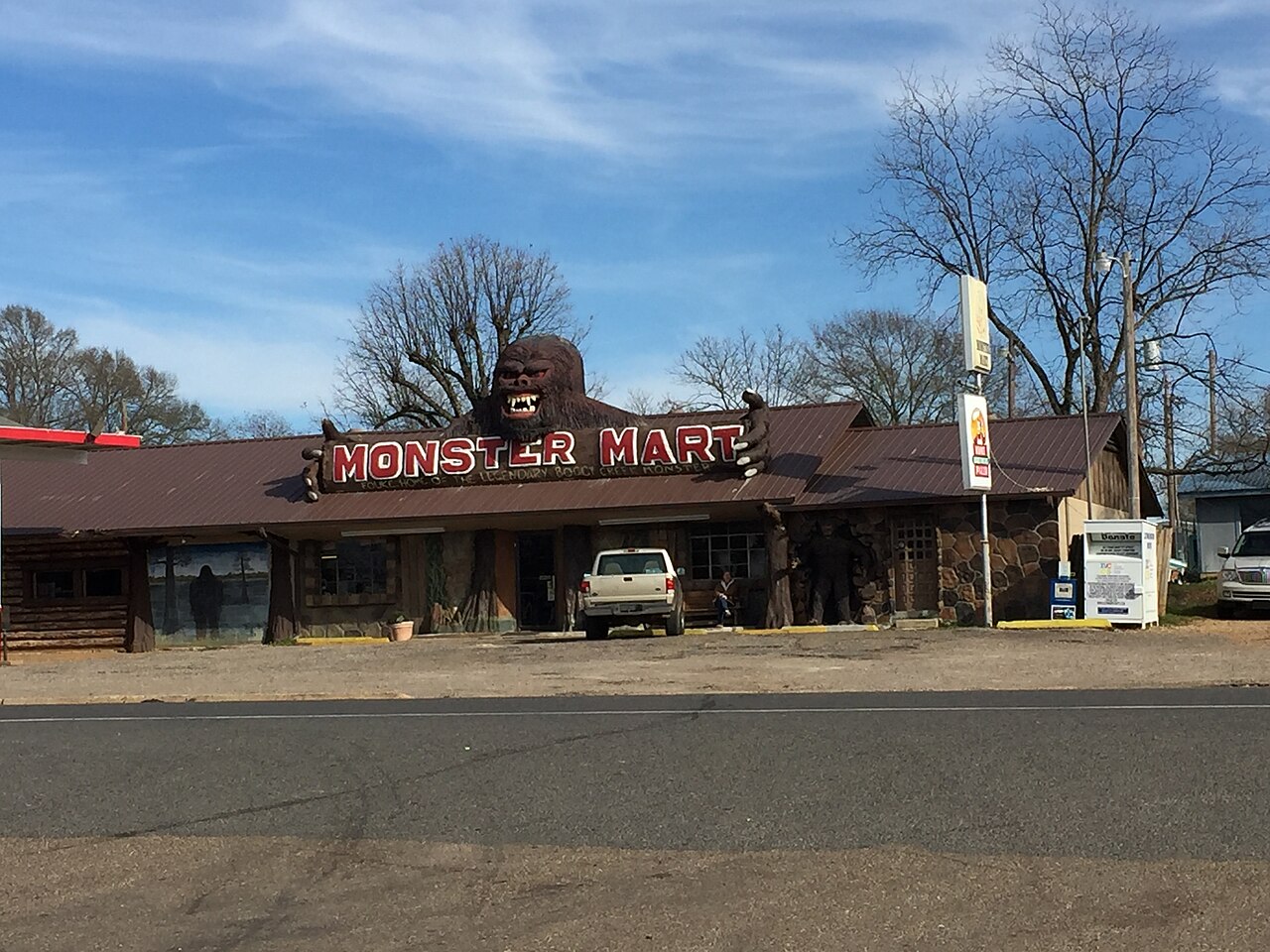
In the tangled bottomlands around Fouke, Arkansas, locals have spent decades swapping stories about a towering, foul‑smelling creature slipping between the cypress trees and muddy creek banks. Known interchangeably as the Fouke Monster and the Boggy Creek Monster, this regional cryptid exploded from small‑town rumor into national pop‑culture when a 1970s wave of sightings inspired the independent horror docudrama The Legend of Boggy Creek, turning Miller County’s anxiety into a drive‑in phenomenon.
Fouke sits near the Sulphur River bottoms, a maze of bayous, sloughs, and pine flatwoods that feels tailor‑made for monster mythology. Residents and nearby communities were already telling stories about a strange ape‑like visitor well before the ’70s, with recollections of similar creatures in the 1940s and 1950s sometimes tied to an older nickname, the “Jonesville Monster.” Witnesses generally describe a hulking, 7–8‑foot, broad‑shouldered figure, covered in dark hair and walking upright like a person, with reports frequently emphasizing an overpowering stench and shrill, almost human screams echoing through the swamp at night. Unlike the classic Pacific Northwest Bigfoot, some tracks reported around Fouke show three prominent toes instead of five, a detail that has fascinated believers and skeptics alike.
The encounter that pushed the monster into headlines happened in spring 1971 at the rural home of Bobby and Elizabeth Ford outside Fouke. Local newspapers such as the Texarkana Gazette reported that something large and hairy reached through a window screen late at night, frightening Elizabeth and setting off a chain of events that ended with Bobby firing a shotgun at a creature he said was prowling around the house. Ford later sought treatment at St. Michael’s Hospital in Texarkana for scratches and shock, and Miller County authorities documented damage to the home along with a series of deeply imprinted, three‑toed tracks measuring nearly 14 inches long in the surrounding yard. The sheriff’s office report and press coverage triggered a flurry of additional sighting claims from hunters, farmers, and other residents, transforming what had been an unreported local legend into a full‑blown media storm.
Into that frenzy stepped Arkansas filmmaker Charles B. Pierce, who saw cinematic potential in the swamp‑bound terror. Working with a shoestring budget reported around $100,000–$160,000, Pierce crafted The Legend of Boggy Creek, a hybrid of reenactment, pseudo‑documentary narration, and atmospheric nature footage that prefigured the tone and approach of later found‑footage horror. He cast actual Fouke residents, including people tied to the original reports, to dramatize their own experiences, lending the film a “local truth” vibe that helped sell it as more than just a creature feature. The gamble paid off: drive‑ins and grindhouse theaters turned the film into a runaway hit, with box office estimates topping $20 million and pushing the Fouke Monster into the same cultural orbit as Bigfoot and the Mothman for 1970s monster‑obsessed audiences.
The legend didn’t stop with a single movie. Pierce returned to the swamp mythology in the 1980s with Boggy Creek II: And the Legend Continues, while other filmmakers and documentarians have periodically revisited the story, reinforcing the creature’s cult status for horror fans and cryptozoology buffs. Meanwhile, Fouke leaned into its notoriety: regional tourism and events such as the Fouke Monster Festival turn the once‑terrifying stories into an annual celebration of local lore, screening the original film, hosting lectures, and offering guided tours of the Boggy Creek area to curious visitors. Sightings also never completely dried up; scattered reports of a similar creature surfaced in the 1990s and late 1990s, including accounts of something leaping from a bridge or skulking near backroads, keeping the myth alive for a new generation.
Explanations for what people actually saw—or thought they saw—run the gamut from undiscovered primate to misidentified wildlife. Cryptozoology advocates argue that the dense, sparsely populated bottomlands of southwest Arkansas, with their food sources and cover, could shelter a relict hominid or other large, elusive animal, pointing to long‑term patterns in the reports and the apparent consistency of the creature’s description. Biologists and skeptical investigators counter that black bears, especially injured or mange‑afflicted bears moving awkwardly or rearing on hind legs, can resemble a shaggy biped in poor lighting, and that stress, fear, and expectation play huge roles in how witnesses interpret fleeting encounters. The infamous three‑toed tracks have come under particular scrutiny; analyses by skeptics suggest that some prints show signs of human manufacture or hoaxing, bolstering the idea that at least part of the Boggy Creek story is performative myth layered onto ordinary wildlife.
Whatever its zoological reality, the Fouke Monster endures because it perfectly bridges rural folklore and genre entertainment. It belongs to the same family of American monsters that loom at the edges of our maps: Bigfoot in the Pacific Northwest, skunk apes in the Everglades, winged horrors like the Mothman in West Virginia. But thanks to The Legend of Boggy Creek, Fouke’s creature did more than lurk in campfire yarns—it helped define how low‑budget horror could use “real” local stories and documentary trappings to unsettle audiences, paving the way for later experiments in faux‑found footage and reality‑adjacent fright. For geek‑culture fans, that makes Boggy Creek more than just a swamp and the Fouke Monster more than just a rumor; together, they’re a reminder of how quickly a single night’s scare can ripple outward into an enduring piece of genre history.
Image Credits
In-Article Image Credits
Monster Mart in Fouke, Arkansas. January 2016 via Wikimedia Commons by Reagscoop with usage type - GNU FreeFeatured Image Credit
Monster Mart in Fouke, Arkansas. January 2016 via Wikimedia Commons by Reagscoop with usage type - GNU Free


