
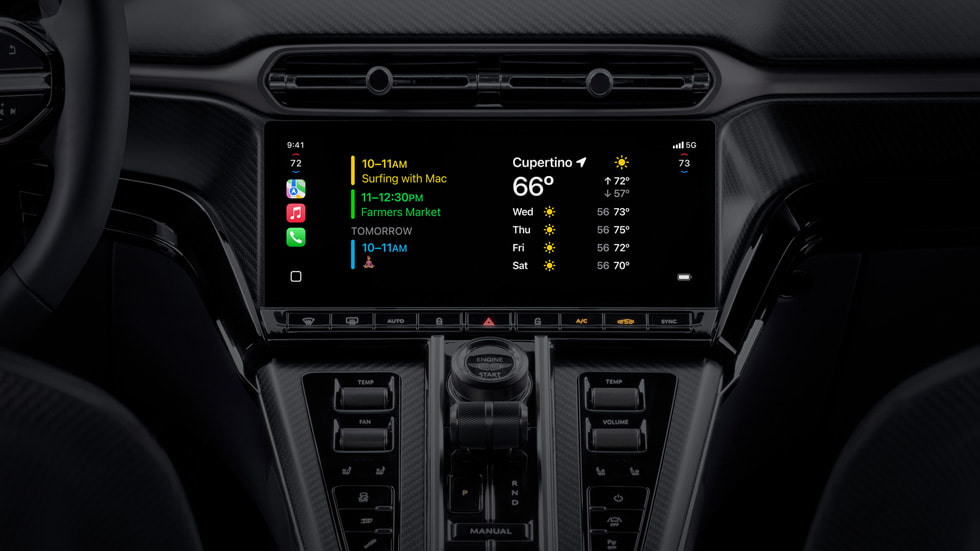
Apple’s next-gen CarPlay Ultra is more than a shiny reskin of your in-car iOS experience; it’s a full takeover of the car’s digital cockpit that goes far beyond what today’s CarPlay can do, but that deeper integration also explains why you probably can’t get it in your current ride yet.
Classic CarPlay, the version most drivers know today, is essentially a projection layer: your iPhone does the heavy lifting for navigation, music, calls, Siri, and supported apps, while the car’s infotainment system mostly just displays that interface on the central screen. When you want to tweak climate controls, change drive modes, or adjust native vehicle settings, you typically have to bounce out of CarPlay and back into the manufacturer’s own UI. It’s a familiar, app-centric experience that mirrors iOS, but it sits beside the carmaker’s software rather than replacing it.
CarPlay Ultra flips that relationship. Apple describes Ultra as a “deeply integrated” platform that blends “the best of iPhone and the best of the car,” turning CarPlay from a projection system into the main interface for the vehicle’s digital controls. Instead of living only on the central infotainment display, Ultra can span every screen in the cabin, from instrument clusters and head-up displays to passenger and rear-seat panels. The system can present speed, fuel or battery status, trip data, cameras, and other car-native information inside Apple-designed layouts, while also letting you control climate, heated seats, and audio without leaving the CarPlay environment. Outlets like Stuff, TopGear, and CarBuzz note that Ultra supports richer widgets, multi-screen setups, and brand-tailored themes that mix Apple’s clean aesthetic with each automaker’s visual identity.
Under the hood, Ultra still relies on the driver’s iPhone for much of the interface and app logic, appearing wirelessly as soon as the car’s displays wake up, but critical driving functions remain powered by the vehicle’s own systems to preserve reliability. Articles breaking down Apple’s developer documentation point out that Ultra blends “local UI” — information sourced directly from the car, like fuel level or climate data — with phone-driven content in one coherent Apple-style layout. That hybrid design is why Ultra can keep showing essential cluster information even if the iPhone connection drops, a key difference from the more phone-dependent feel of standard CarPlay.
So why isn’t CarPlay Ultra everywhere yet? Apple’s May 2025 announcement framed Ultra as beginning to roll out to “select” new vehicles, not as a drop-in update for every existing CarPlay-compatible car. Deeper integration means automakers must collaborate with Apple to map their hardware controls, safety logic, and brand look into Ultra’s interface, and the platform typically requires newer digital dashboards with multiple high-resolution displays. Coverage from sites like Autoevolution and 9to5Mac emphasizes that Ultra will coexist with regular CarPlay: many future models will keep offering the classic version, while a smaller slice of next-gen cars adopt Ultra as their primary software skin.
For tech-savvy drivers and Apple fans, Ultra signals a bigger shift in the in-car OS wars. Instead of juggling a carmaker’s sometimes clunky UI plus a phone projection layer, Ultra promises a unified, highly customizable cockpit where maps, media, vehicle stats, and essential controls all live in one Apple-flavored space. At the same time, it raises familiar questions about data sharing and control: Apple gets a stronger foothold in the dashboard, while automakers must balance their desire for branded experiences with the appeal of a polished, iOS-like interface that many drivers already trust. As Engadget’s explainer on the differences between CarPlay and CarPlay Ultra notes, the original system remains a great upgrade over barebones factory infotainment, but Ultra is the ambitious next step — a full-on digital cockpit reimagining that, for now, remains a premium feature reserved for the newest and most connected cars on the road.


