
Artificial intelligence is moving toward one of the most consequential jobs in public safety: telling people when disaster is approaching. Chatbots can help emergency managers draft warnings faster, translate them, and tailor instructions to individual needs—but the push toward AI-assisted emergency alerts is exposing an uncomfortable weakness: a faster message is not necessarily a more trusted one.
The technology is arriving before any clean handoff between human judgment and automated writing. Emergency managers already use generative AI informally to workshop plans and prepare public messaging, while software companies are building tools that can produce updates for extreme weather and other crises. One such platform, EM1, reportedly works with roughly 100 government agencies and school districts, though those organizations are not yet using it to automate their live weather alerts.
There is a practical reason agencies are interested. The United States’ Integrated Public Alert and Warning System can authenticate and distribute messages across wireless phones, television, radio, and NOAA Weather Radio, but people still have to write clear instructions before those systems can do their jobs. FEMA’s Common Alerting Protocol provides a standardized format for sending one warning across multiple channels; it does not determine whether the wording is accurate, comprehensible, or appropriate for a frightened audience.
Recent research suggests personalization may make warnings more useful while making their authorship more complicated. A University of Colorado Boulder team used Google’s Gemini to create alerts that included reminders about pets, dependents, and medication. The study found that tailored messages could encourage trust and action, but researchers cautioned against replacing conventional warning formats—and warned that revealing AI involvement could create longer-term skepticism if people believe human oversight has been removed.
That trust problem is not theoretical. Experimental research has found that people generally rate government-issued warnings as more credible than warnings attributed to AI, while messages from both sources work better when they agree. Other findings indicate that AI-generated alerts suffer a sharper credibility loss after an error than human-authored warnings. In a crisis, even a polished hallucination, missing evacuation detail, or wrongly targeted instruction could teach the public to ignore the next alert.
The most defensible near-term model is therefore not an emergency chatbot acting alone, but an assistant operating inside a strict human-in-the-loop system. Google’s crisis alerts already combine AI-powered detection with authoritative data and review by crisis-operations specialists, while its Public Alerts service distributes warnings from official agencies through Search, Maps, and mobile notifications. AI may ultimately help agencies communicate sooner and in more languages, but the deciding factor will remain recognizably human: someone qualified must verify the warning, own the decision, and make clear who is accountable when the stakes are life or death.
Image Credits
In-Article Image Credits
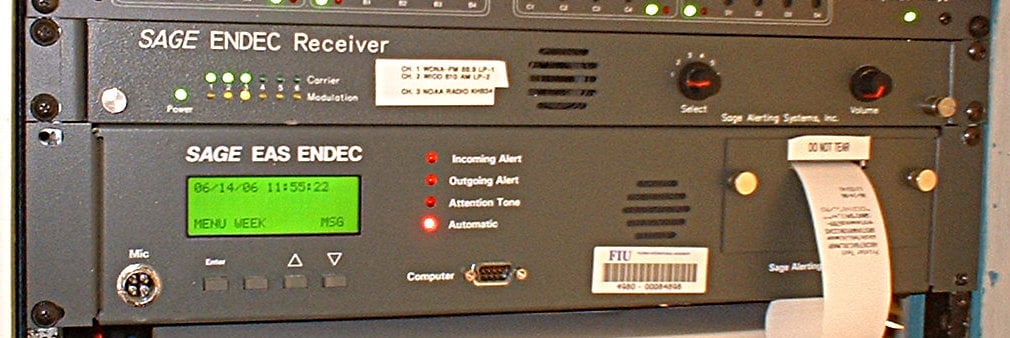
A Sage Alerting Systems EAS ENDEC and matching receiver, used to receive and propagate EAS Emergency Alert System alerts via Wikimedia Commons by VXO with usage type - Public Domain. By VXO at English Wikipedia - Transferred from en.wikipedia to Commons., Public Domain, https://commons.wikimedia.org/w/index.php?curid=63893275Featured Image Credit
A Sage Alerting Systems EAS ENDEC and matching receiver, used to receive and propagate EAS Emergency Alert System alerts via Wikimedia Commons by VXO with usage type - Public Domain. By VXO at English Wikipedia - Transferred from en.wikipedia to Commons., Public Domain, https://commons.wikimedia.org/w/index.php?curid=63893275


