
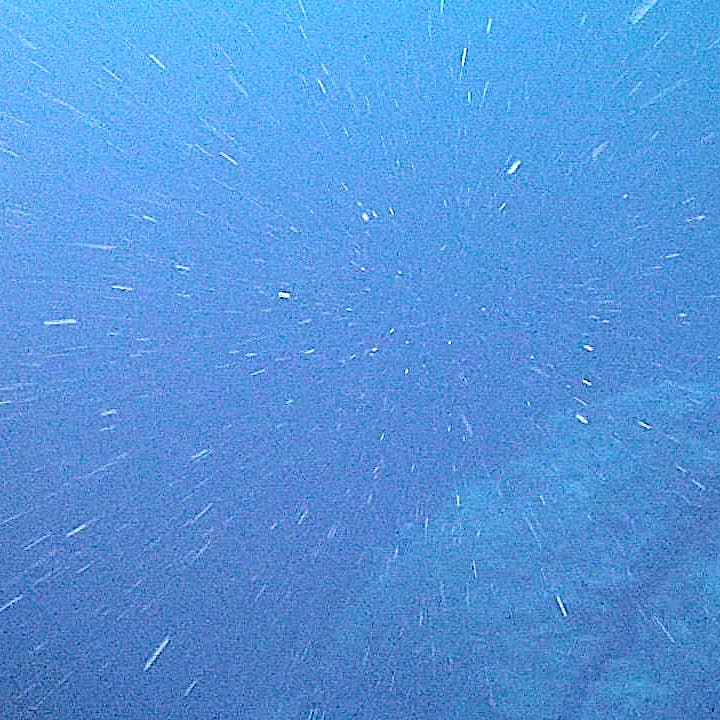
Underwater “snow” may be one of the ocean’s most important climate-control systems—and its stickiness could determine whether carbon sinks into the deep or returns to the atmosphere. A new study finds that the thickest, gooiest marine-snow particles can transport more than six times as much carbon to the deep ocean as less viscous particles. The discovery puts ocean slime at the center of a major carbon-storage mystery.
Marine snow is made from organic debris produced near the surface, including remnants of plankton and other biological material. The particles continually drift downward, carrying carbon away from the atmosphere as they sink. More than 10 billion tonnes of carbon begin that journey each year, but the University of Lincoln says only roughly one to three billion tonnes reaches the deep ocean, where it can remain stored for hundreds or thousands of years.
The research, published in Science on October 8, was led by Bryce Inman, whose work began at the Scripps Institution of Oceanography at the University of California San Diego and continued at the University of Lincoln in Stuart Humphries’ laboratory. The study, titled Marine snow viscosity regulates microbial degradation and the ocean carbon sink, also involved Scripps scientist François Azam.
The team’s key insight is that marine snow is not physically uniform. Using specialized microscopy, researchers created three-dimensional maps of viscosity inside individual particles. Bacteria readily colonized and penetrated softer regions, while denser, more resistant areas acted like a protective core. Laboratory experiments showed that these high-viscosity particles took longer to degrade and fragment, giving them more time to sink before their carbon was released as carbon dioxide.
That finding adds a microscopic variable to a process scientists have traditionally described through particle size, density, sinking speed and microbial activity. Computer simulations suggest that the most viscous particles can travel farther downward, explaining how a seemingly small difference in texture could produce such a dramatic change in carbon delivery. Independent coverage from Phys.org likewise identifies viscosity as a previously underappreciated control on marine-snow breakdown and depth.
The result does not mean that every naturally occurring blob of ocean mucus will lock away the same amount of carbon. Marine snow can be altered by currents, temperature, food-web changes and the bacteria living on it, while other research has shown that mucus structures can sometimes slow sinking and keep carbon in upper waters longer. Instead, the new work gives oceanographers a sharper way to explain why apparently similar particles can have very different climate effects—and provides a promising measurement target for improving future carbon-cycle models.
Image Credits
In-Article Image Credits
Marine snow is a shower of organic material falling from upper waters to the deep ocean via Wikimedia Commons by NOAA National Ocean Service with usage type - Public Domain. By NOAA National Ocean Service - Extracted from this Commons image(see [1]), Public Domain, https://commons.wikimedia.org/w/index.php?curid=86227762Featured Image Credit
Marine snow is a shower of organic material falling from upper waters to the deep ocean via Wikimedia Commons by NOAA National Ocean Service with usage type - Public Domain. By NOAA National Ocean Service - Extracted from this Commons image(see [1]), Public Domain, https://commons.wikimedia.org/w/index.php?curid=86227762


