
NASA’s Artemis II mission did more than send four astronauts around the Moon: its rocket exhaust appears to have briefly reshaped part of Earth’s upper atmosphere. Researchers found that the mission produced multiple ionosphere disturbances large enough to potentially introduce errors into GPS positioning across North America, a finding detailed in new coverage of the atmospheric effects.
The effect was not a literal hole punched through the sky. Instead, rocket exhaust temporarily reduced the concentration of charged particles in the ionosphere, the electrically active region through which satellite-navigation signals travel. Changes in that plasma can alter how signals move, causing some receivers—particularly single-frequency systems—to calculate a position several meters away from the true location. The study did not find evidence of a widespread GPS outage, but its authors say the disturbances could briefly affect accuracy if atmospheric corrections were insufficient.
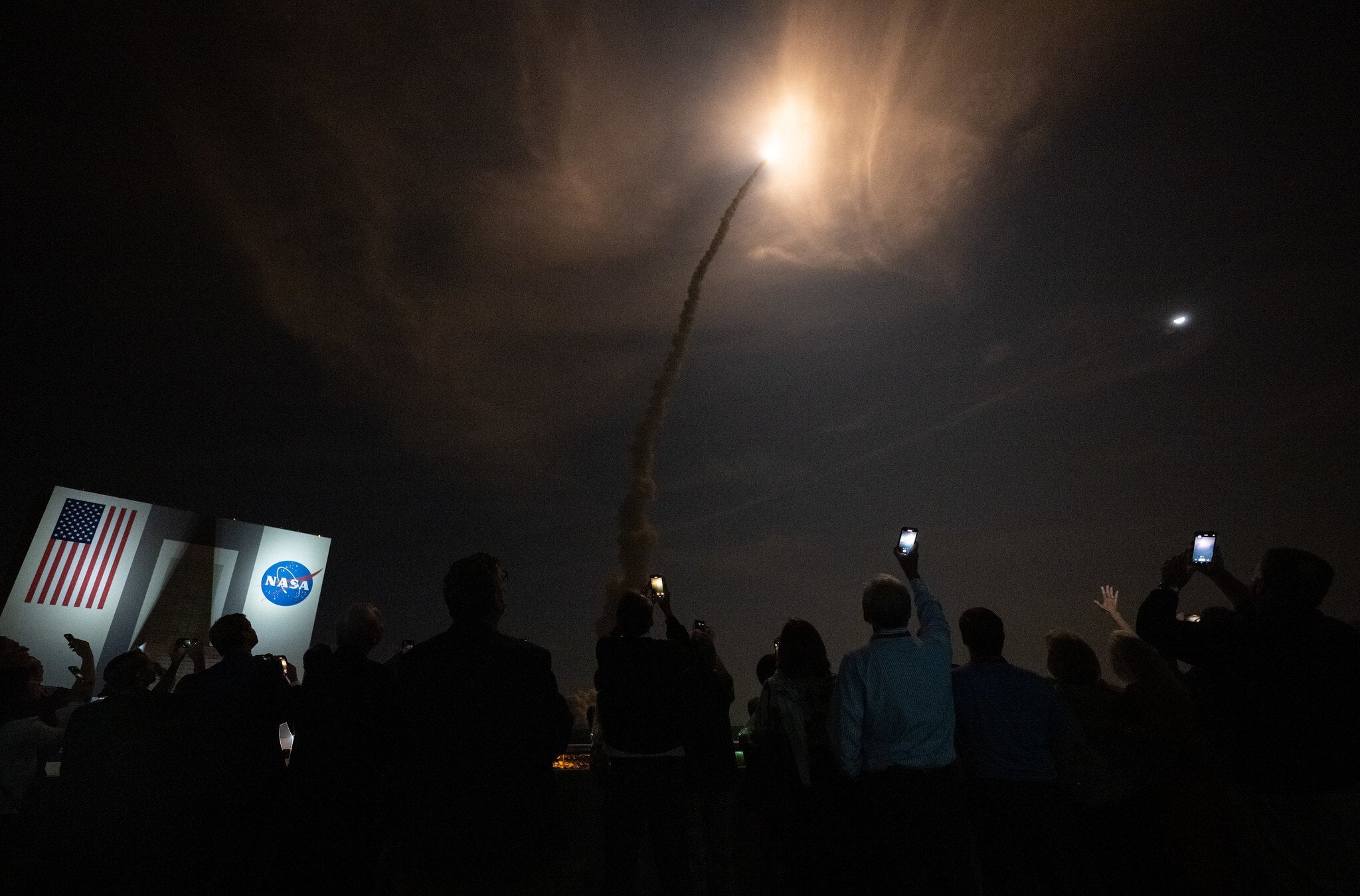
Artemis II created three distinct disturbances during different phases of the mission. The first followed the April 1 launch from Kennedy Space Center. A second appeared after the Orion spacecraft’s apogee-raising maneuver roughly two hours later, while a third followed the trans-lunar injection burn about 25 hours after liftoff. The largest disturbance stretched across approximately 50 degrees of longitude—around 5,000 kilometers—over the continent.
To identify the signatures, researchers from Taiwan’s National Cheng Kung University analyzed measurements from more than 3,500 ground stations receiving GPS, GLONASS, and Galileo signals. The observations revealed not only changes associated with rocket exhaust, but also shock, acoustic, and gravity waves propagating through the atmosphere. The researchers described the repeated disturbances from one mission as unusual, with the upper-stage burns producing a much stronger ionospheric response than the comparatively low-altitude first-stage flight.
That distinction matters as launch activity accelerates. A single temporary positioning error may be insignificant for a smartphone, especially when a device combines multiple satellite systems and correction services. The stakes are higher for surveying, aviation, automated vehicles, drones, precision agriculture, and other systems that depend on reliable location data. Charles Lin, one of the study’s authors, warned that disturbances of this scale could become more consequential if major launches occur more frequently.
Artemis II launched on April 1, 2026, carrying Reid Wiseman, Victor Glover, Christina Koch, and Canadian astronaut Jeremy Hansen aboard Orion for a 10-day crewed lunar flyby. NASA describes the mission as the first crewed test of the SLS rocket, Orion, and the ground systems supporting human missions to the Moon. The ionosphere findings do not undermine the mission’s success, but they do add an unexpected environmental consideration to the Artemis era: future launch planning may need to account not only for weather near the pad, but also for temporary space-weather effects generated high above it.


