
For generations, fusion drives have been the stuff of hard sci-fi—engines that could sprint to Mars in weeks and push starships toward other suns—but a new wave of companies and research labs argues those rockets might leave the page and enter orbit within the next decade. In a recent deep dive, Live Science highlighted how U.K. startup Pulsar Fusion, California-based Helicity Space, and fusion researchers at Princeton are converging on practical fusion propulsion, prompting Helicity CEO Stephane Lintner to claim that “everything we know about space travel is going to change within a decade.”
At the core of the hype is nuclear fusion, the same process that powers the sun by fusing hydrogen into helium at temperatures of around 15 million degrees Celsius. Terrestrial fusion experiments such as ITER’s massive tokamak in France are designed to hold superheated plasma for minutes at a time, with recent records approaching 22 minutes of sustained confinement but still without commercially viable power output. For propulsion, the goal is different: instead of trying to bottle the plasma efficiently to generate grid electricity, a fusion rocket would deliberately expel high-energy plasma out the back of the vehicle, trading the challenge of perfect confinement for the ability to produce extremely high exhaust velocities and continuous thrust in the vacuum of space. As University of Washington professor Bhuvana Srinivasan put it in Live Science’s report, fusion propulsion is in some ways harder and in some ways easier than building a terrestrial fusion plant, because the plasma does not need to be perfectly tamed—it needs to be pointed.
Pulsar Fusion is targeting that future with its Sunbird technology path, building a fusion-capable propulsion architecture step by step rather than leaping directly to a working starship engine. The company, based in Bletchley, England, has developed high-performance electric and hybrid rocket thrusters and plans static tests of its fusion-adjacent hardware in 2025, followed by an in-orbit demonstration of core technology components in 2027. Live Science reports that Pulsar Fusion’s work has attracted support from organizations including the European Space Agency and the U.K. Atomic Energy Authority, underscoring how seriously major institutions are taking the prospect of fusion-based spaceflight. CEO Richard Dinan has already unveiled the Sunbird spacecraft design at the company’s facility, presenting it as a platform that could eventually host true fusion propulsion once the underlying physics and engineering mature.
On the other side of the Atlantic, Helicity Space is pursuing a different flavor of fusion, built from the ground up for rockets rather than power plants. The company’s Helicity Drive uses a pulsed magneto-inertial fusion scheme, firing multiple plasma jets that merge and reconnect in self-organizing magnetic structures, then compressing them in a kind of peristaltic magnetic “pump” to reach fusion conditions. Instead of a steady-state reactor, Helicity aims for rapid bursts of fusion that produce high-energy plasma exhaust, enabling a drive that is compact, scalable from hundreds of kilowatts to gigawatts, and designed to avoid large stores of radioactive fuel. That pitch has attracted serious backing: Helicity closed a $5 million seed round in late 2023 with investors including Airbus Ventures, and later secured strategic capital from Lockheed Martin’s venture arm to push its lab prototypes from two to four plasma guns and toward a full proof-of-concept drive. NASA’s Innovative Advanced Concepts program has also funded studies of a “Helicity Drive”–powered constellation to explore the heliosphere, signaling institutional interest in using fusion propulsion for long-range science missions beyond the reach of chemical rockets.
Princeton’s fusion community brings decades of plasma physics to the table with its Direct Fusion Drive (DFD) concept, developed in collaboration between the Princeton Plasma Physics Laboratory (PPPL) and Princeton Satellite Systems. DFD is built around PPPL’s Princeton Field-Reversed Configuration machine, a compact device designed to heat and confine plasma in a way that naturally lends itself to propulsion and onboard power generation. Technical papers from PPPL outline a roadmap through prototypes like PFRC-3, which aims to demonstrate confinement and high temperatures without full fusion, and a subsequent PFRC-4 device that would be fully shielded and capable of actual fusion reactions. Earlier coverage from ITER’s own news site notes that the DFD team believes an operational engine could be possible as early as 2028, a timeline that may be optimistic but reflects the level of confidence some researchers have in turning their lab-scale machines into real spacecraft drives. If successful, DFD could offer a single engine module that powers a ship’s systems while simultaneously delivering continuous high-thrust, high–specific impulse propulsion—a combination current ion and chemical systems cannot match.
For space agencies and the sci-fi-obsessed, the implications are enormous. Live Science points out that fusion-driven craft could reach speeds of hundreds or even thousands of miles per second, far beyond today’s probes, making Mars missions measured in weeks and outer-planet journeys measured in months a plausible engineering goal rather than pure fantasy. Princeton’s DFD studies similarly argue that such drives could propel interstellar precursor missions into the local interstellar medium within a human lifetime, turning what are currently multi-century trips into projects that fit inside a single career. Faster transits would slash radiation exposure and microgravity-related health risks for astronauts, a benefit highlighted in discussions of fusion-powered rockets aiming to clear hurdles of long travel times and crew safety. None of this comes free: every concept on the table still must overcome challenges in miniaturizing fusion hardware, managing waste heat, protecting crews from neutron and gamma radiation, and demonstrating repeatable fusion conditions outside the carefully controlled environments of ground-based experiments.
Yet for fans raised on the Epstein drive from The Expanse or the fusion torches of classic NASA studies like Project Daedalus, the current moment feels less like distant speculation and more like the first act of a familiar story. The companies and labs behind Sunbird, Helicity Drive, and Direct Fusion Drive are not pitching magic warp bubbles; they are iterating through hardware, chasing grants, courting investors, and publishing technical papers that can be scrutinized and challenged like any other engineering effort. Even if early fusion engines only fly as uncrewed demonstration payloads, their success would redraw the map for robotic exploration, putting fast sample-return missions, agile outer-planet orbiters, and ambitious heliosphere probes within reach. From there, it is not hard to imagine the geek-culture future where video games, TV shows, and tabletop campaigns start name-dropping real fusion drives instead of fictional ones—and where the line between “hard sci-fi” and “space tech news” gets thinner with every new test firing.
Image Credits
In-Article Image Credits
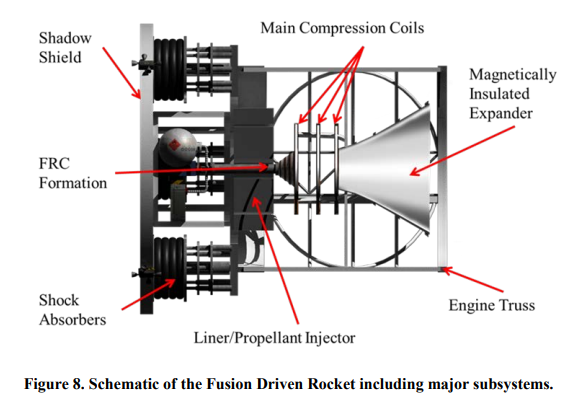
Schematic of the Fusion Driven Rocket including major subsystems via Wikimedia Commons by NASA with usage type - Public DomainFeatured Image Credit
Schematic of the Fusion Driven Rocket including major subsystems via Wikimedia Commons by NASA with usage type - Public Domain


