
If gravity is secretly holographic, then the universe starts looking a lot less like classic sci-fi space opera and a lot more like a cosmic projection screen, with the drama of spacetime emerging from a deeper, lower-dimensional code. Quanta Magazine’s new feature on the AdS/CFT correspondence digs into that wild possibility, arguing that in certain precise setups, gravity literally erases the difference between “volume” and “surface” — a clue that reality might be encoded in fewer dimensions than it appears.
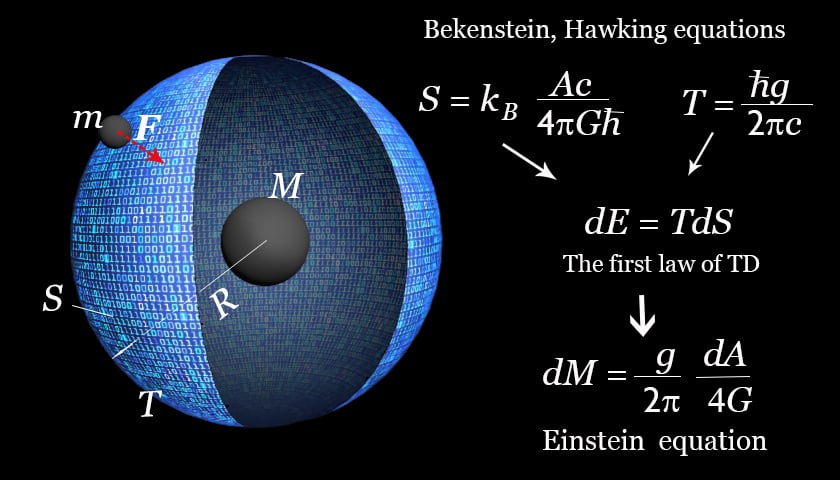
The holographic vibe in modern physics traces back to black holes, where the usual intuition that “more volume means more stuff” flat-out fails. Jacob Bekenstein and Stephen Hawking showed that a black hole’s entropy — basically the amount of information needed to describe it — scales with the area of its event horizon, not the volume inside. That “area law” inspired the holographic principle: the idea that any region of space governed by gravity might be fully described by degrees of freedom living on its boundary, the way a flat hologram encodes a 3D object. In Quanta’s telling, AdS/CFT is the moment that vague principle crystallized into hard mathematics rather than just a suggestive metaphor.
AdS/CFT itself is a duality connecting two wildly different-looking theories: a quantum gravity or string theory living in a higher-dimensional space with negative curvature called anti–de Sitter (AdS) space, and a conformal field theory (CFT) without gravity living on that space’s lower-dimensional boundary. Juan Maldacena’s late-1990s papers showed that, in a particular setup, these two descriptions were not just similar but exactly equivalent, with a “dictionary” pairing every object and process in the bulk gravity theory to a counterpart in the boundary quantum field theory. That’s why physicists call it a holographic duality: the boundary theory plays the role of the hologram, encoding everything about the higher-dimensional gravitational world it borders.
Quanta’s piece emphasizes that in the AdS/CFT framework, the equivalence between bulk volume and boundary area isn’t a hand-wavy slogan — it’s baked into the math. A “blockbuster trilogy” of late-’90s papers showed that computing physical quantities in the AdS bulk and on the CFT boundary gave identical results, reinforcing the idea that gravity naturally trades three-dimensional dynamics for two-dimensional data when seen through the right lens. That makes holography feel less like a speculative metaphor and more like a near-theorem about how quantum gravity behaves in an AdS universe, even if our own cosmos appears closer to de Sitter space and remains a tougher nut to crack.
For anyone steeped in genre fiction, it is tempting to jump straight from “holographic gravity” to simulation horror stories, but the physics is subtler than a Matrix reboot. The holographic principle does not say our 3D lives are fake illusions; it says that the most fundamental description of the universe might live in fewer dimensions than the emergent geometry we experience. In AdS/CFT, a perfectly ordinary quantum field theory without gravity on the boundary can give rise to a rich, curved spacetime with gravitational dynamics in the bulk, suggesting that spacetime itself could be an emergent construct built from more abstract quantum ingredients like fields and entanglement.
Beyond the philosophical tailspin, holographic dualities have become practical calculators for some of the gnarliest problems in physics. Because AdS/CFT ties a strongly coupled quantum field theory to a more tractable gravity setup, researchers have used it as a tool to study phenomena like quark–gluon plasmas, exotic superconductors, and other strongly interacting many-body systems that defy traditional perturbative methods. Holographic ideas have also reshaped how theorists think about quantum information — for instance, through relations that connect geometric quantities in the bulk to entanglement entropy in the boundary theory, hinting that the “glue” of spacetime might literally be patterns of quantum entanglement.
As Quanta’s feature makes clear, the holographic view of gravity has matured from a strange acronym whispered in specialist corridors to a central organizing idea for quantum gravity research, with AdS/CFT standing as its flagship example. Twenty-five years after Maldacena’s original proposal, follow-up work has broadened the duality’s scope and fueled attempts to extend holographic reasoning to universes more like our own, including efforts to understand cosmology, dark energy, and even the information paradox in realistic settings. For geek-culture fans used to holograms as flashy set dressing, the new twist is that physics may be quietly telling us the props were right all along: the real universe could be a vast, self-consistent projection of deeper quantum code, with gravity as the mechanism that turns boundary data into the spacetime stage we live on.
Image Credits
In-Article Image Credits
The file demonstrates the way of thinking of the entropic gravity, holographic principle, entropy distribution, and derivation of Einstein GR equations from these considerations via Wikimedia Commons by Yormahmad Kholov with usage type - Creative Commons LicenseFeatured Image Credit
The file demonstrates the way of thinking of the entropic gravity, holographic principle, entropy distribution, and derivation of Einstein GR equations from these considerations via Wikimedia Commons by Yormahmad Kholov with usage type - Creative Commons License


