
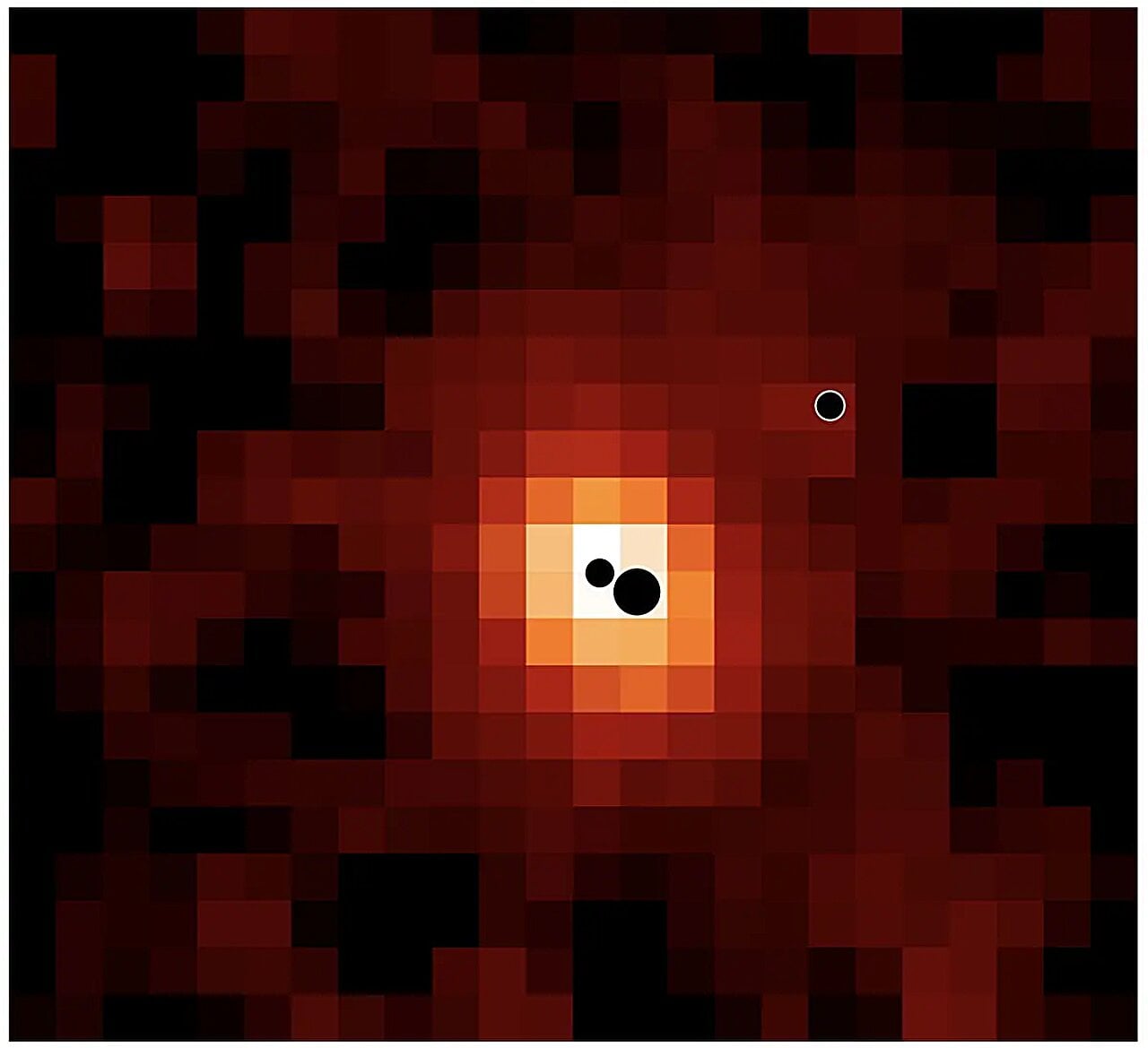
The early universe just got a lot more crowded. Astronomers using the James Webb Space Telescope have identified three actively feeding supermassive black holes inside a single galaxy more than 12.5 billion light-years away—an unprecedented sight from roughly 1.2 billion years after the Big Bang. The discovery in galaxy J0148-4214 gives researchers a rare look at black-hole growth while the universe was still in its infancy.
Two of the objects sit near the galaxy’s center, separated by only about 620 light-years in projection. The larger weighs approximately 80 million times as much as the Sun, while its smaller companion has a mass of roughly 600,000 Suns. A third black hole, estimated at around two million solar masses, occupies the galaxy’s outer region approximately 5,500 light-years from the center.
The international team, led by the Max Planck Institute for Extraterrestrial Physics, made the identification with JWST’s Near-Infrared Spectrograph using its Integral Field Unit mode. Instead of relying only on visible-looking points of light, researchers examined the spectral fingerprints of hydrogen moving at extreme speeds through the black holes’ gravitational fields. Spectro-astrometry helped separate the two central sources even though Webb could not resolve them as distinct point objects.
That technique matters because the system could easily have looked like a single active black hole without spatially resolved spectroscopy. The team considered alternatives including shocks, stellar winds, supernovae, and unusually massive stars, but other spectral signatures favored three accreting black holes. The results also show that the objects are not growing at identical rates: the much smaller central black hole is feeding especially rapidly, apparently exceeding the conventional Eddington limit for black-hole accretion.
The numbers are striking in context. J0148-4214 contains only about 1.3 billion solar masses in stars, meaning the black holes make up an unusually large fraction of their young host galaxy. The central pair is expected to merge within the next few hundred million years, while the outer object could be a displaced remnant from an earlier merger or a black hole gradually moving inward.
For astronomers, the discovery strengthens the case that galaxy mergers and close gravitational encounters helped supermassive black holes grow rapidly in the early universe. It also turns J0148-4214 into a possible laboratory for future gravitational-wave astronomy: the eventual merger history of this compact trio could help explain the massive black-hole collisions that missions such as the planned LISA observatory are designed to detect.
Image Credits
In-Article Image Credits
Map of the distant galaxy J0148-4214 in ionised hydrogen (Hα). The locations of the three massive black holes are indicated by black circles (not to scale). The most massive and least massive black holes are located in the galaxy centre; a third black hole is located in the galaxy outskirts. Credit: Hannah Übler via Phys.org by ax Planck Institute for Extraterrestrial Physics with usage type - Public DomainFeatured Image Credit
Map of the distant galaxy J0148-4214 in ionised hydrogen (Hα). The locations of the three massive black holes are indicated by black circles (not to scale). The most massive and least massive black holes are located in the galaxy centre; a third black hole is located in the galaxy outskirts. Credit: Hannah Übler via Phys.org by ax Planck Institute for Extraterrestrial Physics with usage type - Public Domain


