
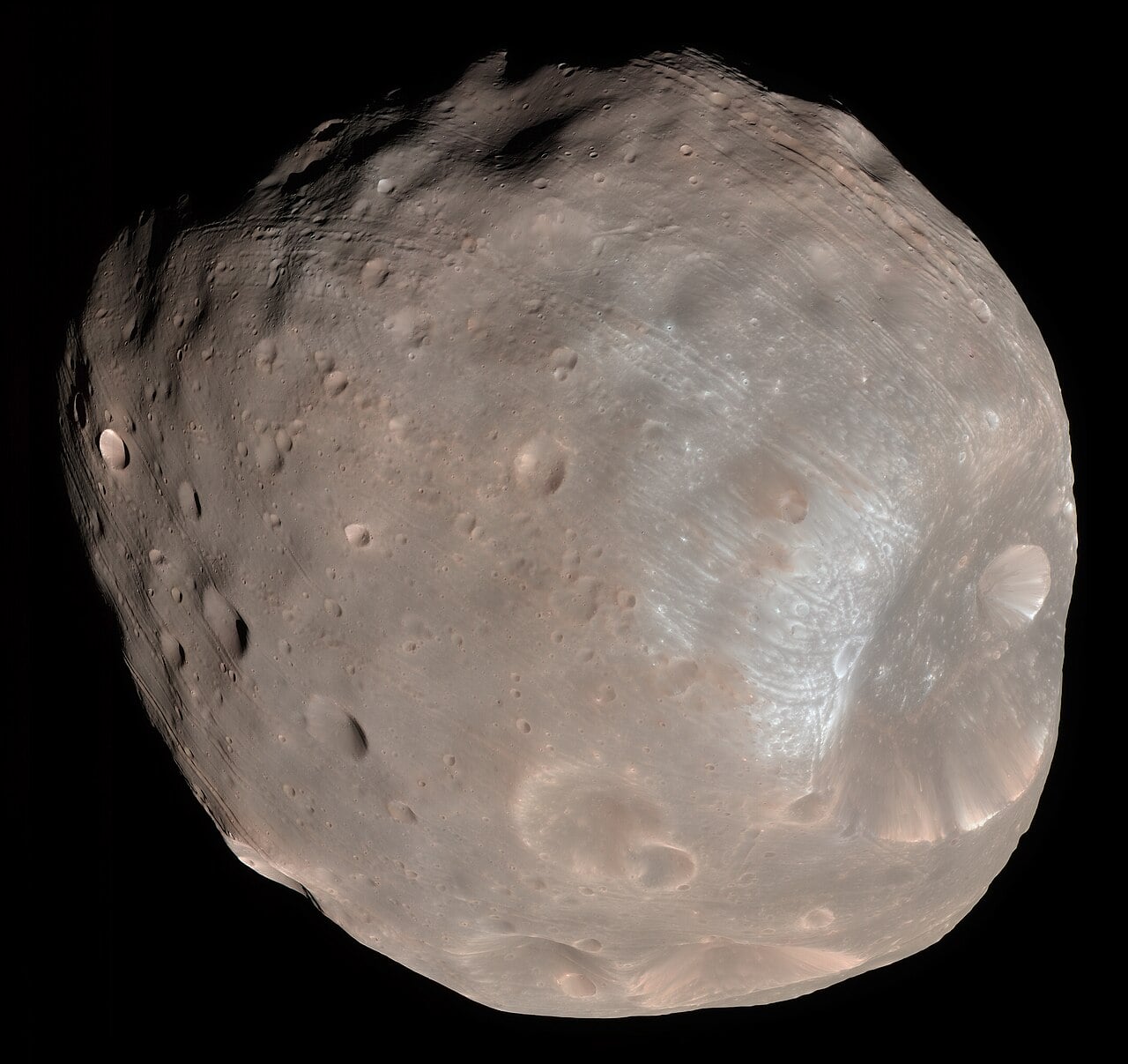
JAXA’s Martian Moons eXploration mission is now heading toward Phobos, a tiny, irregular world where ordinary landing techniques become almost useless. Launched aboard Japan’s H3 rocket on October 20, 2026, MMX will investigate both Martian moons, deploy a rover, and bring pieces of Phobos back to Earth in what could become one of planetary science’s most revealing sample-return missions. The mission’s unusual Phobos landing challenge is central to its scientific ambition.
Phobos is only about 27 kilometers long and has roughly 1/1,800 of Earth’s gravity. It is also thought to be a loosely bound “rubble pile,” meaning a spacecraft or rover cannot treat its surface like solid ground. A conventional touchdown risks bouncing away, tipping over, or disturbing the very material scientists want to study. That makes the moon’s enormous Stickney crater, fractured terrain, and uncertain surface composition both a scientific opportunity and an engineering hazard.
MMX is designed around that difficulty. Its propulsion module will carry the spacecraft to Mars, while the exploration module will survey Phobos and Deimos, conduct observations, release the rover, and gather samples. A separate return module will eventually send the collected Phobos material toward Earth. NASA says the spacecraft is expected to reach Mars in 2027, collect a sample no earlier than 2028, and return it to Earth in 2031. NASA describes MMX as a mission to determine the moons’ origins and deliver Phobos material home.
The international payload includes Idefix, a roughly 25-kilogram rover developed by France’s CNES and Germany’s DLR. It is expected to become the first rover to drive on a Martian moon, operating on Phobos for about 100 days. Its instruments include navigation cameras, a Raman spectrometer, a radiometer, and cameras aimed at the wheels and ground beneath them—useful tools for understanding how the rover moves across a surface that may behave more like a shifting pile of debris than a roadway.
That surface could also hold clues to Phobos’s origin. Researchers continue to debate whether the moon is a captured asteroid, debris thrown into orbit by an ancient impact on Mars, or the remnant of an earlier satellite system. MMX’s close-up observations and returned samples may help settle that question while offering a new look at the early history of Mars and the broader solar system. JAXA’s mission overview identifies Phobos sample return as the centerpiece of the expedition.
For now, MMX faces a long cruise before its most delicate work begins. After reaching Mars, the spacecraft will study the moons from orbit, select operational and sampling sites, and attempt the carefully controlled deployment of Idefix. If the rover survives the landing and the return capsule reaches Earth as planned, MMX will deliver more than a technical milestone: it could provide the first laboratory samples from a Martian moon and finally explain why these two strange objects orbit the Red Planet.
Image Credits
In-Article Image Credits
Mars moon phobos via NASAFeatured Image Credit
Mars moon phobos via NASA


