
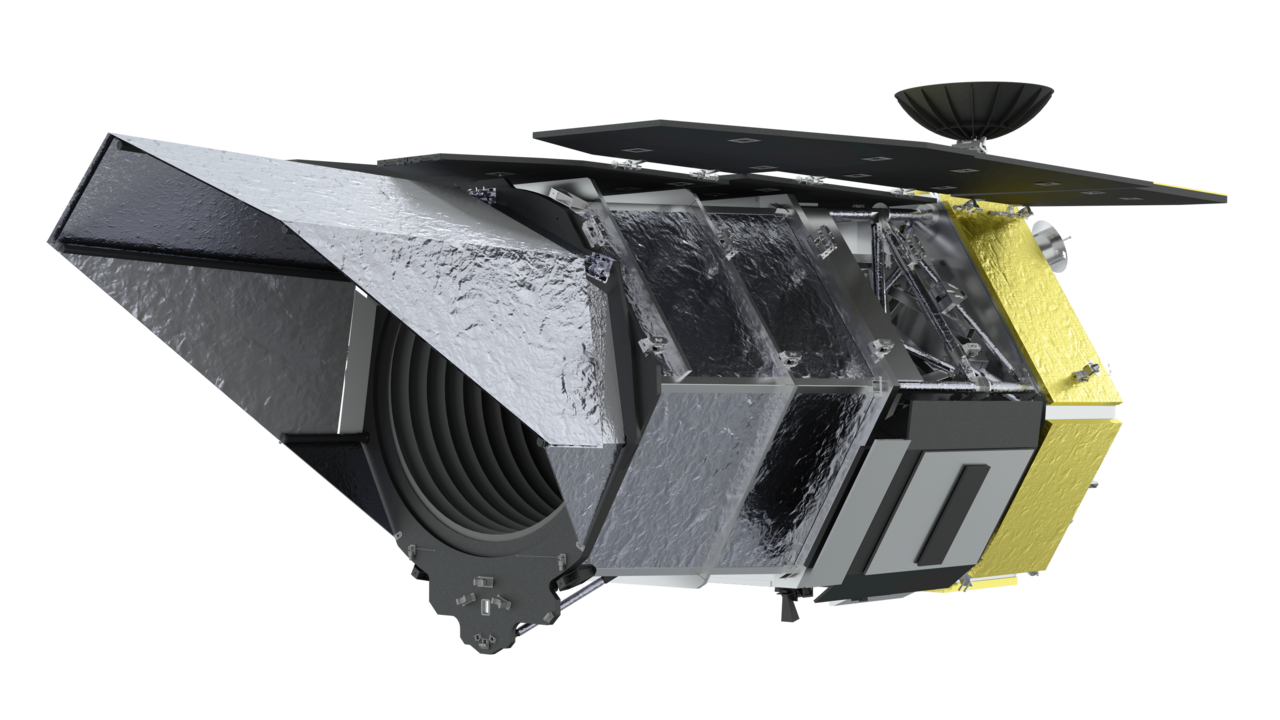
NASA’s Nancy Grace Roman Space Telescope has already delivered a surprise before beginning its main science mission: the observatory could see the universe in substantially finer detail and operate for far longer than planned. Early results from Roman’s commissioning indicate that unusually precise launch maneuvers preserved years of propellant, while adjustments to its optics improved the expected sharpness of its images.
Roman launched from NASA’s Kennedy Space Center on Aug. 30, 2026, aboard a SpaceX Falcon Heavy and is traveling toward the second Sun-Earth Lagrange point, roughly 1 million miles from Earth. NASA says the spacecraft’s journey and commissioning process are progressing successfully as engineers activate and test its systems ahead of full operations.
The fuel savings could be the biggest long-term bonus. Two major engine burns performed during and shortly after launch were executed so accurately that each preserved as much as four years of propellant. Taken together, the savings could provide roughly 12 additional years of usable fuel, potentially extending Roman well beyond its planned 10-year mission and into 2048. That projection depends on the spacecraft’s future health, operating conditions, and the resources available to support it.
Roman’s optical performance is also beating the expectations established during its design. After remotely adjusting the telescope’s primary mirror, engineers found that the observatory should produce images about 30% sharper than anticipated. That improvement matters because Roman is built to survey enormous regions of sky quickly: NASA expects its field of view to be at least 100 times wider than Hubble’s, allowing it to measure light from as many as a billion galaxies over its lifetime.
The telescope’s main Wide Field Instrument will map galaxies and stars in infrared wavelengths, giving researchers a powerful new way to investigate dark energy, dark matter, and the evolution of cosmic structure. Roman will also conduct a statistical census of planetary systems in the Milky Way, using gravitational microlensing to find worlds that are difficult to detect with conventional planet-hunting techniques. NASA estimates the mission could reveal around 100,000 new exoplanets, while its coronagraph technology demonstration will test methods for blocking starlight and directly studying planets and planet-forming disks.
Roman is designed to complement rather than replace Hubble and the James Webb Space Telescope. Webb excels at deeply examining individual targets, while Roman’s wide-field view is intended to create vast astronomical surveys that can identify patterns and promising objects for more detailed follow-up. Once the spacecraft reaches L2 and completes commissioning, astronomers will begin receiving the first high-resolution images from an observatory that may offer both a wider cosmic perspective and a much longer scientific afterlife than anyone initially counted on.
Image Credits
In-Article Image Credits
Nancy Grace Roman Space Telescope via Wikimedia Commons by NASA with usage type - Public DomainFeatured Image Credit
Nancy Grace Roman Space Telescope via Wikimedia Commons by NASA with usage type - Public Domain


